
Table of Contents
- 1. What is a B2B content flywheel?
- 2. Stages of the content flywheel (and how AI/SEO accelerate them)
- 3. How Lyfe Forge fits into the B2B content flywheel
- 4. Practical steps to build your own content flywheel
- Conclusion: Make your content work like a system, not a to-do list
1. What is a B2B content flywheel?
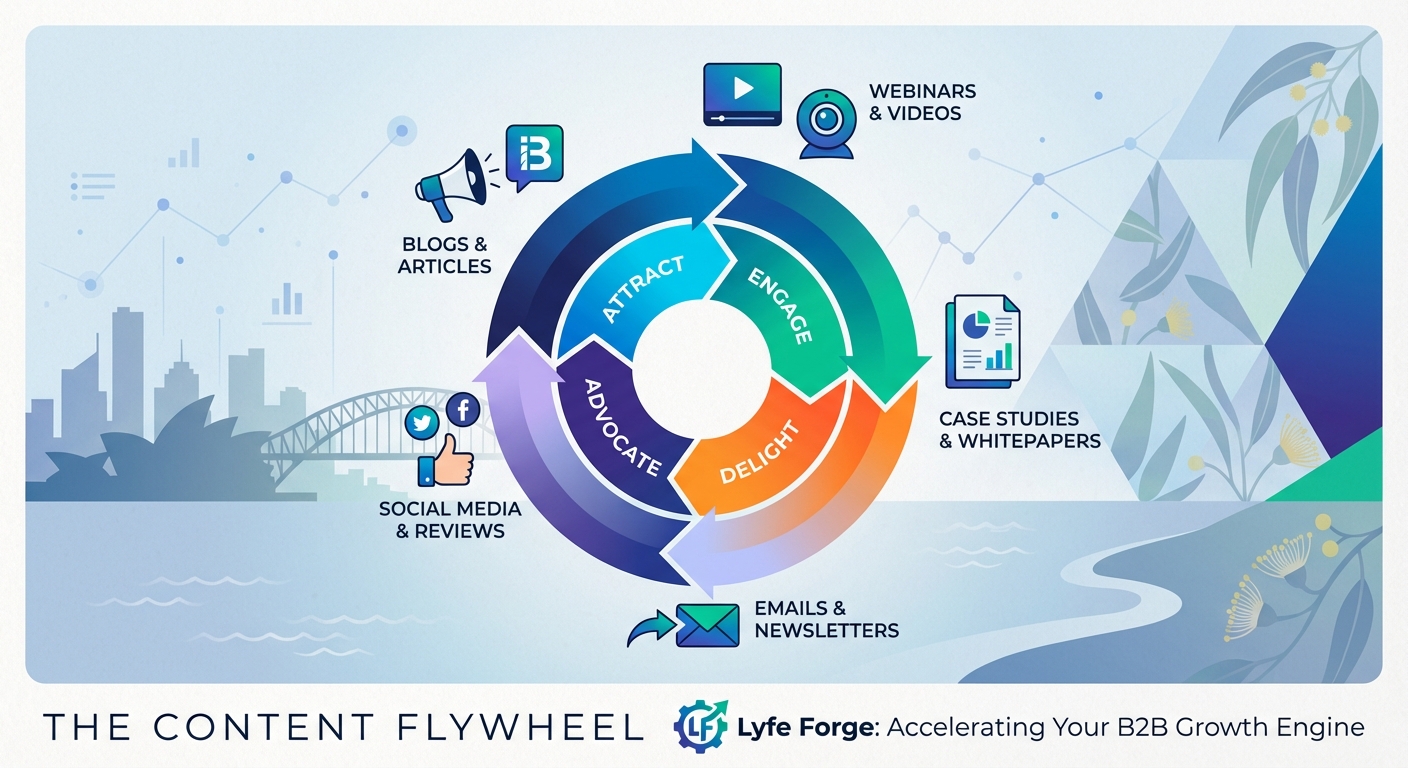
A B2B content flywheel is a self-reinforcing system where every asset you create feeds the next one. Instead of “write blog → publish → forget”, you build a loop. Each article, case study, or webinar can be repurposed, linked, and measured so it keeps driving results long after launch, much like the Content Flywheel models described in broader B2B content strategy and guides such as What is Content Flywheel & How to Create One.
Think of a physical flywheel. It is heavy and hard to move at first. But once it spins, every extra push adds speed. The content flywheel works the same way: early content feels slow, but as you publish, repurpose, and refine, momentum builds and lead quality improves. In practice, you stop seeing content as “blog posts” and start seeing it as an interconnected system.
A single in-depth guide can become social snippets, a webinar, email nurture flows, sales one-pagers, and support docs. Each version points back to the others, boosting SEO, engagement, and trust. People who find you through one door can quickly wander through the rest of the house.
This model also matches how B2B buyers actually behave today. Their journey is messy. People bounce between Google, LinkedIn, review sites, webinars, and customer stories before they ever talk to sales. A flywheel lets you be present at all those points and reuse what works instead of reinventing the wheel for every channel, which aligns closely with how an AI content engine for B2B marketing is designed to operate.
Compared with a traditional funnel, which treats customers as the “end” of the process, flywheels put existing customers at the centre. Their results, reviews, and referrals drive the next wave of awareness. When you design content with that loop in mind, your cost per lead and acquisition cost tend to fall over time, a pattern echoed in B2B SaaS Content Marketing Flywheel analyses.
2. Stages of the content flywheel (and how AI/SEO accelerate them)
Most B2B content flywheels share a similar core structure: Attract, Engage, Delight, and Advocate. Some teams slice it further into stages like Activate, Adopt, Adore, and Advocate, but the idea is the same. You design content to support the whole customer lifecycle, not just the sale, as frameworks like the Content Flywheel for B2B Startups make clear.
In the Attract stage, the goal is to pull the right people into your orbit. Typical assets include SEO blog posts, search-driven content clusters, guides, and “hero” pieces like webinars or podcasts. Strong keyword research and topic clustering are crucial here, because you want to show up when buyers search for problems, not just when they search your brand name. In Australia, LinkedIn has become a particularly strong channel for B2B discovery, with more than 15 million local users and near-saturation in its core professional audience, so thought leadership posts, video clips from events, and short carousel summaries of your bigger content can all feed the Attract stage efficiently. forbes.com.au
The Engage stage is about depth. Here you use playbooks, comparison articles, case studies, ROI explainers, and interactive tools like calculators or quizzes. This content answers detailed questions, tackles objections, and helps buyers build a business case. It is also where structured email nurture sequences and retargeting campaigns live, which is where AI content creation features that support multiple formats become particularly useful.
Delight content focuses on delivery and outcomes. For SaaS and service businesses, this can include onboarding sequences, FAQ hubs, implementation guides, and training webinars. When you help customers adopt your product faster and see outcomes sooner, you increase retention and reduce churn. Australian loyalty research suggests that improving retention can meaningfully impact profit because loyal customers often spend more and are more likely to refer others, though newer studies note that the value and spending habits of retained customers matter more than retention rates alone. bain.com
Advocate content turns happy customers into a visible growth engine. Think customer video stories, written case studies, testimonials, and referral programs. In a flywheel, these stories are not just “nice to have” proof; they become some of your highest-performing Attract and Engage assets because real results beat brand claims every time, a point underlined in resources on Understanding the B2B SaaS Content Marketing Flywheel.
Underneath all of this, you still need a structure. Many B2B teams map content ideas to a simple awareness framework or jobs-to-be-done model. You list the questions buyers ask at each step, then pair them with content types, repurposing options, and channels. That map becomes the blueprint for your flywheel backlog, so you are never guessing what to create next. workflows.io
If the content flywheel is your engine, AI and SEO are the turbocharger. They help you create better content faster, make smarter decisions about what to publish, and keep old assets working harder over time. For busy Australian marketing teams, this is often the difference between a solid idea and an actual, running flywheel, especially when paired with an Australian AI content platform built for local conditions.
AI tools can help at every stage. At the Attract stage, they can generate topic ideas, outlines, and draft blog posts based on keyword research and search intent. At the Engage stage, they can assemble comparison matrices, summarise complex technical concepts, or suggest questions for interactive tools. At the Delight and Advocate stages, they can help turn support tickets and customer interviews into guides, FAQs, and case studies, mirroring approaches outlined in Creating high-impact B2B content with AI tools.
Studies and industry experiments show that AI-assisted content teams can produce far more volume with similar or better quality when paired with human editors. Tests run by SaaS marketers have shown 5 – 10x speed improvements on drafting tasks when using AI for first passes, while still relying on human writers to shape the narrative and voice. However, some experts argue that this velocity comes with trade-offs that marketers can’t afford to ignore. While AI can churn out drafts at remarkable speed, over half (56%) of Australian businesses using AI for social content report running into quality-control issues ranging from subtle factual errors and unintentional plagiarism to baked-in bias that slips past a quick skim. Over-reliance on AI without deliberate human intervention can also flatten everything into the same beige mush – content that technically “works,” but feels generic, interchangeable, and stripped of any distinct brand voice. And in adjacent fields like news, research from the University of Sydney suggests AI-generated summaries can quietly sideline local Australian journalism in favour of broader, international sources, raising flags about whose stories get amplified by default. Taken together, these caveats don’t invalidate AI’s upside, but they do underline a core principle: teams that want both speed and substance need strong editorial guardrails and a clear brand perspective, not just more output. reddit.com
SEO technology amplifies this further. Platforms that focus on topic clusters and semantic coverage help teams map out pillar pages and supporting articles around strategic themes. That structure is perfect for a flywheel because internal links between related articles keep readers moving, which sends strong signals to search engines about relevance and authority. Guides on validating B2B content ROI highlight how this kind of structured, cluster-based SEO leads to more steady compound growth rather than short-term spikes. cxl.com
Rich media also plays a special role. Research inspired by “media richness” theory and broader engagement studies shows that, in practice, posts with video, images, or interactive elements tend to earn more comments, likes, and clicks than plain text, especially in early stages like awareness and interest. That extra engagement gives you more data, which feeds back into your flywheel, and more formats to repurpose. sciencedirect.com
Of course, AI is not a silver bullet. On its own, it can produce generic content that sounds like everyone else. The winning setup is a hybrid one: use AI to handle summarising research, generating outlines, and drafting variations, then have human marketers refine, fact-check, and add stories or local nuance. That blend gives you scale without losing authenticity, particularly when guided by clear usage principles in a platform’s Terms of Service and Privacy Policy.
3. How Lyfe Forge fits into the B2B content flywheel
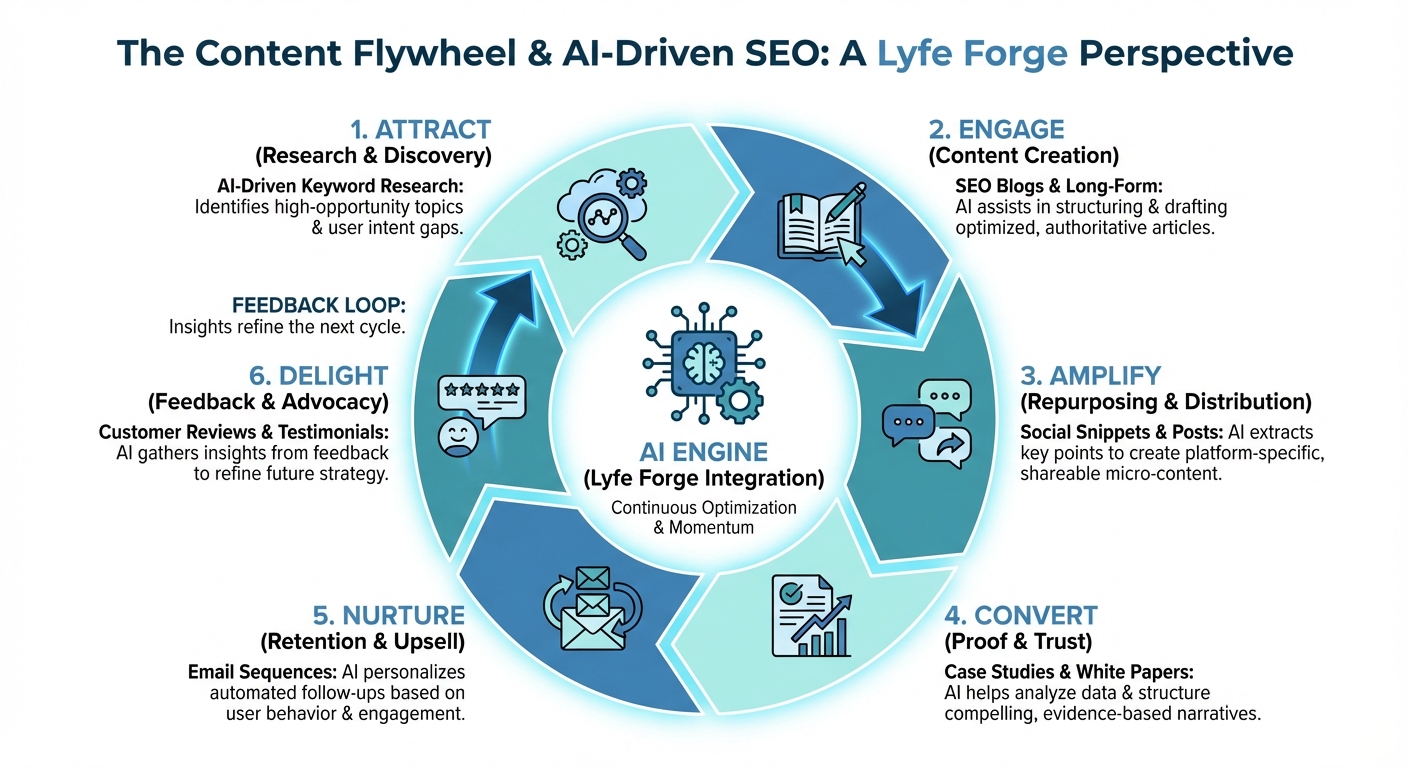
Lyfe Forge is built to sit inside your content flywheel, not next to it. It is an Australian-based, multi-AI content platform that combines research, drafting, SEO, and publishing in a single workflow. It is not just “an AI writer”; it operates like a content operations system for agencies, in-house SEO teams, and B2B marketers who want compound growth. Transform content creation with Lyfe Forge AI without having to stitch together a dozen tools.
At the Attract stage, Lyfe Forge helps you turn search demand into SEO-ready content at speed. Its pipeline runs from topic gap analysis through to full long-form drafts that align with keyword clusters and search intent. Instead of jumping between keyword tools, writing apps, and your CMS, you can plan, write, and prepare publishing in one place. For teams managing multiple clients, that saves a surprising amount of mental overhead, especially when you use the platform’s AI content creation features for clustering and briefing.
Inside the platform, a “multi-AI council” approach can combine different models for research, reasoning, and drafting. One model might handle factual checks, another might suggest outlines, and a third might generate copy. This reduces the risk of errors and helps surface better angles for each piece. It also means your content gets a richer base of ideas before a human editor steps in, a practical twist on the AI Content Flywheel concept.
Lyfe Forge’s Client DNA-style features (branding vaults, tone presets, template structures) help keep voice consistent across all stages of the flywheel. The copy for your thought leadership blog, your onboarding guide, and your case study can all pull from the same brand rules. That consistency is vital when you are repurposing one core asset into many formats because readers move between them quickly and notice when something feels off.
For Engage and Delight stages, you can use Lyfe Forge to turn one core source – say, a webinar transcript or customer interview – into a suite of assets. That might include a pillar article, follow-up email series, social clips, internal sales notes, and a knowledge-base article. Each version can be tailored to a channel but still track back to one source of truth, which makes governance and approvals less of a headache.
The platform’s integrations with analytics tools like Google Search Console and GA4 enable feedback loops. You can see which pages are gaining traction, which keywords are breaking through, and which older assets are ready for an update. That data can then drive your next batch of ideas, completing the flywheel loop from performance back to planning.
If you want to explore how those workflows look in practice, you can review the feature breakdown and demo flows on the main Lyfe Forge site, compare it with other tools via the LyfeForge vs Jasper, Copy.ai & Others page, or skim the pricing plans to see how a free start might fit into your current stack.
4. Practical steps to build your own content flywheel
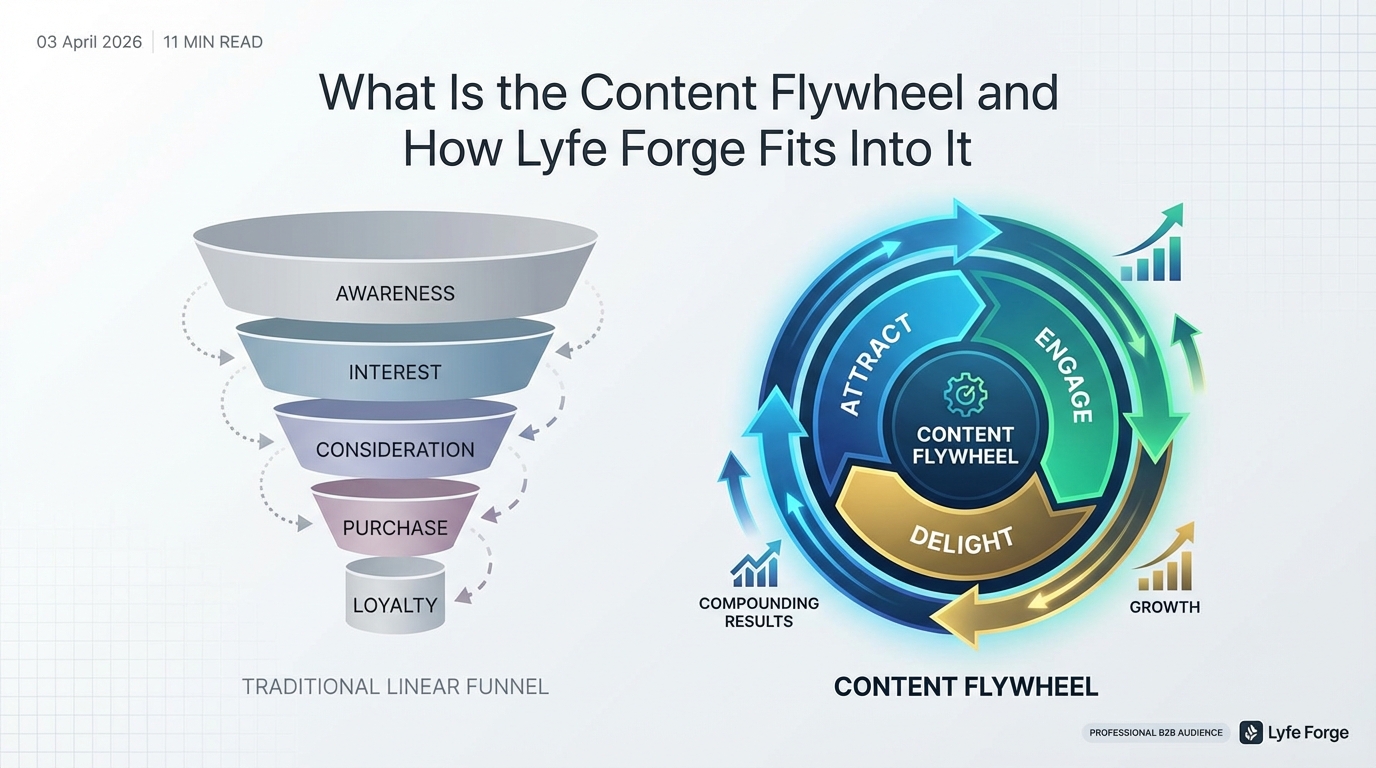
Turning the flywheel from theory into practice does not need to be complex. You can start small and layer in tools like Lyfe Forge once the basics are in place, taking advantage of its Start Free option to experiment without heavy upfront cost.
First, map your buyer journey. List the questions prospects ask at each stage: before they know you, when they compare options, when they test your product, and after they become customers. Pair each question with one or two content formats, like a blog article, calculator, or onboarding checklist.
Second, choose one pillar topic where you want to build authority. For example, “B2B SEO for SaaS in Australia”. Use an SEO platform or Lyfe Forge’s research features to identify related subtopics and search intents. That gives you a cluster of 10 – 20 articles, videos, or guides that can link to each other, forming the basis of your own B2B SaaS content marketing flywheel.
Third, design a simple repurposing flow. Every time you create a “hero” asset – such as a webinar, report, or deep-dive blog – plan 5 – 10 derivative pieces in advance. A single guide might become LinkedIn posts, email sequences, infographics, and a short video. This step is where AI tools shine, because they can quickly produce first drafts or outlines for each derivative format. theskillspot.com
Fourth, set clear metrics. Instead of just counting page views, choose measures that reflect flywheel health: organic traffic growth rate, pages per session, returning visitor rate, and leads or demos from organic content. Guides on measuring content marketing ROI stress the importance of tying content to real business outcomes, not vanity metrics. stratabeat.com
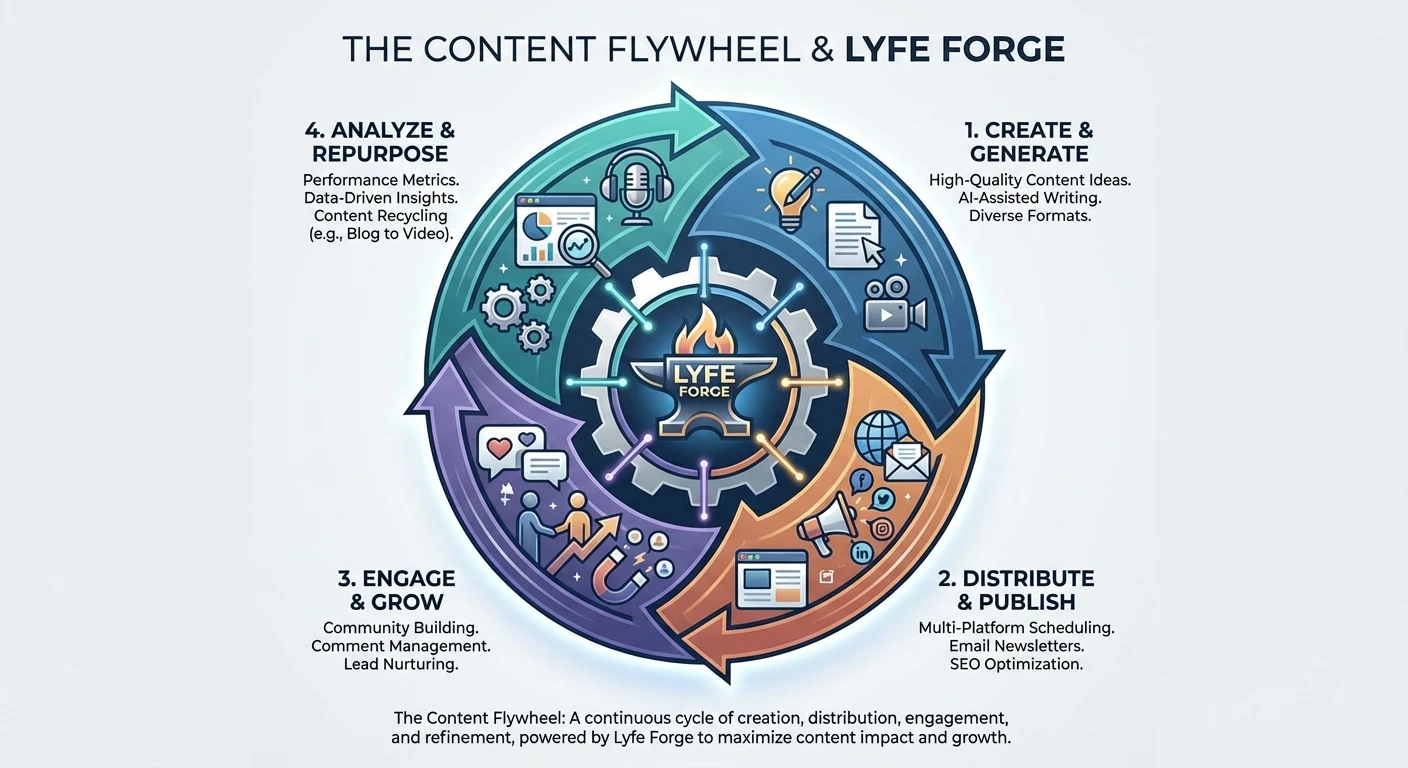
Finally, build a monthly “review and refresh” habit. Look at which pieces are gaining traction, update them with fresh examples, add internal links to newer articles, and spin off extra formats where you see demand. Over time, this simple loop – publish, repurpose, measure, refresh – will start to feel far more powerful than a standard calendar, especially once you have a stable process with clear governance baked into your cookie policy and analytics setup.
Conclusion: Make your content work like a system, not a to-do list
The content flywheel is more than a buzzword. It is a practical way to turn scattered blogs, webinars, and case studies into a connected growth engine. For Australian B2B teams, that means aligning content with the whole buyer journey, reusing what works, and letting customer success fuel your next wave of awareness.
AI and SEO give you the leverage to do this without burning out your team, and platforms like Lyfe Forge bring those capabilities into one workflow. If you want to see how a multi-AI, SEO-first platform could power your own content flywheel, consider booking a demo or trial via the contact page. The sooner you start spinning the wheel, the sooner momentum starts working in your favour.
Frequently Asked Questions
What is a content flywheel in B2B marketing?
A B2B content flywheel is a self-reinforcing content system where every asset you create feeds and powers the next one. Instead of publishing a blog and moving on, you repurpose it into social posts, email sequences, sales enablement, and more—each piece linking back to others to build momentum, traffic, and leads over time.
How is a content flywheel different from a traditional marketing funnel?
A traditional funnel is linear: you create content to push people from awareness to purchase, and they ‘exit’ at the bottom. A content flywheel is circular, with customers at the centre—their results, reviews, and referrals feed new content that drives more awareness and demand. Over time, this loop reduces cost per lead and makes each new piece of content more effective.
How does Lyfe Forge fit into the content flywheel model?
Lyfe Forge provides an AI-driven SEO content engine that supports every stage of the flywheel, from research and strategy to creation, optimisation, and repurposing. It helps Australian B2B businesses turn a single flagship asset into blogs, landing pages, email flows, and social content, while tracking what works so each cycle performs better than the last.
How can I start building a content flywheel for my business?
Start with one in-depth, evergreen asset that solves an important problem for your best-fit customers, such as a guide or case study. Then use tools like Lyfe Forge to spin that into SEO blog posts, LinkedIn threads, email sequences, and sales collateral, making sure each piece links back to the others and is measured so you can double down on what performs best.
What types of content work best in a B2B content flywheel?
High-value, evergreen assets like how-to guides, industry explainers, and detailed case studies work best because they can be repurposed many times. From there you can create supporting blogs, webinars, email nurtures, FAQs, and social snippets, all connected via internal links and consistent messaging to strengthen SEO and nurture buyers at different stages.
Can a small marketing team realistically run a content flywheel?
Yes, but you need to be strategic about what you create and how you reuse it. Platforms like Lyfe Forge are designed to help lean teams in Australia plan topics, generate SEO-optimised drafts, and systematically repurpose one core piece into multiple formats, so you get flywheel benefits without needing a large in-house content department.
How does Lyfe Forge use AI to improve content flywheel performance?
Lyfe Forge uses AI to research keywords, generate SEO-friendly outlines and drafts, and suggest repurposing opportunities across channels. It also helps identify which pieces are driving traffic, leads, and engagement so you can refine topics, update content, and plug proven messages back into the flywheel instead of guessing each time.
How does a content flywheel help with SEO over time?
As you build a flywheel, each related article and asset links to others, creating a strong topical cluster that search engines recognise as authority. This internal linking, combined with consistently updated and repurposed content, can improve rankings for multiple keywords, increase organic traffic, and keep your pages performing long after they’re first published.
Is a content flywheel suitable for Australian B2B companies with long sales cycles?
A content flywheel is particularly useful for long B2B sales cycles because it supports the many touchpoints buyers go through—Google searches, LinkedIn, webinars, and case studies—before talking to sales. Lyfe Forge helps Australian businesses map and produce content for each of these touchpoints, then reuse winning assets to keep nurturing accounts over months, not just weeks.
How do I measure if my content flywheel is working?
Track how individual assets and clusters perform across traffic, engagement, leads, and influenced revenue, rather than only looking at one-off blog views. With Lyfe Forge, you can see which topics and formats are compounding over time, which pieces feed multiple channels, and how updates or repurposed content impact rankings and conversions in later cycles.