
Table of Contents
- Introduction: Why Content SEO Tools Need to Do More Than “Write”
- From Idea to Blog: The AI Content Flywheel Made Simple
- AU‑First SEO: How Lyfe Forge Handles Local Search, Law, and Language
- Workflow, Speed and ROI: Lyfe Forge vs Traditional and Outsourced Content
- Trust, E‑E‑A‑T and Human‑AI Collaboration Inside Lyfe Forge
- Practical Ways to Use Lyfe Forge in Your Content Strategy
- Conclusion: Turn One Idea Into a Full Content Engine
Introduction: Why Content SEO Tools Need to Do More Than “Write”

Most content SEO tools promise “fast blogs at the click of a button”. You paste a keyword, they spit out 1,500 words. But if you have ever tried to rank those posts in Australia, you know the hard truth: writing is only one slice of the job.
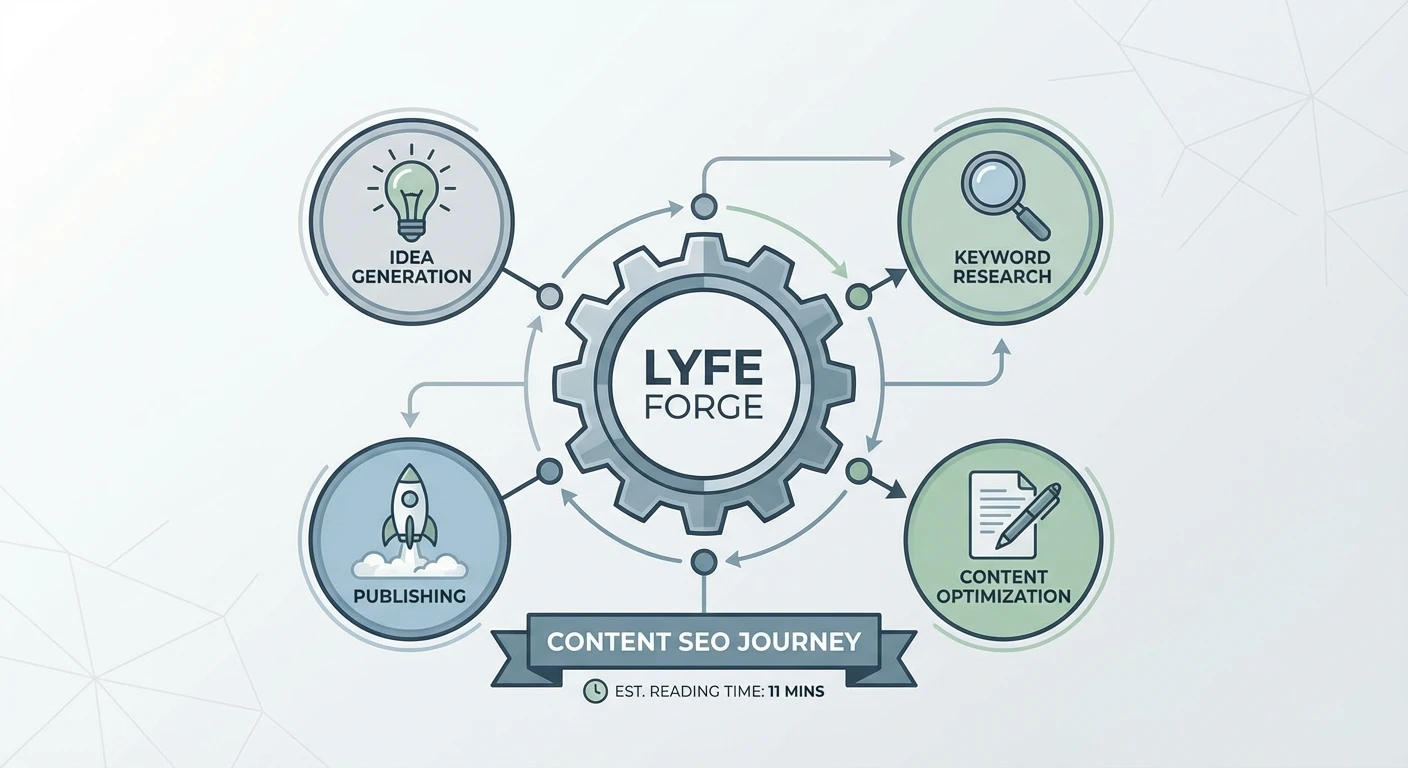
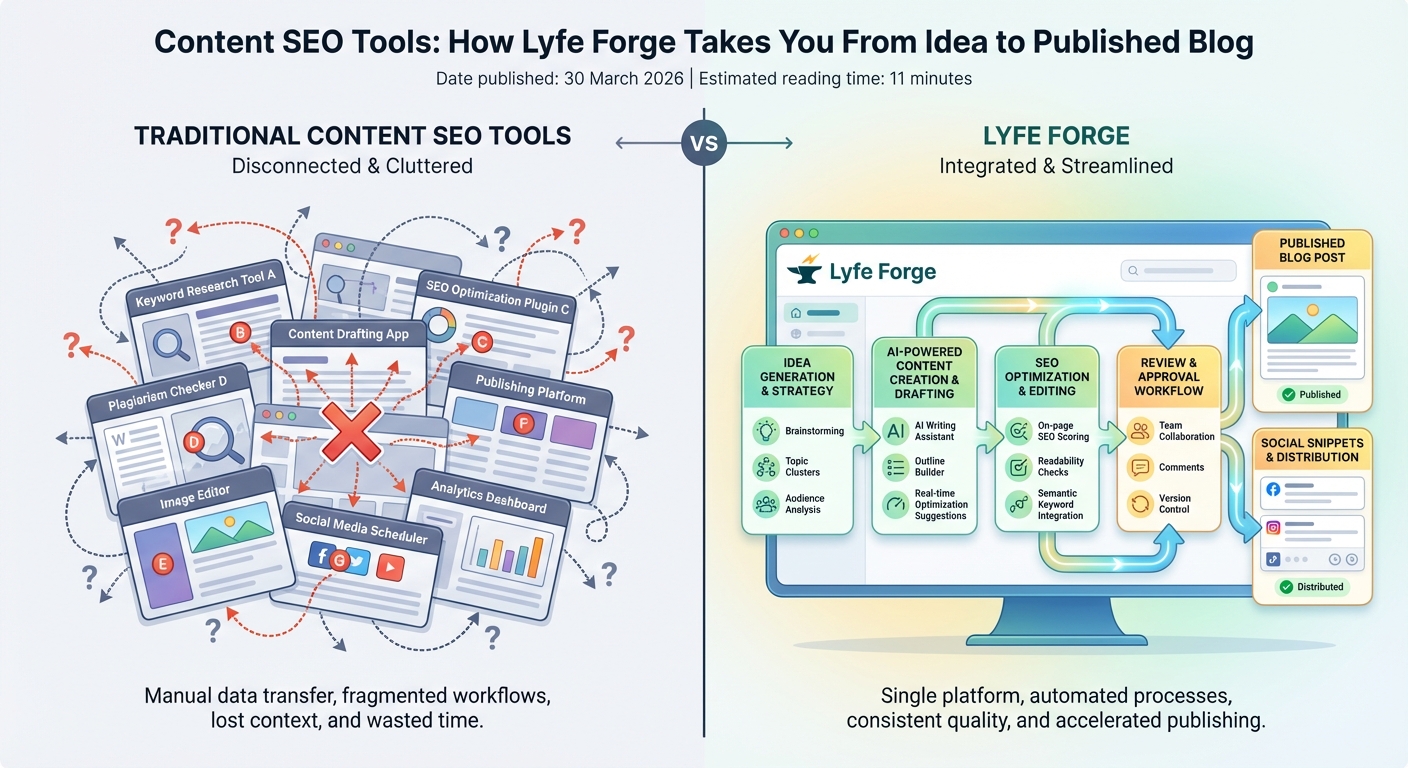
You still need strategy, keyword research, fact‑checking, on‑page SEO, internal links, and proper publishing. That end‑to‑end path – from idea to live blog – is exactly where Lyfe Forge comes in. It is built as a content flywheel rather than “just another writer”, so every step feeds the next and you spend less time wrestling with tools and more time on decisions that actually grow traffic.
In this guide, you will see how Lyfe Forge takes a single idea and turns it into a researched, SEO‑optimised, Australia‑ready blog that is queued in your CMS, plus extra assets for email and social.
From Idea to Blog: The AI Content Flywheel Made Simple
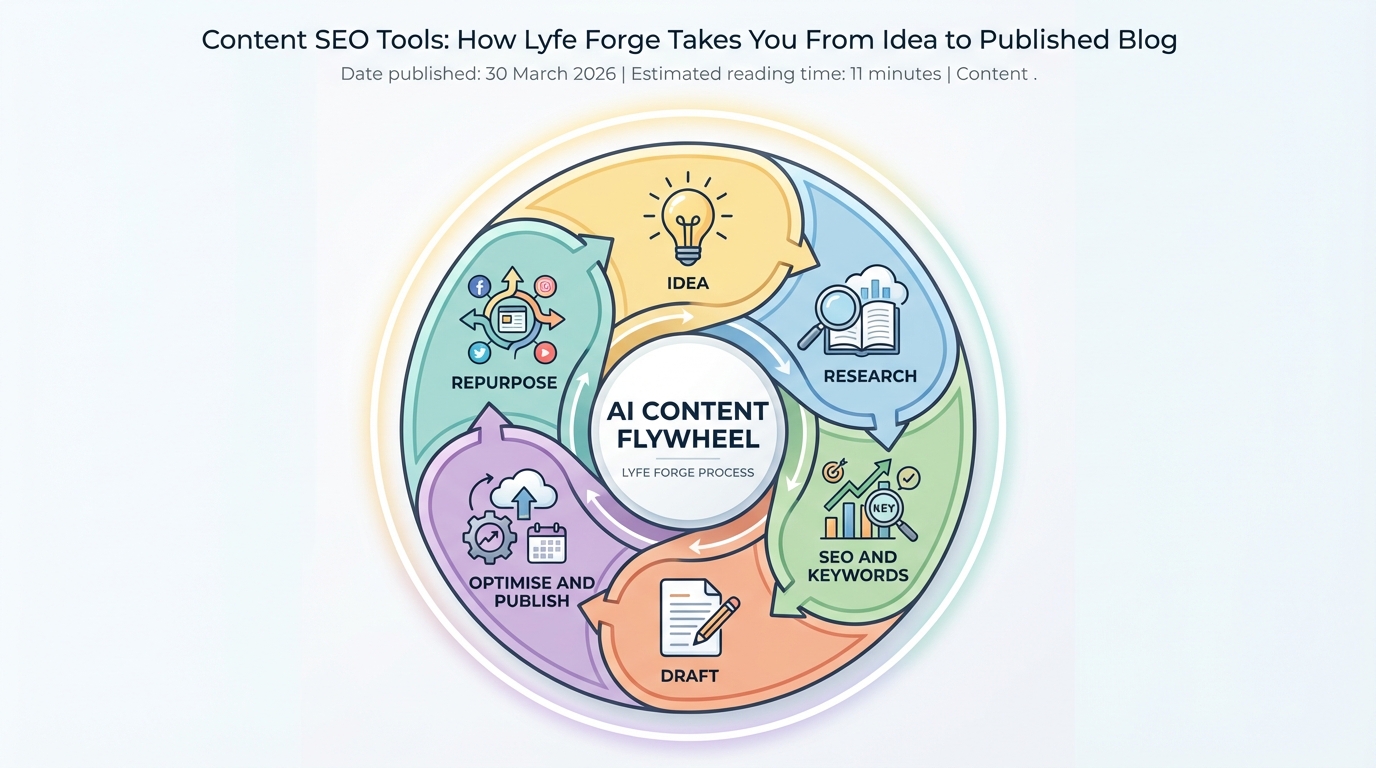
Think of an AI content flywheel like a bicycle wheel. Once it starts spinning, every pedal stroke makes the next one easier. In content terms, each blog you publish makes the next topic, keyword, and outline faster to produce. Lyfe Forge is built around this idea‑to‑blog flywheel, echoing the kind of AI‑powered content repurposing platform approach many teams now rely on to scale.
The cycle starts with ideation. Lyfe Forge analyses your niche, competitors, audience gaps, and live performance data to suggest strategic topics and angles. It can pinpoint gaps where competitors are more visible in search and your content has limited or no presence. Each idea comes with suggested target keywords and subtopics, ready to become a full brief. This is a big step up from generic AI tools that force you to think up prompts from scratch.
From there, the platform performs keyword research and clustering so you are not chasing random phrases. It can import or align with data from specialist SEO platforms, following the kind of modern workflow outlined in guides like Averi’s walk‑through of keyword → brief → draft → publish. That style of connected process is what lets one idea spin into a structured content plan over time, instead of isolated one‑off posts that go nowhere. Similar principles show up in resources like The AI Content Flywheel: How a 2‑Person Team Can Outpublish a 20‑Person Content Department, where a tight system matters more than sheer headcount.
Next comes deep research. Lyfe Forge’s multi‑AI platform runs research across up to five leading AI providers at once and cross‑references their results to fact‑check every claim before drafting. This helps reduce obvious hallucinations and gives you a research pack with sources you can quickly review. The draft stage then draws on that verified outline and applies your “Brand DNA” – tone, phrasing rules, disclaimers – to keep every article consistent.
Finally, that same ecosystem continues after publishing. Because performance data feeds back into future briefs, winning topics and formats influence the next round of ideas. Over a few months, you are no longer guessing: you are running an actual flywheel, tuned for SEO and your audience, not just pressing “generate” on a blank page each time.
https://www.averi.ai/guides/keyword-brief-draft-publish-modern-seo-content-workflow
AU‑First SEO: How Lyfe Forge Handles Local Search, Law, and Language
Many content SEO tools were built for a global or US audience. Australian marketers then have to wrestle the draft into shape, fix spelling, and manually weave in our local terms – NDIS, ATO, RBA, GST, and so on. Lyfe Forge flips that script by making AU‑specific SEO a first‑class feature rather than an afterthought.
Inside Lyfe Forge, keyword research can be geo-targeted for Australia via per-client geographic settings and localized research sources. The platform can be configured to prioritise Australian search results and local competitors, so when it suggests headings or FAQs, they’re aligned with how people actually search in Australia. This makes a huge difference in regulated niches like finance and health, where search intent and terminology are quite specific.
Drafts can also be localised automatically. That means AU spelling, metric units, references to Australian regulators, and internal links to your own Australian‑hosted pages rather than random overseas resources. Because the system is designed around idea‑to‑blog workflows, those internal links are suggested as part of the on‑page optimisation step rather than left for you to hack in at the end.
Compliance is another area where a generic AI writer can trip you up. Lyfe Forge can prompt you to add industry‑specific footer disclaimers—using templates for Medical/Health and Financial/Legal content—and help you steer clear of claims that could be seen as misleading by regulators like the ACCC. The ACCC itself warns that businesses must avoid false or misleading claims in their marketing, which applies just as much to AI‑assisted content as to anything written by hand. Having those prompts wired into your content workflow lowers risk without slowing you down.
The result is not just “Australian spelling”. It is a system that understands AU search patterns, law and user expectations, and then bakes those into the brief, draft, and on‑page optimisation steps so you do not have to retrofit them later.
https://www.accc.gov.au/business/advertising-and-promotions/false-or-misleading-claims
Workflow, Speed and ROI: Lyfe Forge vs Traditional and Outsourced Content
Let’s talk numbers, because “faster” is meaningless without a baseline. For a 1,500 – 2,000 word SEO blog, a typical manual workflow – research, brief, drafting, editing, SEO, formatting and publishing – often eats 8 – 12 hours per piece. That is a full day for a marketer or a good chunk of a freelancer’s week.
With Lyfe Forge‑style automation, you typically cut that down to roughly 2.5 – 4 hours end‑to‑end. Research, brief and outline drop to 10 – 30 minutes. An AI draft takes another 10 – 20 minutes. Human review, fact‑checking and polishing usually sit in the 1 – 2 hour range, and integrated publishing adds only 5 – 15 minutes for final tweaks and scheduling. That works out to roughly a 40–70% time saving per article, which at around $80 per hour equates to approximately $250–$450 in labour saved every time you hit publish.
Scale that to ten posts a month and you’re saving roughly 5–15 hours — plus around $1,000–$1,800 in equivalent labour. You can reinvest that time into campaigns, CRO experiments, or deeper customer research rather than endless formatting in your CMS.
Research from Ahrefs backs up the broader picture: in their survey of 879 marketers, AI‑generated content came in around 4.7× cheaper than human‑written content, with an average cost of $131 per AI blog post versus $611 for a fully human one. Studies on AI content marketing also show significant reductions in per‑article cost when you pair AI with structured processes instead of using it as a loose “helper”. Lyfe Forge is built in that structured way: every stage from keyword to publishing is part of one flow, so those savings are easy to capture. Similar outcomes are reported in resources like SEO Content Automation with AI and detailed rundowns of automatic WordPress blog generation with AI agents, where automation turns sporadic publishing into a predictable pipeline.
Compared with outsourcing to agencies, you avoid the long back‑and‑forth on briefs, the delays when a writer gets busy, and the cost creep on “just one more round of edits”. You still get expert input – your own team’s – but you spend that energy on high‑impact review and strategy, not on basic research or layout.
When you look at content SEO tools through this ROI lens, the question shifts from “Is AI writing as good as a copywriter?” to “Where should humans spend their limited hours?” Lyfe Forge’s answer is clear: let automation handle the heavy lifting; keep humans on judgment calls and brand decisions.
https://ahrefs.com/blog/ai-content-is-5x-cheaper-than-human-content/
Trust, E‑E‑A‑T and Human‑AI Collaboration Inside Lyfe Forge
High‑volume content is useless if people do not trust it – or if Google treats it as thin or spammy. This is where E‑E‑A‑T (Experience, Expertise, Authoritativeness, Trustworthiness) matters. Search engines are increasingly focused on signals that real people with real knowledge stand behind what is published.
Lyfe Forge is built around a hybrid human – AI model rather than full automation. Automation handles the mechanical work: idea discovery, most keyword research, first drafts, basic on‑page optimisation, and distribution prep. Humans then layer on lived experience and expert judgment. That might mean a founder adding an anecdote about how a strategy worked for an Australian client, or a lawyer in your team checking a paragraph that touches on consumer law.
Before publishing, you can use Lyfe Forge’s research pack to verify facts and sources quickly. Because the system pulls from multiple AI models and preserves citations, it is much easier to spot anything that looks off. You then add your own data, adjust claims to match your internal numbers, and insert required disclaimers. The final article reflects both efficient automation and real‑world experience.
This human‑AI blend is not just a nice‑to‑have. A A meta‑analysis in Nature Human Behaviour found that hybrid teams – where humans and AI collaborate – achieve significantly greater performance gains on content creation tasks than humans alone.. Other research on marketing content shows that drafts improved by human editors reach engagement levels very close to fully human work, but at a fraction of the cost and time.
Lyfe Forge bakes these ideas into its workflow. It nudges you to maintain author bios, business details, and clear contact information on your site. It supports structured internal linking, which helps search engines understand your authority on a topic. And it gives your team a shared space to review AI drafts so no one is tempted to push unedited content straight to production.
In plain terms: the platform gives you speed, but also puts guardrails in place so you stay on the right side of both Google’s quality expectations and Australian consumer law around truthful marketing.
https://www.nature.com/articles/s41562-024-02024-1
Practical Ways to Use Lyfe Forge in Your Content Strategy
So how do you actually use Lyfe Forge day‑to‑day? Here is a simple, practical pattern that many AU teams can follow without changing their entire stack overnight.
First, set up your Brand DNA once. Define tone, banned phrases, must‑mention offers, and disclosure rules. That way every draft already sounds like your brand and meets your legal team’s base expectations. Next, build a small topic cluster around one core theme – say “NDIS plan management” or “GST for small businesses”. Use Lyfe Forge to generate 10 – 20 related topics and cluster them into pillar and supporting posts. As you do, you can lean on frameworks from resources like How to Use Automated Content Creation to Boost Content Marketing to keep automation aligned with strategy.
For each topic, spin up a brief and outline using AU‑specific SERP patterns. Check that the headings reflect what your Australian competitors are actually ranking for. Then let the AI produce a first draft using its verified research. You or a subject matter expert can block out an hour a week to review two or three drafts, add experience, and sign off.
Once approved, publish directly to your CMS through Lyfe Forge’s integrations with platforms like WordPress or Webflow. In the same step, let the platform auto‑generate a short LinkedIn post, a newsletter blurb, and a one‑paragraph summary for your internal wiki. You have just turned one idea into a mini campaign without manually copying and pasting across tools.
Finally, use your analytics to see which posts bring in the most organic traffic or leads, then feed those insights back into the next round of ideas inside Lyfe Forge. Over a quarter or two, you will see the flywheel effect: more data, better topics, denser internal linking, and content that feels less like a chore and more like a system that runs.
Conclusion: Turn One Idea Into a Full Content Engine
The old way of creating SEO content – jumping between tools, chasing writers, fixing drafts line by line – simply does not scale for Australian teams that need consistent, trustworthy output. Content SEO tools that only “write” miss the bigger picture.
Lyfe Forge is built for that bigger picture. It joins ideas, AU‑focused keyword research, verified drafting, E‑E‑A‑T‑friendly review, and direct publishing into one flywheel. You can reclaim hours per post, trim production costs, and build a repeatable system instead of relying on a pile of one‑off hacks.
If you are ready to turn your next idea into a complete, SEO‑ready blog (and a stream of related assets) without burning your team out, explore what Lyfe Forge can do for your content engine today.
Frequently Asked Questions
What is Lyfe Forge and how does it help with SEO blog content?
Lyfe Forge is an AI-powered content platform that takes you from initial idea through to a published, SEO-optimised blog post. It combines topic ideation, keyword research, outlining, drafting, optimisation and publishing workflows into one tool, so you don’t have to juggle multiple apps or freelancers.
How does Lyfe Forge take me from content idea to a published blog?
You start by entering your niche or focus area, and Lyfe Forge suggests data-backed topic ideas with target keywords and subtopics. It then generates an SEO brief, creates a draft tailored to your audience, helps you optimise headings, meta tags and internal links, and prepares the final article so it can be queued or exported into your CMS for publishing.
How is Lyfe Forge different from other AI content SEO tools that just write articles?
Most AI tools only generate text from a single prompt, leaving you to handle strategy, keyword research and on-page SEO yourself. Lyfe Forge is built as an end-to-end content flywheel: it analyses competitors, clusters keywords, structures content for search, and connects through to publishing and repurposing, so each blog you publish makes the next one faster and more targeted.
Does Lyfe Forge do keyword research and topic clustering for my blogs?
Yes, Lyfe Forge automatically performs keyword research around your niche and clusters related terms so you’re not targeting random phrases. It maps primary and secondary keywords to each blog idea and outlines subtopics, helping you build topical authority instead of one-off, disconnected posts.
Can Lyfe Forge help Australian businesses rank better in local search results?
Lyfe Forge is built with Australian businesses in mind, focusing on search intent and competition in the Australian market. It can surface topics and angles that match how Australians search, and helps you create content that’s locally relevant rather than relying on generic, US-focused AI output.
How does Lyfe Forge improve on-page SEO for my blog posts?
The platform guides you through optimising titles, headings, meta descriptions, image alt text, and internal links based on your chosen keywords. It structures your content so search engines can easily understand your topic, while keeping readability high for human visitors.
Can Lyfe Forge connect to my CMS so I can publish content directly?
Lyfe Forge is designed to slot into your publishing workflow by exporting SEO-ready drafts in formats that are easy to import into popular CMS platforms. Depending on your setup, you can either paste formatted content directly or use integrations to queue posts for review and publishing.
Does Lyfe Forge create other content assets like email and social posts from my blog?
Yes, once a blog is finalised, Lyfe Forge can repurpose it into supporting assets such as email snippets, social media captions and short summaries. This lets you promote each article across channels without manually rewriting everything from scratch.
Is Lyfe Forge suitable for small businesses that don’t have a dedicated SEO specialist?
Lyfe Forge is built to guide non-experts through each step of SEO content creation, from picking topics to optimising and publishing. Small businesses can use it to get agency-level structure and research without needing deep SEO knowledge or large budgets.
How does Lyfe Forge ensure the content is accurate and not just generic AI text?
Lyfe Forge encourages fact-checking and refinement within the workflow, so you can review claims, update local details and add your expertise before publishing. Its structured briefs and outlines help keep the content specific to your brand, audience and market, reducing the risk of vague or incorrect AI-generated copy.