
Table of Contents
- Introduction: Why Content Series SEO Matters Now
- What “Content Series SEO” Means in 2026 (and Why AI Matters)
- The AI-Driven Workflow for a Multi-Part SEO Series
- Inside Lyfe Forge’s Content Series Planner: SIGA, Scheduling and Overlap Detection
- Using Personas, Research and Competitor Mapping with AI for Series SEO
- Practical Tips to Launch Your First AI-Powered Content Series
- Conclusion: Turn Research into a Search-Dominating Series
Introduction: Why Content Series SEO Matters Now
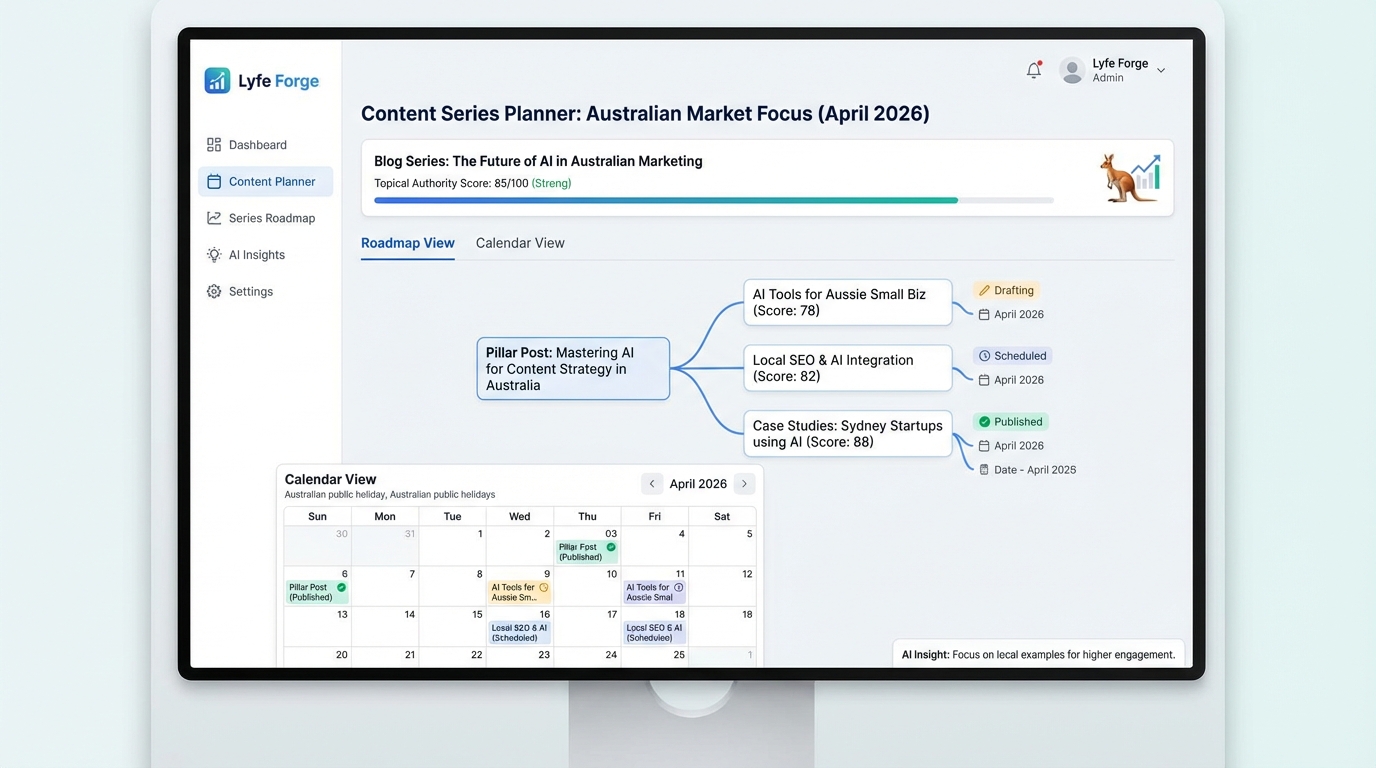
Content series SEO is fast becoming the backbone of serious search strategies in Australia. A single strong blog post can rank, sure, but a connected series of posts can own an entire topic. That is what “topical authority” looks like in practice.
The catch? Planning, writing, and keeping a multi-part series consistent is hard work. Many teams burn out after three posts, and their “pillar strategy” dies on the whiteboard. AI tooling, and platforms like Lyfe Forge, change that equation by taking over the heavy planning and analysis.
In this guide, you’ll see what content series SEO really means in 2026, how AI fits into the workflow, and how Lyfe Forge’s Content Series Planner (plus its SIGA-style overlap controls) helps you create multi-part SEO series that stay on-topic, avoid repetition, and roll out on schedule.
AI Content Strategy: How to Plan, Create, and Publish with AI in 2026
What “Content Series SEO” Means in 2026 (and Why AI Matters)
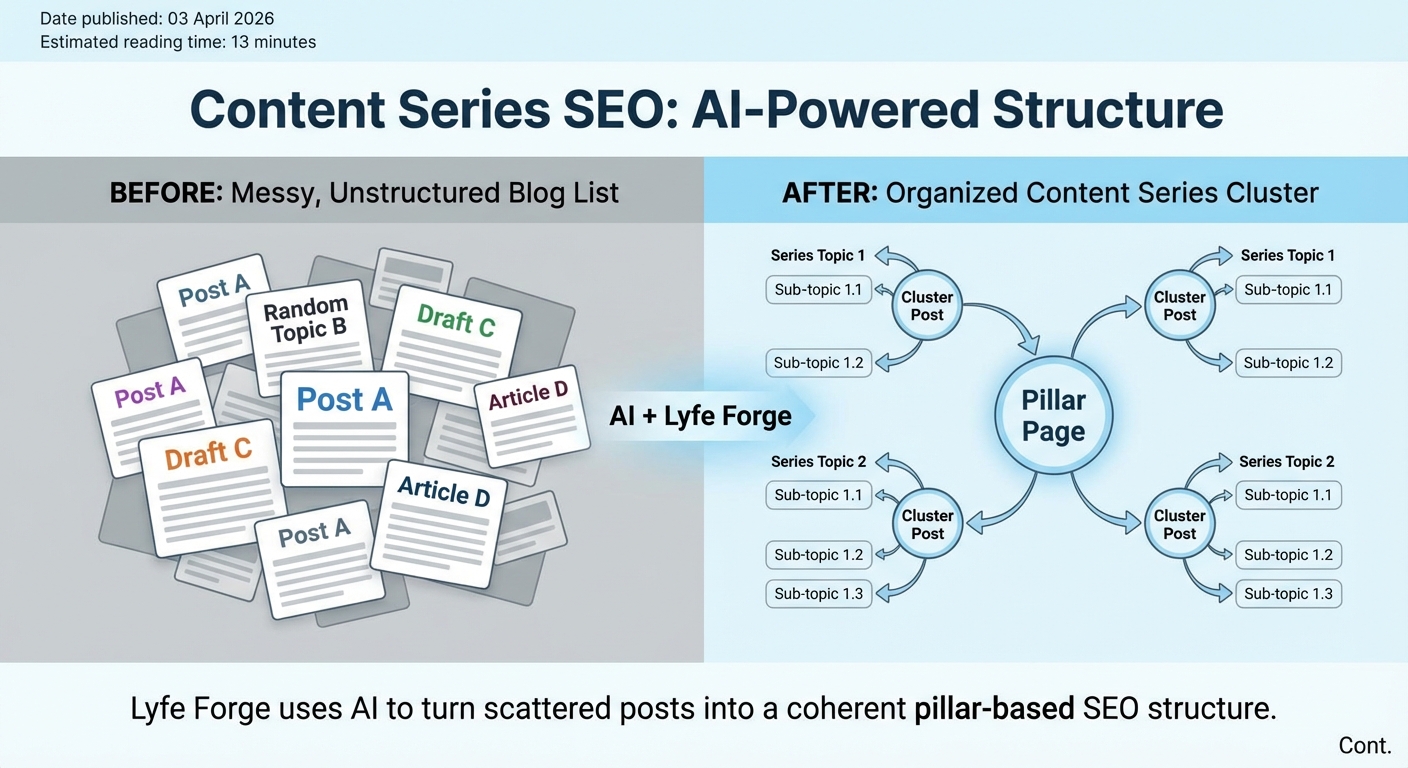
A content series, sometimes called a pillar – cluster series, is a set of connected pieces on one broad topic. Think of a 6 – 12 part blog series where one main “pillar” post gives the big picture, and each supporting post dives into a narrower angle like FAQs, tools, case studies, or mistakes to avoid.
From an SEO point of view, this structure does a few important jobs at once. It lets you cover a topic from many angles, which helps search engines see your site as a strong resource. Internal links between the parts create a neat content cluster, so Google can crawl and understand your theme. Readers get clear paths to keep exploring instead of bouncing after one article, a pattern that frameworks like the SEO Content Strategy Template: Complete Guide for 2026 Success strongly encourage.
In the past, planning this kind of series took a strategist days. You had to research keywords, inspect competitors, plan internal linking, and then brief each article one by one. Modern AI content tools now automate large chunks of this work, from clustering related topics to generating outlines and even draft calendars. Benchmarks from recent Australian industry reports suggest AI can significantly cut task time for many content teams – sometimes by more than half – especially when it’s used for research, drafting, and optimisation together, a pattern echoed in AI Content Strategy in 2026: How to Build a Data-Driven Strategy That Actually Converts
..For Australian businesses, this matters because you’re often competing with bigger global brands that can afford large content teams. Smart use of AI can narrow that gap. With Lyfe Forge’s Content Series Planner, a small team can turn one deep research project into an entire SEO-ready series without juggling dozens of spreadsheets and documents.
Using AI for content planning and strategy: Dos and don’ts
The AI-Driven Workflow for a Multi-Part SEO Series
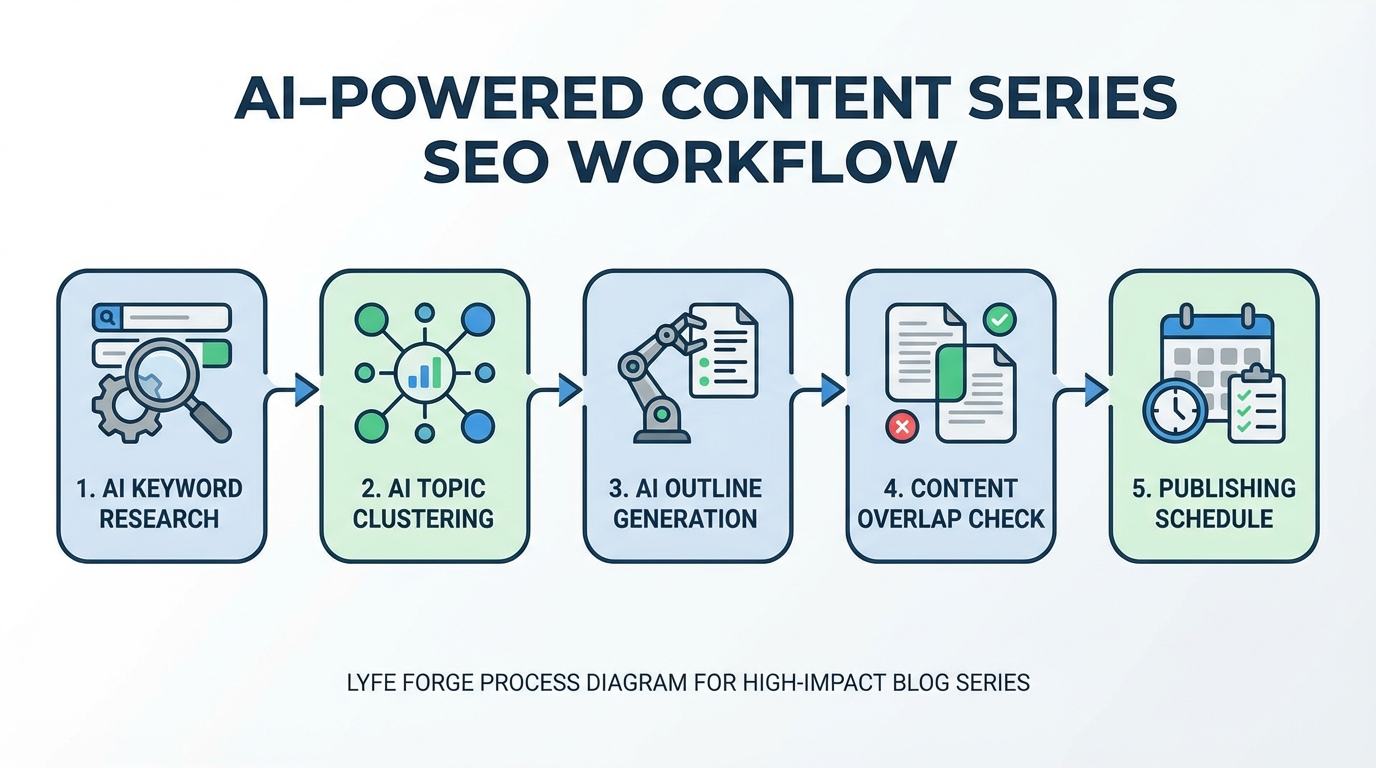
High-performing teams in 2025 – 2026 tend to follow a similar end-to-end pattern when they use AI for content series SEO. The steps stay roughly the same, even if the tools change: understand the audience, research the topic, map the series, draft at scale, then optimise and measure.
First, you map your audience and personas. AI can help here by turning raw inputs (customer quotes, support tickets, analytics) into simple persona summaries. In Lyfe Forge, you’d run deep research on your core audience problems, then feed those insights into a series plan. This keeps every part of the series tied to real needs, not guesswork, and aligns with the kind of persona-driven planning described in 10 Powerful Ways to Use AI for Content Creation (Even If You’re Not a Tech Expert).
Next comes topic and competitor research at the series level. Modern SEO tools with AI features can scan top-ranking content and surface the big clusters of subtopics your series should address. That data flows into Lyfe Forge’s research runs, where each run outputs structured “findings” – the facts, quotes, and angles that the AI will later allocate across parts.
Once your research is in place, you move into series mapping. Here, an AI system can suggest a pillar page and supporting posts, with early ideas for internal links and approximate word counts. Lyfe Forge automates this via its “Analyse & Plan Series” step, which reads all your findings, groups them into themes, and proposes a full plan – complete with a unifying title and coverage percentage.
Finally, you use AI for batch draft creation and optimisation, followed by human editing for brand voice and accuracy. This hybrid approach – fast AI plus careful human review – is increasingly recommended in official guidance and industry practice as a sustainable way to achieve high-quality series production across sectors.
ContentBot – AI Content Automation and Workflows
Inside Lyfe Forge’s Content Series Planner: SIGA, Scheduling and Overlap Detection
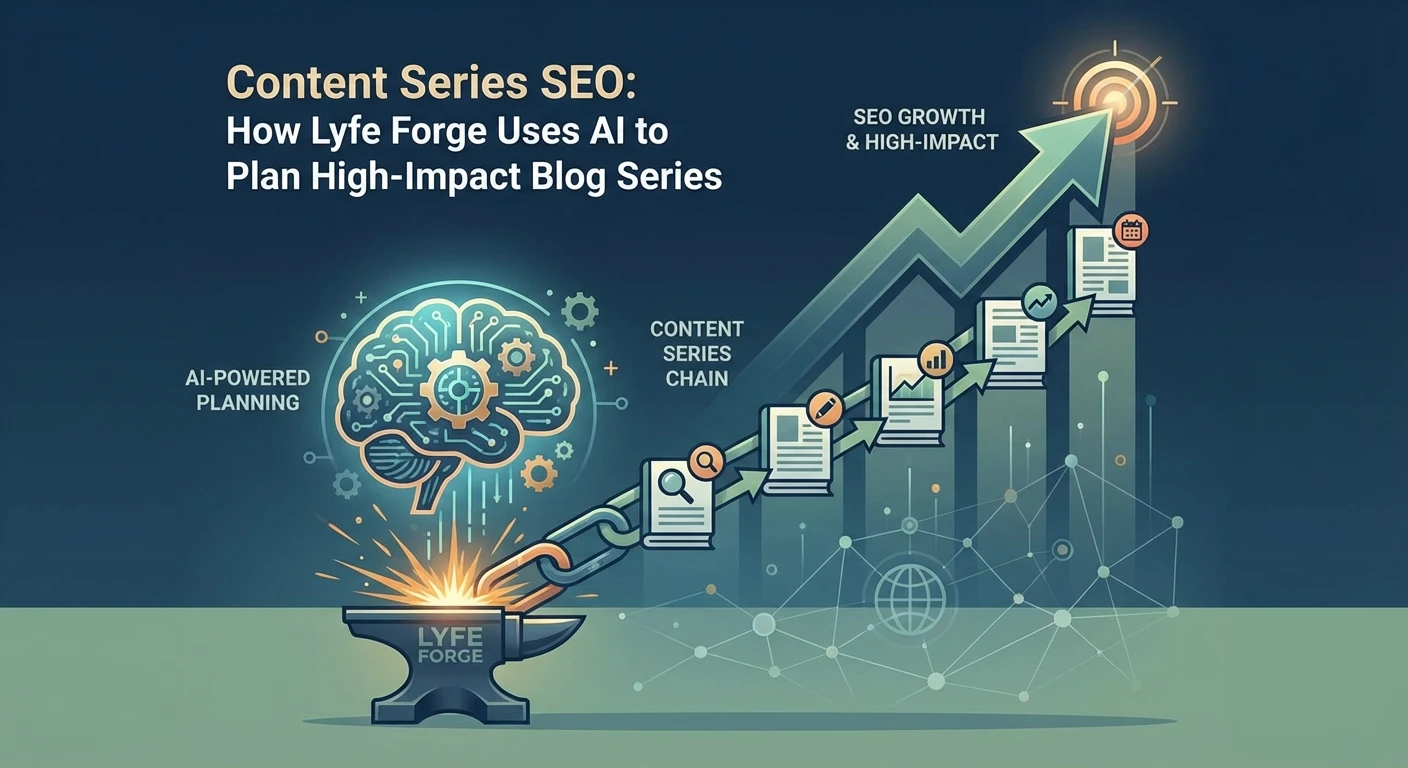
Lyfe Forge is designed around a simple promise: turn deep research into a full SEO content series, without losing editorial control. Its Content Series Planner works as a SIGA-style companion: it helps you Structure, Iterate, Generate, and Audit your series.
You start on the Research page, where you can run multi-engine deep research on your topic. Each run creates structured findings that live inside Lyfe Forge. When you open the planner from the Blog or Research page, you simply tick which research runs you want to combine into a series. The planner even shows how many findings each run contains, so you can judge depth before you commit.
After that, you configure article length, auto-scale, and reading level. Length presets run from “Super Brief” (400 – 700 words) through to “Long” (2,500 – 4,000 words), and the auto-scale switch lets the AI decide how many parts you need so you don’t underuse or overcrowd your research. You also pick a reading ease level, which helps keep every article in the series consistent for your audience.
Clicking “Analyse & Plan Series” triggers AI-powered series analysis. Lyfe Forge runs your findings through its multi-provider AI pipeline, synthesises them into a research-backed brief, and outlines a series plan with proposed part titles, topics, and indicative word counts. Crucially, it also assigns specific findings to specific parts, which sets the stage for precise overlap control later.
Before you generate anything, you can fully customise the plan. Rename parts, drag them into a new order, and open each one to inspect its assigned findings. A pre-generation similarity preview flags where parts look too similar at the idea level, so you can adjust scope early. When you’re ready, you generate parts individually or all at once, in either sequential or parallel mode, and you can turn on background generation so large series keep writing while you move on to other tasks.
The final piece is overlap detection. After generation, Lyfe Forge highlights outputs using an internal colour-coding system to help you quickly scan and prioritise what needs attention, rather than displaying quantified similarity scores with specific percentage-based green, amber, and red badges. If you’ve enabled auto-regeneration, the system can automatically retry high-overlap parts with stronger differentiation instructions – a built-in safety net against duplicate-feeling content, and a practical advantage when you compare LyfeForge vs Jasper, Copy.ai & Others.
Best AI SEO Agents in 2026 (Ranked by What They Actually Automate)
Using Personas, Research and Competitor Mapping with AI for Series SEO
Many guides on content series SEO talk about keywords and clusters, but skip the question of who the series is really for. AI gives you a practical way to tie personas, research, and competitor analysis together before you ever hit “generate”.
Start with persona mapping. Feed your AI tool a mix of inputs: anonymised customer quotes, FAQs from your AU support inbox, GA4 insights, and any local industry reports. Use a persona prompt such as, “You are a senior content strategist in Australia…” to get rich, usable personas. These personas can then guide which subtopics should be early in the series (e.g., basic explainers for beginners) versus later, more advanced posts.
Next, layer in AI-powered competitor mapping. Tools like topic-gap checkers can scan rivals’ content to highlight subtopics they’ve missed, such as advanced linking tactics or local AU-specific regulations. You can then instruct Lyfe Forge’s research engine to explore those gaps, so your findings already lean into areas where you can stand out instead of copying what’s already out there.
Once you have personas and competitor gaps, you run deep research inside Lyfe Forge on your chosen themes. The result is a rich pool of findings aligned to real people and real market gaps. When the Content Series Planner analyses this, it generates a series map that naturally walks your key personas from awareness, through consideration, to decision and even post-purchase content.
This alignment matters for SEO and for Google’s focus on “helpful content”. When each article solves a clear problem for a known persona, engagement metrics like time-on-page and click-through between posts tend to improve. That, in turn, supports your topical authority signals across the series, especially when paired with smart internal linking inside Lyfe Forge’s Projects workflow and informed by SEO and AI Search in 2026: Trends & Predictions.
AI Content Strategy in 2026: How to Build a Data-Driven Strategy That Actually Converts
Practical Tips to Launch Your First AI-Powered Content Series
Turning all this theory into action does not need to be complex. Here’s a simple, practical way to launch your first content series SEO project with Lyfe Forge as your companion.
First, choose one core topic where you want to build authority for the next six months – for example, “SMS marketing for Australian retailers” or “NDIS digital compliance guides”. Run two or three deep research sessions inside Lyfe Forge on that topic and its closest subtopics. This gives the Content Series Planner enough findings to work with, and you can forecast outcomes using the Content ROI Calculator.
Second, open the planner and select those research runs. Set your article length to “Short” or “Medium” and turn on auto-scale, so the AI can suggest how many parts you need. Set reading ease somewhere around “Easy” to suit a broad AU audience, then click “Analyse & Plan Series”.
Third, spend real time on review: rename parts in plain language, drag them into a logical order, and trim or expand scopes so each post answers a clear question. Check the pre-generation similarity preview and adjust any parts that look too close before you generate.
Finally, switch to the Schedule tab and set a publishing rhythm that fits your team, such as one post per week. Turn on background generation for the full series, then handle human edits and on-page SEO inside Lyfe Forge’s Projects view. As you see overlap scores and performance data, use those signals to tweak future series, turning this first run into a repeatable playbook for your marketing team, supported by flexible pricing plans that make scaling more manageable.
Using AI for content planning and strategy: Dos and don’ts
Conclusion: Turn Research into a Search-Dominating Series
Content series SEO is no longer just a theory for big brands with time to burn. With AI and the right workflow, Australian teams of any size can plan, write, and ship multi-part series that genuinely build topical authority.
Lyfe Forge’s Content Series Planner gives you a SIGA-style companion across the whole journey: it structures your series from real research, lets you iterate the plan, generates articles with background and sequential modes, and audits quality with overlap detection and scheduling built in, all under clear Terms of Service and a transparent Privacy Policy.
If you’re ready to move beyond one-off blog posts and start owning topics end-to-end, spin up your first research run in Lyfe Forge today, open the Content Series Planner, and let the AI handle the heavy lifting while you stay in control of strategy and quality; if you have questions, you can always contact Lyfe Forge or review the Cookie Policyto understand how data is used.
AI Content Strategy: How to Plan, Create, and Publish with AI in 2026
Frequently Asked Questions
What is content series SEO and how is it different from regular blog SEO?
Content series SEO is a strategy where you create a connected set of posts (a pillar article plus supporting cluster posts) around one core topic instead of publishing isolated, one-off blogs. This structure builds topical authority, improves internal linking, and helps search engines understand you as a go-to resource, which usually leads to stronger, more stable rankings than standalone posts.
How does Lyfe Forge use AI to plan SEO content series?
Lyfe Forge’s Content Series Planner uses AI to analyse a core topic, map out related subtopics, and propose a multi-part series structure (pillar plus supporting posts). It then suggests titles, angles, and internal linking patterns so you can cover the topic comprehensively while keeping each post focused and distinct.
How do I create an SEO content series using Lyfe Forge?
You start by entering your main topic or target keyword into Lyfe Forge’s Content Series Planner, along with your market focus (such as Australia). The AI then generates a proposed series outline, which you can refine, approve, and turn into a production schedule with briefs for each post, including internal link suggestions and SEO notes.
How does Lyfe Forge’s AI help avoid keyword and content overlap in a series?
Lyfe Forge uses SIGA-style overlap controls to detect when two draft or planned posts are targeting the same or very similar intent. It flags potential cannibalisation, recommends differentiating angles or combining posts, and ensures each article covers a distinct slice of the topic so the series works together instead of competing with itself.
Can Lyfe Forge help with topical authority for the Australian market specifically?
Yes, Lyfe Forge is built with the Australian market in mind and can tailor series plans to Australian search behaviour, terminology, and competition. By focusing your series on AU-specific queries, regulations, and examples, it helps you build topical authority that’s relevant to local audiences and local search results.
What are the benefits of using AI for content series planning instead of doing it manually?
AI speeds up research, reveals subtopics and questions you might miss, and keeps the structure of your series consistent from post one to post twelve. It also reduces planning fatigue by handling clustering, overlap detection, and internal link logic, so your team can focus on subject-matter expertise and quality writing.
How many posts should be in an SEO content series planned with Lyfe Forge?
Most content series Lyfe Forge plans fall in the 6–12 post range, with one main pillar article and multiple supporting posts like FAQs, tools, case studies, or mistakes to avoid. The exact number depends on how broad your topic is and how deep you want to go to truly own that search space.
Does Lyfe Forge integrate AI writing with its content series planner?
Lyfe Forge focuses first on strategy and structure, but it also supports AI-assisted outlines and draft generation based on the series plan. You can generate briefs, suggested headings, and draft sections for each post, then refine them manually to align with your brand voice and expertise.
How does internal linking work in a Lyfe Forge content series for SEO?
The Content Series Planner identifies which posts should link to the pillar article and to each other, creating a clear cluster for search engines. It suggests anchor text and link directions so readers have natural next steps and Google can easily understand the relationships between articles.
Is Lyfe Forge suitable for small Australian businesses that are new to SEO?
Yes, Lyfe Forge is designed so non-experts can set a topic, get a clear series plan, and follow guided steps to publish SEO-focused content. Small businesses can start with a single content series, then scale to additional topics as they see results and get more comfortable with the workflow.