
Table of Contents
- Introduction: Why Keyword SEO Gap Matters Now
- Keyword SEO Gap, Content Gap & Traditional Workflows
- How Lyfe Forge’s SIGA Reinvents Keyword SEO Gap Analysis
- E-E-A-T, AI Search & Practical AU Keyword Gap Strategy
- Conclusion & Next Steps
Introduction: Why Keyword SEO Gap Matters Now
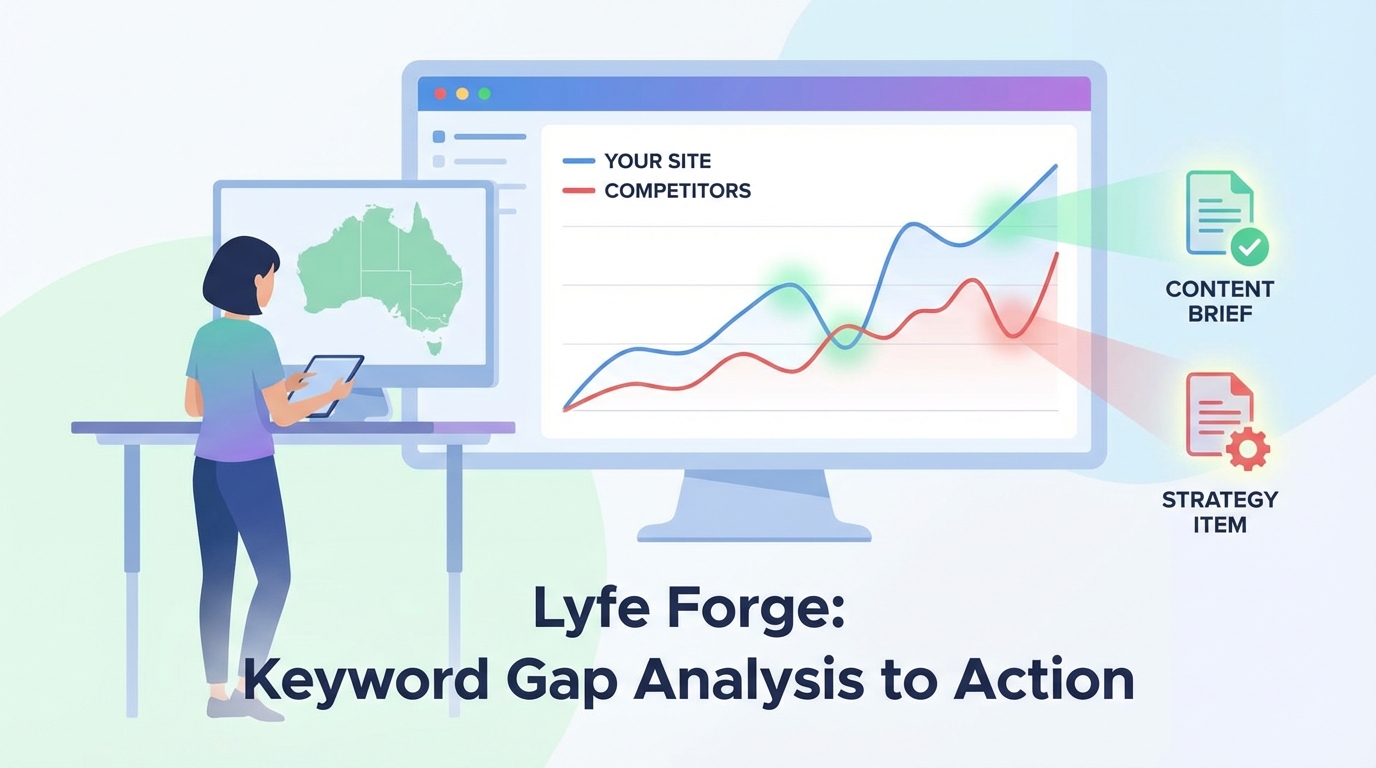
If you’re serious about organic growth in Australia, you can’t ignore the keyword SEO gap. Your competitors are already ranking for terms your ideal customers type into Google every day, and each missing keyword is a quiet leak in your funnel.
Classic tools will show you a spreadsheet of “keywords they rank for that you don’t.” Helpful – but not enough. They rarely explain why those pages rank, what they’re missing, or how you can beat them without wasting months guessing. In an AI‑driven search world, that guesswork is too slow, which is why many teams are shifting toward integrated AI platforms like Lyfe Forge that tie research and execution together.
Keyword SEO gap analysis only matters when it turns into decisions: which topics to cover, which pages to fix, and which competitors to outplay first. However, some experts argue that moving too fast toward fully integrated AI stacks can create a different kind of blind spot. When every insight and action is funneled through a single platform, teams risk over‑fitting to what the model thinks “should” work, and under‑investing in the messy, manual sleuthing that uncovers unconventional opportunities. Classic tools and slower, human‑driven analysis can still surface nuanced intent shifts, brand nuances, and off‑page dynamics that current AI systems often flatten or overlook. In practice, the strongest operators aren’t abandoning traditional workflows so much as layering AI on top of them – using platforms like Lyfe Forge to accelerate the grunt work, while deliberately preserving space for human judgment, creative divergence, and old‑fashioned competitive curiosity. That’s where a more strategic, intent‑driven approach starts to pull ahead of simple keyword lists.
Keyword SEO Gap, Content Gap & Traditional Workflows
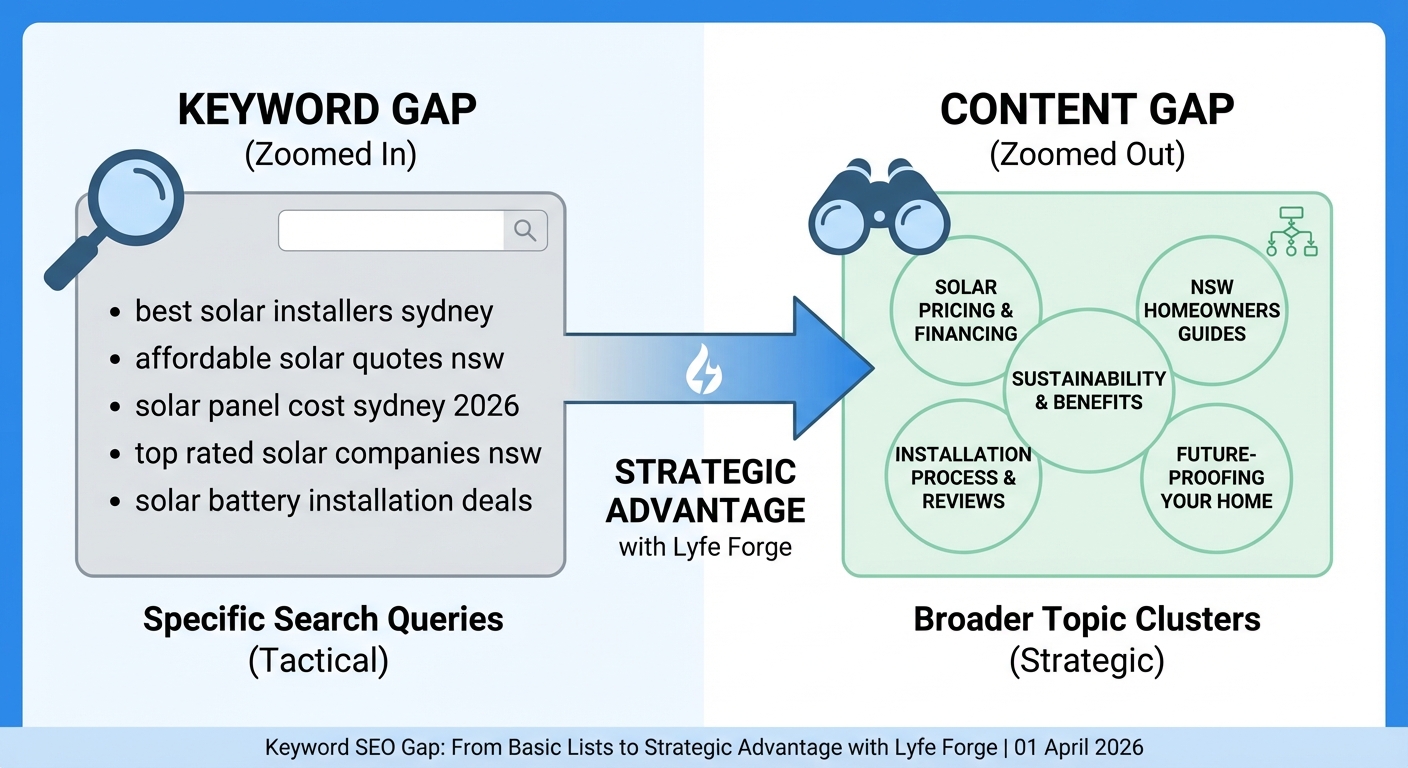
A keyword SEO gap analysis compares the keywords your site ranks for with the keywords your competitors rank for. Wherever they appear in search and you don’t – or they outrank you – that’s a gap. Done well, this gives you a clear list of opportunities to close the distance between you and the current winners, mirroring structured approaches like Keyword Gap Analysis: What It Is & How to Do It.
It helps to separate this from content gap analysis. Keyword gap analysis zooms in on individual queries like “best solar installers Sydney”, while content gap analysis zooms out to themes such as “solar pricing and financing for NSW homeowners.” In practice, you often start with keyword gaps, then build broader topic clusters once you see patterns across many terms, which aligns with how Keyword Gap Analysis: The Key to Successful SEO frames competitive planning.
Gaps also differ by intent. Informational queries (“how much solar panels cost in Brisbane”) sit at the top of the funnel. Commercial investigation queries (“best commercial solar installer Australia”) show people are weighing options, while transactional terms (“book solar installation quote Perth”) sit near the sale. A strong keyword SEO gap strategy looks for misses across all three stages, not just the high‑volume “how to” phrases, echoing the funnel‑wide mindset in Keyword Gap Analysis: Benefits & Best Practices.
Another wrinkle is competitor type. You have direct business competitors, and you have “SERP competitors” – sites that keep showing up for your core topics even if they don’t sell the same thing. Think government portals, large publishers, comparison sites. In Australia, comparison brands and big media often scoop up a large share of early informational searches, while local service providers that invest in local SEO are better placed to capture high‑intent, location‑based queries closer to the point of purchase. A good keyword gap workflow needs to factor in both groups, which is why many SEOs lean on frameworks like the searchengineland.com gap analysis guide when mapping competitors.
Before you touch advanced tools, you still need a clear picture of your own site and your rivals. Define your main domain, target geography (for example “Australia” or “NSW + VIC”), and business model, then list both business competitors and SERP competitors that keep showing up for your head terms. For many AU brands, this mix includes local agencies, national players, and at least one big directory or marketplace.
With that list, you can start a free‑tool workflow. Export performance data from Google Search Console so you know what you already rank for and where you sit. Then layer on free or limited keyword gap tools like Semrush’s trial or Ahrefs Webmaster Tools to compare your domain against a handful of competitors and surface “Missing” or “Weak” keywords. Enrich that list by scanning Google’s People Also Ask boxes and related searches for more natural‑language questions; tools such as the Keyword Gap Analysis Tool can validate which of those questions are worth pursuing.
If you’re running deeper campaigns, paid platforms add extra muscle. Semrush’s Keyword Gap tool lets you compare up to five domains, classify terms into groups like Shared, Missing, Weak, Untapped, and Unique, and filter by search intent and country. You can then pipe promising terms into keyword tracking and content planning tools inside the same ecosystem, which saves a lot of manual spreadsheet work.
AI‑assisted SEO platforms such as Surfer SEO can analyse live SERPs for a target keyword and translate that competitive data into structured content briefs – suggested word counts, headings, and related terms – inside their content editors. You still have to bring your own expertise, but it cuts hours off early research and gives writers a clear target to hit, much like how How to Use a Keyword Gap Analysis to Beat Your Competitors recommends moving quickly from data to concrete briefs.
All of that is useful, but notice what’s still missing. You get long lists of phrases and some guidance on difficulty and volume, yet you rarely get a sharp answer to “What exactly should our article say to win this search?” That’s the point where most keyword SEO gap processes stall or drift into guesswork, and where a more integrated content engine such as the AI Content Creation Features inside Lyfe Forge starts to matter.
How Lyfe Forge’s SIGA Reinvents Keyword SEO Gap Analysis
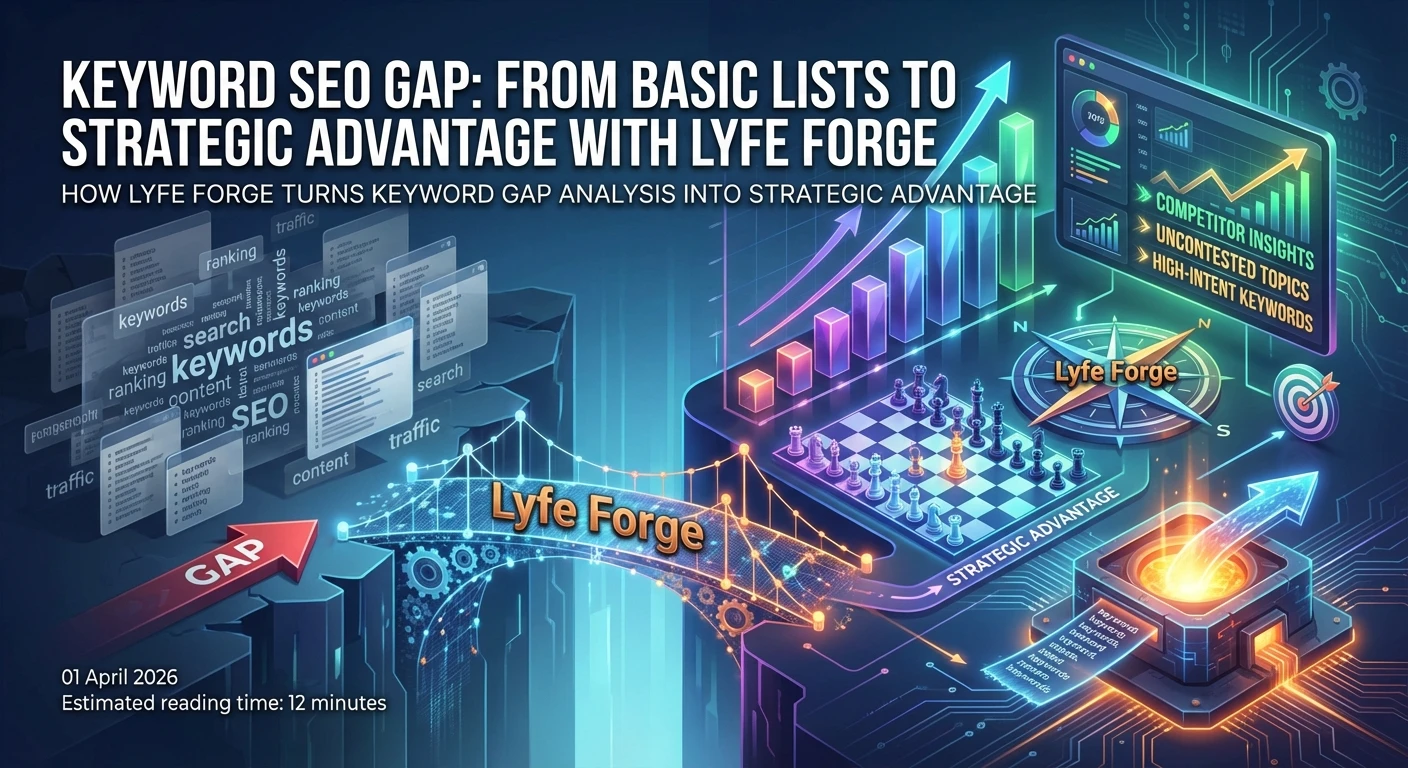
Lyfe Forge was built to fix that guesswork. Instead of stopping at “here are the gaps,” it asks: “What is the searcher really trying to achieve here, and what are current pages failing to deliver?” That’s the heart of our Strategic Intent Gap Analysis (SIGA) system, which powers the broader Transform Content Creation with Lyfe Forge AI platform.
Everything starts in the Keywords section. When you create a keyword research project, When you create a keyword research project, Lyfe Forge clusters related phrases into topic-based groups and enriches them with estimated search volume, competition level, and intent (informational, commercial, transactional). Each keyword gets a recommendation score based on a blend of factors: estimated search volume, how competitive the SERP looks, and how well the query aligns with high‑intent opportunities like in‑depth informational searches.
If you connect Google Search Console, Lyfe Forge also highlights phrases where you already sit on pages two to five of Google. These “striking distance” terms are powerful because a single strong piece of content can lift you onto page one much faster than starting from zero. The result is not just a raw keyword dump but a ranked shortlist of content ideas that balance potential traffic and realistic difficulty, which you can then cost out with tools like the Content ROI Calculator.
Once you’ve picked your target terms, SIGA is where things change. From the same Keywords screen, you can launch a SIGA run for each keyword. Instead of only scraping titles or headings, SIGA examines what top‑ranking pages actually do – and where they fall short. It flags thin or outdated sections, missing subtopics, weak structure, and UX issues like walls of text or confusing layout.
Under the hood, SIGA breaks its findings into five lenses. “Top Ranking Weaknesses” calls out quality problems on current winners and scores their severity. “Missing Intent Elements” surfaces what users seem to want that no one is delivering yet. “Under‑Answered Questions” lists related queries that deserve subheadings or FAQs. “Poor Execution Areas” shows where competitors gloss over depth, accuracy, or clarity. Finally, “Strategic Opportunity” summarises, in plain language, exactly how your content can leapfrog the field.
SIGA also supports multi‑provider intelligence. You can run the same keyword through different AI sources – OpenAI Search, Perplexity, Gemini, Brave AI, Grok – and store each result set separately. This matters because each engine has a different search index and reasoning style; when you combine them, you see blindspots that a single tool would never reveal.
The final step is the SIGA‑to‑Content pipeline. When you generate a draft article in Lyfe Forge, those SIGA insights aren’t left behind in a report folder; they’re injected into the brief the AI writer sees. The model is guided to directly answer the under‑served questions, fix the structural issues, and cover the missing intent elements identified earlier. You’re not just asking an AI to “write a blog about X” – you’re asking it to produce a strategic response to very specific competitive weaknesses, all within an accessible pricing plan.
To keep that process transparent, every piece you create with this workflow carries a SIGA Contribution Badge in the Lyfe Forge interface. You can click back and see which insights fed the outline and what decisions were made at research time, which is invaluable when teams change or when you review performance months later.
For high‑value topics – think cornerstone guides or money‑page supporting articles – Deep SIGA goes further. It widens the search context, uses larger token windows, and produces more granular analysis at the section and question level. You can queue Deep SIGA runs across many keywords and let the system build a rich picture of your competitive landscape while you focus on strategy, supported by the broader workflows outlined on the About Lyfe Forge page.
E-E-A-T, AI Search & Practical AU Keyword Gap Strategy
Google’s E‑E‑A‑T framework – Experience, Expertise, Authoritativeness, Trustworthiness – sits behind most serious SEO conversations now. It isn’t a single metric, but a bundle of signals that suggest “this page really knows what it’s talking about, and users can rely on it.” As Google weaves more AI into search, those signals become even more important to stay visible.
Recent analysis of Google’s updates shows a shift toward entity‑level understanding and knowledge graphs instead of pure keyword matching. Google tries to understand which brands genuinely own a topic, then rewards sites that cover that topic deeply, accurately, and consistently over time. On the other hand, not everyone agrees that keyword mechanics are fading into the background quite so quickly. However, some experts argue that this picture is a little too tidy. Google’s public rhetoric leans hard on E‑E‑A‑T and topical authority, but in the wild, rankings are still heavily influenced by classic signals: backlinks, crawl budget, technical hygiene, user behavior, even raw brand demand. A site can produce outstanding, thematically coherent content and still get outgunned by a weaker resource riding on a stronger link graph or a bigger brand footprint. And because Google’s systems are probabilistic and noisy, there are plenty of edge cases where “thin plus scattered” pages hitch a ride on domain authority and outperform more comprehensive hubs. In other words, deep coverage helps stack the odds in your favor – but it isn’t a guaranteed golden ticket, and treating topical ownership as the sole or dominant lever can lead teams to underinvest in distribution, promotion, and the unglamorous technical work that still moves the needle. Some practitioners point out that Google’s entity understanding is still largely inferred from classic signals: crawlable page structure, clear topical clusters, and yes, strategic keyword usage that maps cleanly to user intent. Entity SEO doesn’t replace keyword relevance so much as wrap around it; the Knowledge Graph still needs unambiguous language, consistent terminology, and predictable on-page cues to connect your brand to a topic Entity SEO: How Search Engines Understand Your Business Entity SEO. In practice, sites that ignore basic keyword research and search behavior in favor of vague “topical authority” rhetoric often lose ground to competitors who do both – tight, intent‑driven keyword targeting supported by deep, entity‑aware coverage over time Google Algorithm Updates 2026: Impact on Australian SEO. “Thin plus scattered” content struggles; coherent, comprehensive coverage wins, a pattern echoed in content gap analysis research from oneupweb.com.
This is where SIGA‑driven content excels. By design, it pushes you to answer real user questions other sites ignore, which shows lived experience. It nudges you to cover angles that shallow listicles skip, which demonstrates expertise. And because your article ends up more complete and more helpful than what’s already ranking, it builds authoritativeness in that niche over time.
Trustworthiness also improves when you tie SIGA to a disciplined fact‑checking workflow. Lyfe Forge can be used alongside external verification sources and style guides so claims are checked before publication. That reduces the risk of outdated stats, misquoted laws, or “hallucinated” facts slipping into live content – a real issue when teams rely on generic AI writing without guardrails, which is why clear policies such as the Lyfe Forge Privacy Policy and Terms of Service also matter.
There’s also the rise of AI‑generated answers in the SERPs themselves. As search experiences like AI overviews and chat‑style results blend with classic blue links, brands need content that AI systems are willing to quote and reference. That usually means well‑structured pages that clearly answer intent‑rich questions, include relevant entities, and avoid vague, fluffy copy.
SIGA’s focus on under‑answered questions and missing intent pieces maps neatly onto that world. When you plan content around the exact questions people ask – and make your answers precise, structured, and verifiable – you raise your odds of showing up not just in traditional listings, but in AI‑driven surfaces as well. In that sense, SIGA isn’t just about today’s rankings; it’s a hedge against where search is going next, while keeping user safeguards front‑and‑centre through frameworks like the Lyfe Forge Cookie Policy.
Turning that theory into day‑to‑day practice can feel daunting, so keep it simple and repeatable. Start by auditing your current visibility: export Google Search Console data, highlight queries where you sit between positions 11 and 40, and segment them by intent (informational, commercial, transactional). These are prime candidates for either new content or targeted updates.
Next, pick three to five core competitors – both business and SERP – and run a standard keyword gap comparison in your tool of choice. Filter for high‑relevance terms with clear commercial or decision‑stage intent in Australia. Don’t chase every shiny high‑volume phrase; focus on those that tie directly to your offers and locations, using playbooks like Keyword Gap Analysis to Dominate Your Competitors as a loose benchmark rather than a rigid template.
Now connect those findings to SIGA. Drop your best opportunities into a Lyfe Forge project, run SIGA on each, and let the system surface the missing intent elements and under‑answered questions. Use those insights to build a content backlog: each item should name the primary keyword, the main user problem, and the specific weaknesses in current results you’re going to beat, which is exactly the kind of workflow Lyfe Forge outlines across its AI content capabilities.
As you publish, track both rankings and engagement. Use Search Console and analytics to see whether SIGA‑informed pages climb faster or convert better than older content. Over time you’ll spot patterns – maybe your audience responds strongly to detailed FAQs, or to local case studies – that you can feed back into future SIGA runs and briefs, and refine further with input from the Lyfe Forge team if needed.
Make keyword SEO gap review a habit, not a one‑off project. Markets shift, competitors launch new sections, and AI‑driven SERPs evolve. A lean quarterly cycle where you refresh gap data, prioritise fresh opportunities, and run SIGA on the best of them is usually enough to stay ahead without drowning your team in endless audits – or in the cost and complexity that older tools often carry compared in analyses like LyfeForge vs Jasper, Copy.ai & Others.
Conclusion & Next Steps
Keyword SEO gap analysis used to stop at “here’s a list of phrases your competitors rank for.” In today’s AI‑shaped search landscape, that’s not enough. You need to understand user intent, content weaknesses, and the exact moves that will let you overtake existing winners fast.
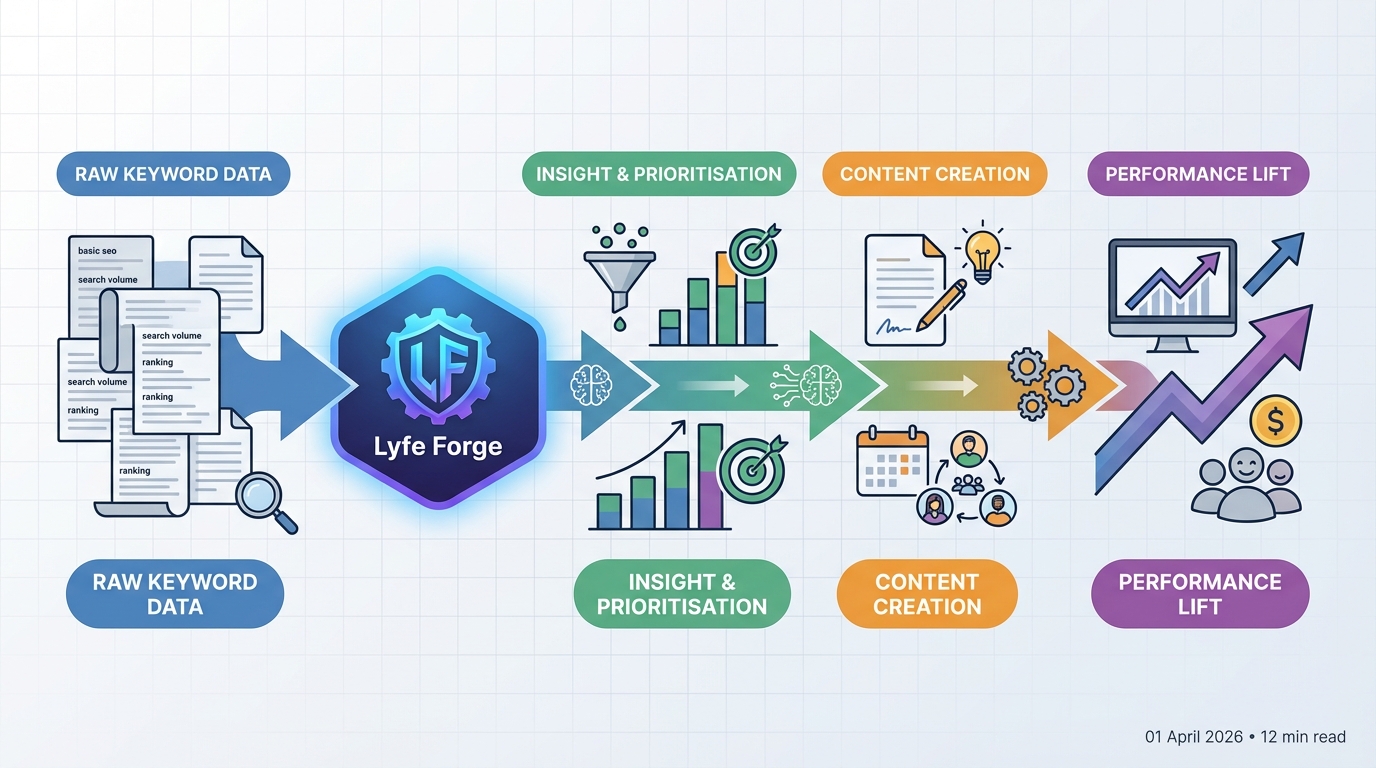
Lyfe Forge’s SIGA turns gap research into a strategic engine: scoring keywords, dissecting competing pages, and feeding precise insights straight into your content creation workflow. The result is material that doesn’t just exist in the index – it answers real questions better than anyone else and builds E‑E‑A‑T over time, all within an option to start free and scale as you grow.
If you’re ready to move beyond static spreadsheets and guesswork, plug your site and competitors into Lyfe Forge, explore the SIGA‑powered workflow, and let your first analysis show you exactly where to strike next.
Frequently Asked Questions
What is a keyword SEO gap and why is it important for my website?
A keyword SEO gap is the difference between the keywords your site ranks for and the keywords your competitors already rank for in Google. It matters because every relevant keyword they own and you don’t is traffic, leads, and revenue you’re quietly losing. By identifying and closing these gaps, you can target high‑intent searches, improve visibility, and win customers who are currently going to competitors.
How do I run a keyword SEO gap analysis step by step?
First, list your main competitors and export their ranking keywords from SEO tools like Semrush, Ahrefs, or Similarweb. Then export your own ranking keywords and compare the lists to find terms they rank for that you don’t or where they outrank you. Next, group those keywords by topic and intent (informational vs commercial), and finally prioritise gaps based on search volume, difficulty, and business value. Platforms like Lyfe Forge streamline this by automating the comparison and clustering into actionable content plans.
What is the difference between a keyword gap and a content gap?
A keyword gap is a missing or weak ranking for specific search terms compared to competitors. A content gap is the underlying missing or incomplete page, article, or resource that should be targeting those terms and user intents. In practice, keyword gaps tell you *where* you’re losing visibility, while content gaps tell you *what* you need to create or improve to close that gap. Lyfe Forge connects both layers by turning keyword gaps directly into content briefs and optimisation tasks.
Why are traditional keyword gap tools not enough on their own?
Traditional tools mostly give you raw lists of keywords but don’t explain why competitor pages rank, what search intent they satisfy, or how to realistically beat them. You still have to manually cluster, prioritise, and turn those lists into briefs, on‑page changes, and link strategies, which is slow and error‑prone. They also tend to ignore E‑E‑A‑T signals, brand nuance, and content quality factors that now drive rankings. Lyfe Forge’s SIGA system adds that missing strategic layer by analysing intent, quality, and competitive strength, not just raw keywords.
How does Lyfe Forge’s SIGA actually work for keyword SEO gap analysis?
SIGA (Search Intent & Gap Analysis) ingests your site and competitor data, then automatically identifies where competitors win on important queries. It clusters those gaps into themes, maps them to search intent, and evaluates factors like content depth, topical coverage, and E‑E‑A‑T signals. From there, it generates prioritised recommendations: which pages to create, which to update, and where to consolidate or expand content. This turns a static keyword list into a clear execution roadmap your team can follow.
Can Lyfe Forge help me create content to close my keyword gaps, not just find them?
Yes, Lyfe Forge is designed to bridge research and execution. After identifying keyword and content gaps, it generates structured content briefs, suggested page outlines, and AI‑assisted drafts aligned with search intent and your brand. It also guides you on on‑page optimisation and internal linking so new pieces are technically and semantically ready to rank. This reduces the lag between discovering opportunities and publishing high‑quality content that can close the gap.
How does Lyfe Forge support E-E-A-T when closing keyword SEO gaps?
Lyfe Forge evaluates not just keywords but the signals Google associates with Experience, Expertise, Authoritativeness, and Trustworthiness. It encourages the inclusion of expert bylines, evidence, real‑world examples, and transparent sourcing in the content it helps you plan or draft. It also highlights where you may need supporting content clusters, better internal linking, or reputation signals to reinforce authority on a topic. This makes your gap‑closing content more resilient to algorithm updates that reward genuine expertise.
Is Lyfe Forge better than using Ahrefs or Semrush for keyword gap analysis?
Lyfe Forge doesn’t replace data sources like Ahrefs or Semrush; it sits on top of them to add strategy and execution. Those tools are excellent for raw keyword, backlink, and SERP data, but they leave you to interpret and act on it manually. Lyfe Forge ingests that data and layers on intent modelling, clustering, prioritisation, and content brief generation, so you spend less time wrangling spreadsheets and more time shipping pages. Many teams use them together: traditional tools for breadth of data, Lyfe Forge for turning that data into a practical growth plan.
Can Lyfe Forge work with Australian businesses and local SEO keyword gaps?
Yes, Lyfe Forge is built with Australian businesses in mind and supports AU‑specific search behaviour, locations, and spelling. It can analyse local competitors, identify gaps in location‑based and service‑based queries, and help you build pages or sections that target Australian suburbs, cities, and regions. This is particularly useful for service businesses and franchises that need to scale local landing pages without duplicating content. The platform’s intent and gap analysis ensures each local page is unique, useful, and aligned with how Australians actually search.
How do I avoid relying too much on AI when using Lyfe Forge for keyword gap analysis?
Use Lyfe Forge to handle the heavy lifting—data gathering, clustering, and first‑draft recommendations—but keep human experts in the loop for judgment and nuance. Have your SEO or content team review the suggested topics and outlines against brand voice, unique insights, and off‑page realities like PR, partnerships, and industry trends. Regularly sanity‑check AI‑generated ideas against manual SERP reviews and customer feedback to catch subtle intent shifts or opportunities. This hybrid approach gives you speed from AI and differentiation from human insight.