
Table of Contents
- The Real Truth About AI SEO Content (And How To Stay Safe)
- AI-Generated Content vs AI-Researched Content: Clear SEO Definitions
- How Google Actually Treats AI SEO Content in 2026
- How to Spot Risky AI-Generated SEO Content (Before Google Does)
- Why AI-Researched, Human-Written Content Wins Long-Term SEO
- Simple Workflow: Use AI for SEO Research Without Losing Your Voice
- Practical Tips to Choose the Right Content SEO Approach for Your Business
- Conclusion: Treat AI as Your SEO Research Engine, Not Your Ghostwriter
The Real Truth About AI SEO Content (And How To Stay Safe)
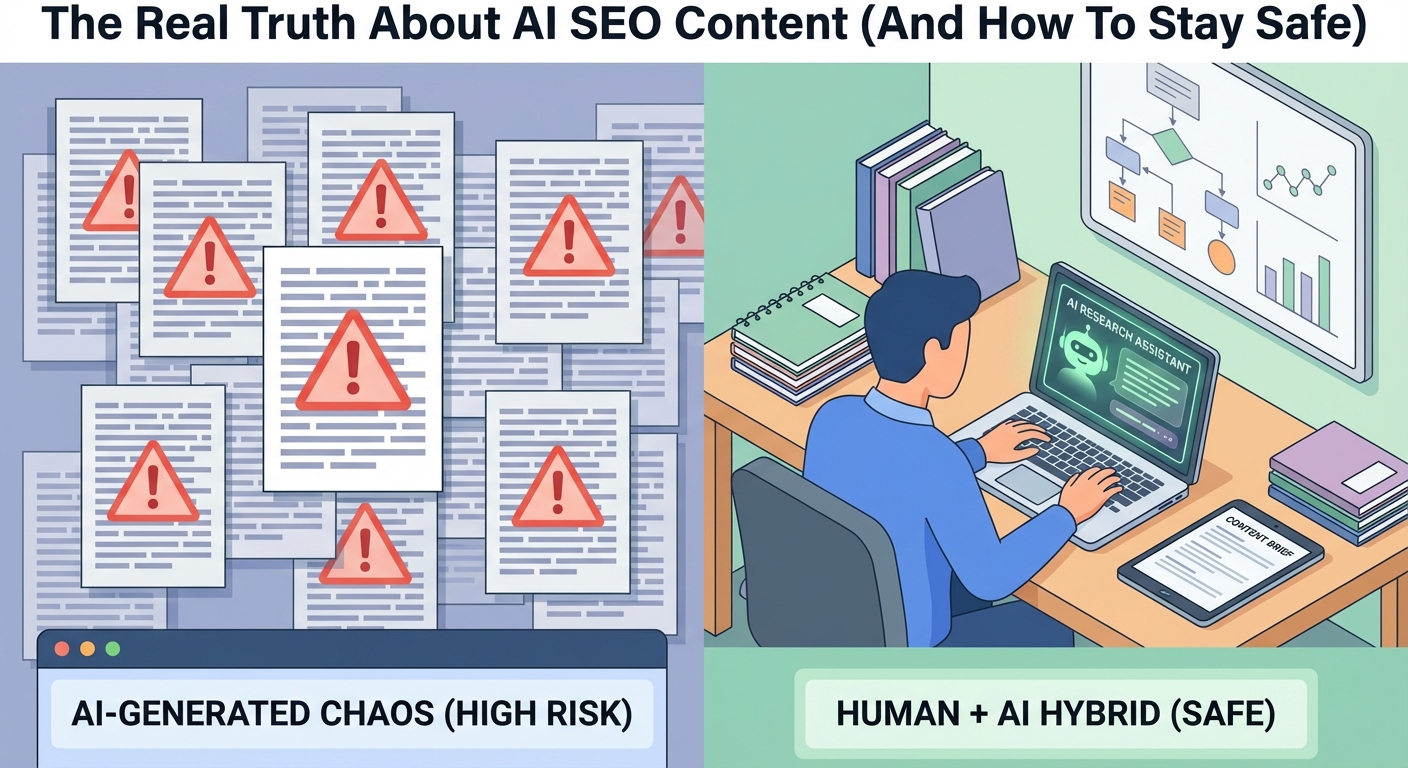
AI tools are everywhere now. They can write blogs, emails, even sales pages. That sounds amazing. But for SEO, there is a big catch.
Google does not want piles of cheap AI text. It wants useful pages that real people trust. That is why the gap between “content SEO generated by AI” and “AI‑researched, human‑written content” now matters so much for rankings and brand safety.
In this guide, we break that down in clear, simple terms. You will learn how Google thinks about AI, how to tell risky content from safe content, and a simple workflow you can steal today. By the end, you can choose the right path for your own content strategy and spend less money on work that will never rank.
According to Google Search’s guidance about AI-generated content, AI is fine when the final page is helpful, accurate, and people‑first. The problems start when automation is used mainly to game rankings, which falls under “scaled content abuse”.
AI-Generated Content vs AI-Researched Content: Clear SEO Definitions
Let’s start with two simple ideas. They sound close, but they behave very differently in search.
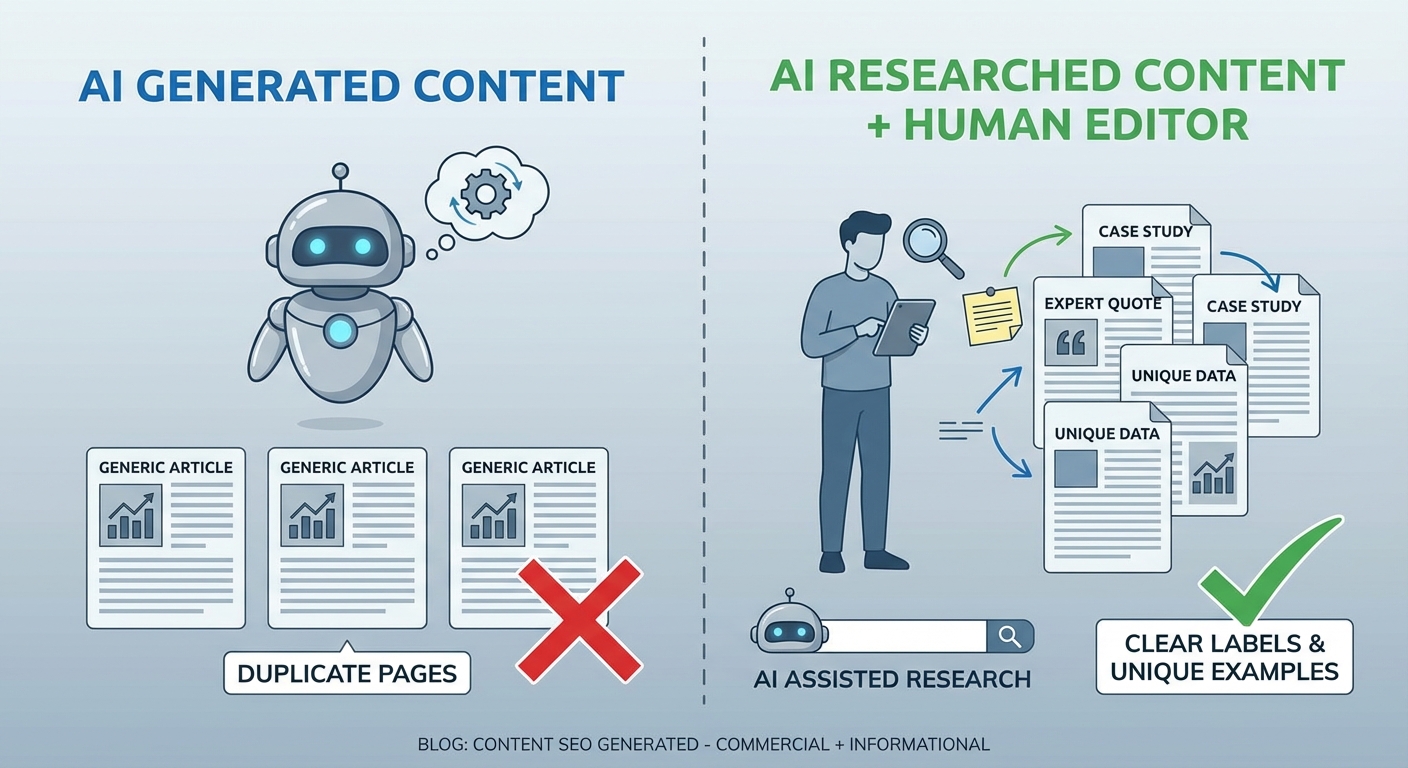
AI‑generated content means the AI writes most of the text you publish. You drop in a prompt, maybe tweak a few words, and ship. The voice, the structure, even the examples mostly come from the model. This can feel fast and cheap. It also tends to look the same as every other auto‑written page.
AI‑researched content is different. Here, humans stay in charge of the writing. AI only helps with research, briefs, and ideas. A writer then adds their own views, stories, and proof. The result has a human shape, but with more speed and better data underneath.
What changes in practice? AI‑generated pages often show flat tone, repeated sentence shapes, light facts, and no lived experience. AI‑researched pages usually have sharper angles, firm opinions, local details, and clear links to real sources and real people.
Google’s line is clear: it doesn’t use the method of content creation (including whether you used AI or not) as a direct ranking factor, and instead focuses on whether the final page is genuinely people‑first, helpful, original, and trustworthy. It ranks them on whether they are helpful, original, and trustworthy. Poor AI text tends to fail those tests, which is why many bulk‑AI sites rise fast, then fade just as quickly; as How Google Detects and Treats AI-Generated Content explains, …as How Google Detects and Treats AI-Generated Content explains, large‑scale, low‑value automation is increasingly treated as a form of “scaled content abuse” under Google’s spam policies and is more likely to be demoted or classified as search spam than simply ignored as neutral content.
How Google Actually Treats AI SEO Content in 2026
There is lots of fear around “Google penalties for AI”. Some of it is fair. Some of it is noise.
Here is the simple version. Google’s spam policies clearly ban using automation, including AI, when the primary purpose is to manipulate rankings with low‑value, thin content at scale—what Google calls “scaled content abuse”—while explicitly allowing automation and AI for creating helpful, high‑quality content. That is called scaled content abuse. If your plan is “auto‑publish 1,000 blog posts this month and hope some rank”, you are inside that danger zone already, as outlined in Google’s own AI content guidance.
At the same time, Google has said many times that AI content is not bad by default. What matters is the end result. Is the page correct? Does it show real experience? Is it safe to follow? A thoughtful article that uses AI only for research sits well inside those rules. A spammy site that relies on generic AI blurbs does not.
Google’s own guidance for creating helpful, people-first content pushes creators to think about “who” a page is for and “why” it exists—by asking things like whether you have an audience that would find the content useful and whether your site has a clear primary purpose—and its quality rater guidelines reinforce this by telling raters to determine the page’s purpose first and identify who is responsible for the site and the content. A real person with clear skills, a bio, and a reason to help users will usually look stronger than a faceless, pattern‑driven article that never names an author. Independent summaries such as Can Google Detect AI-Generated Content? 7 Tips to Avoid Penalization underline how closely these signals tie into trust and safety.
So the smart move in 2026 is not “never touch AI”. It is “never ship AI text without serious human shaping, proof, and ownership”. That is the line that keeps you safely away from spam systems while still enjoying the speed of good tools like Lyfe Forge’s AI content platform.
How to Spot Risky AI-Generated SEO Content (Before Google Does)
Most marketers can now “feel” AI content, even when they cannot fully explain why. But for a real workflow, vibes are not enough. You need a clear checklist.
Text that is mostly AI‑generated often shows the same signals again and again. Sentences sit at nearly the same length. Paragraphs start with the same stock phrases. Claims show up with no links, no dates, and no source names. Local language is a bit off. For an Australian page, that might mean US terms for legal rules or tax, or spelling that shifts back and forth.
AI‑researched, human‑written content looks different on the page. It has a distinct voice. It uses real numbers, real brands, and real people. It cites primary sources and government pages. It sometimes pushes back on a common belief instead of sitting on the fence. In other words, it behaves like something a focused person sat down and wrote for you, not for a bot.
Research on AI detection in academic writing shows how tricky this gets. Machine tools and humans both make a lot of mistakes when they try to say “this is AI” or “this is human” based only on style. That means you cannot run a detector once and call it proof. You must blend tools with human checks, and you must think about intent and risk, not just trace patterns. Studies such as Identification of Human-Generated vs AI-Generated Research Abstracts by Health Care Professionals show just how often even experts struggle with this line.
For your own brand, a quick, simple rule works well: if a draft feels flat, source‑light, and strangely repeat‑y when you read it out loud, treat it as AI‑heavy and rebuild it with stronger human input using an E‑E‑A‑T‑focused AI research workflow.
Why AI-Researched, Human-Written Content Wins Long-Term SEO
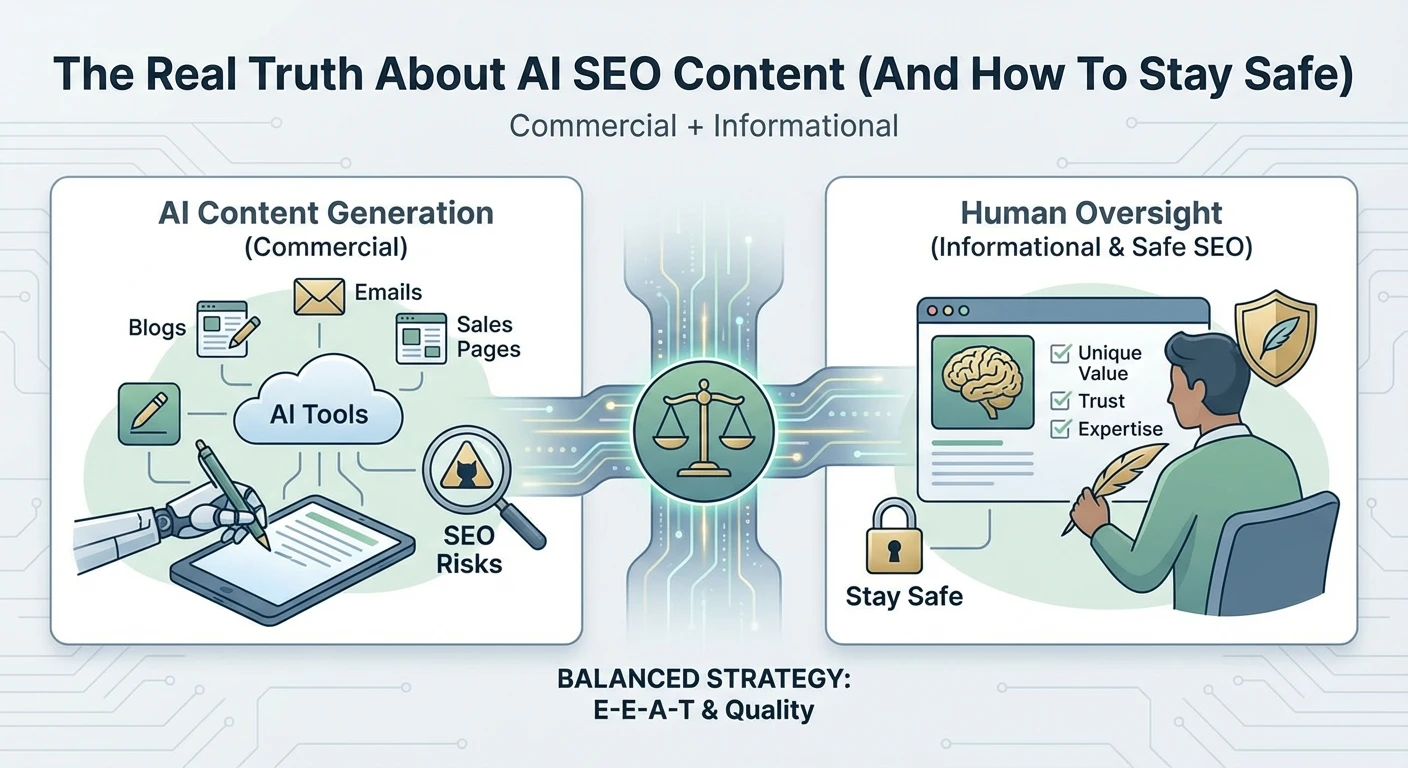
So why not just polish auto‑written text and hope for the best? Because in real search data, that approach tends to stall.
When a person leads the writing and uses AI only to support research, something important happens. However, some experts argue that “stall” might be too blunt a verdict. In certain niches, lightly editing AI‑generated drafts and shipping volume can still move the needle—especially for long‑tail queries, emerging topics, or brands starting from almost zero. Real‑world search data out of markets like Australia even shows pockets where high‑volume, semi‑templated content continues to rank and convert, at least until a stronger, more intent‑aligned competitor shows up. And on smaller sites with clean architecture and a focused topical footprint, that polish‑and‑publish approach can function as a decent bridge strategy (not a destination, but a runway) while more robust content systems, data integrations, and editorial processes are being built. So while the model does tend to plateau at scale, it’s not entirely obsolete—it’s just far less reliable as a long‑term growth engine in modern search. The language becomes less predictable. The flow shifts with the writer’s thought process. The page starts to include side stories, small jokes, and details that no model could guess, like how a rule plays out in a specific Australian city or niche.
Those touches feed straight into Google’s E‑E‑A‑T lens: Experience, Expertise, Authoritativeness, and Trust. First‑hand stories show experience. However, some experts argue this overstates the connection. Google’s own documentation is crystal clear that E‑E‑A‑T isn’t a literal ranking factor, but a lens for human quality raters—not a knob engineers twist in the algorithm. In the same vein, they’ve repeatedly denied using metrics like dwell time or click‑through rate as direct inputs. So those human “touches” aren’t beaming straight into some E‑E‑A‑T meter behind the scenes. Instead, the relationship is more oblique (but still powerful): richer, more lived‑in content tends to keep people reading, earns links, sparks shares, and attracts mentions in all the right places. And those downstream signals—engagement, references, backlinks—are exactly the kinds of ecosystem clues Google can observe at scale, even if it never sees the writer’s side joke about a quirky council rule in Brisbane. Clear explanations and correct facts show expertise. Strong sources and brand signals support authority. Honest tone and safe guidance build trust. Together, these signals give your content a much better chance to survive core updates.
The result is a kind of “hybrid” content that feels natural to both readers and ranking systems. It answers real questions deeply, avoids made‑up claims, and still gets out the door at a sane speed with platforms such as Lyfe Forge’s scalable pricing plans.
Simple Workflow: Use AI for SEO Research Without Losing Your Voice
You do not need a huge team to run a safe AI‑researched workflow. You only need a repeatable process and some discipline.
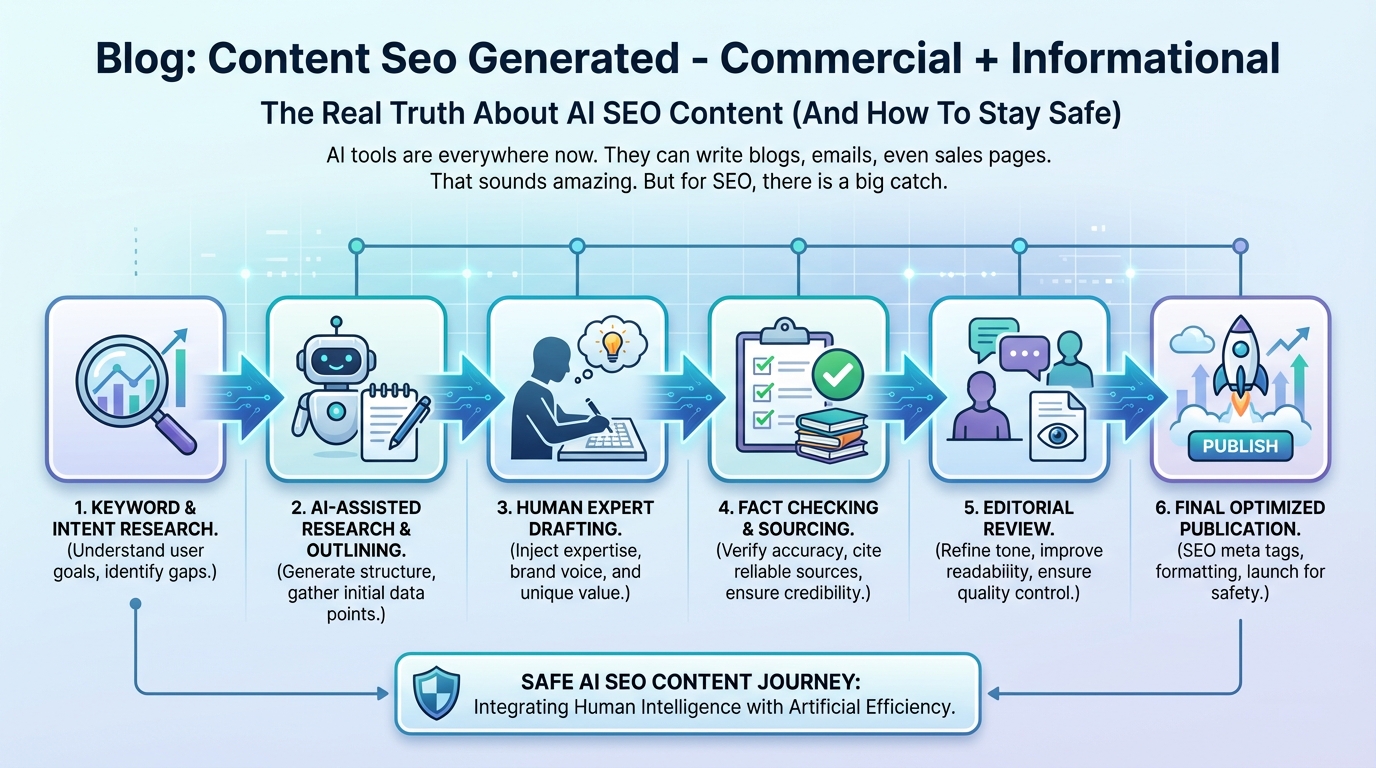
Step 1: Topic and keyword discovery. Start with AI‑powered SEO tools to map demand. Ask them for Australian searches, long‑tail phrases, and gaps in current results. Let the tools list ideas, then pick the ones that match your offers and buyers, using a platform such as Lyfe Forge as your central research hub.
Step 2: SERP and competitor scan. Drop your main keyword into an AI research tool and ask it to summarise the top pages. Look for patterns: what every result covers, and what nobody covers yet. Those gaps are where your content can stand out.
Step 3: Human‑first outline. Ask AI for a rough outline, then change it heavily. Move sections around. Add your own examples, frameworks, and local angles. Mark spots where you will bring in client stories or data.
Step 4: Draft by hand. Write the article yourself. Use your notes and research, but do not paste AI sentences into your draft. If you do borrow a line, rewrite it in your own words until it sounds like you, not the tool.
Step 5: Optimise and test. Once the draft feels right, run it through an SEO checker for headings, internal links, and missed questions. If you use an AI detector, treat the score as a hint, not a verdict; guides like Can Google Detect AI-Generated Content? are useful context, but your own judgment still leads.
This loop keeps AI safely in the “research assistant” box. It also turns every article into a small asset: something you can quote, update, or expand later without worrying that Google will treat it as low‑value spam, especially when your content lives inside a well‑structured site with clear resources like page sitemaps and post sitemaps.
Practical Tips to Choose the Right Content SEO Approach for Your Business

Now let’s bring this down to ground level. You have limited time and budget. Should you lean on AI writing tools, or build an AI‑researched system with human writers?
If you care mostly about speed and your niche is low‑risk, auto‑generation can look tempting. But remember the hidden cost. Thin content still needs editing, fact checks, and future rewrites when it does not rank. Often, that ends up slower and more costly than doing it well once.
If you care about long‑term traffic, brand trust, or complex topics like finance, health, or law, AI‑researched human content is the safer call. You stay inside Google’s rules, reduce the chance of dangerous errors, and build assets that earn links and mentions over time.
There is also a people factor. Teams who use AI just for drafts often start to feel replaceable. Teams who use AI for research and insight tend to feel sharper and more confident because the tools free them to think, not just to type faster. Purpose‑built platforms such as Lyfe Forge are designed to support that kind of empowered creative work.
Across industries, businesses that mix AI’s speed with strong human judgment see better quality and better stability in search. They still move fast, but they do not gamble their domain on auto‑content that may quietly drag rankings down; analyses like Study Looks to Distinguish Between Human and AI-Generated Content highlight why this balanced approach is becoming the norm.
Conclusion: Treat AI as Your SEO Research Engine, Not Your Ghostwriter
AI will keep getting better. That is a given. On the other hand, not everyone is convinced that AI’s upward trajectory is either smooth or guaranteed. Some experts argue that we’re already brushing up against hard constraints: skyrocketing compute costs, energy demands that make data centers political footballs, and a growing chorus of regulators eager to pump the brakes (or at least install speed bumps). They point out that Australia’s bullish investments and national AI plans signal intent, not inevitability—funding can be reallocated, public sentiment can sour, and breakthrough progress can stall for years at a time. And if models start generating more spam than substance, Google’s own defensive moves—stricter quality filters, harsher penalties, tighter crawl budgets—could effectively slow down how much of that ‘better’ AI actually reaches real users. In other words, while the momentum is undeniably strong, treating AI improvement as a foregone, linear conclusion glosses over the very real technical, economic, and ethical friction that could reshape the curve. But Google’s core rule will stay the same. It wants pages that help people, not pages that only help publishers.
If you treat AI as a cheap writer, you inherit all the risks of spam rules, weak E‑E‑A‑T, and brand damage. If you treat AI as a sharp research engine and keep humans fully in charge of the copy, you get the best of both worlds: speed and safety, especially when your tooling respects privacy through clear policies like the Lyfe Forge Privacy Policy and Cookie Policy, and operates under transparent Terms of Service.
Now is a good time to look at your own content SEO process. Where are you letting raw AI text slip through? Where could research tools support stronger, more honest writing instead? Tighten those gaps, and you’ll be in a much better place for the next wave of search changes – starting with an honest comparison of Lyfe Forge vs other AI content tools and an easy, free trial of the platform so you can see the difference in your own data.
Frequently Asked Questions
Is AI generated content bad for SEO?
AI content by itself is not bad for SEO. Google’s own guidance says AI is allowed as long as the final page is people‑first, helpful, accurate, and not created just to game rankings at scale. The real risk comes from low‑quality, lightly edited AI text that is thin, repetitive, or unoriginal. That type of content often gets hit in quality updates and can damage both rankings and brand trust.
What is the difference between AI generated content and AI researched content?
AI‑generated content is where the AI writes most of the final text, and you only do light editing before publishing. AI‑researched content uses AI as a support tool for research, outlining, and data gathering, while a human still crafts the narrative, examples, and opinions. In search, AI‑researched content tends to be more original, specific, and trustworthy. That makes it much safer over the long term for SEO and brand reputation.
Can Google detect AI written content and penalize my site?
Google focuses on the quality and purpose of your content, not on detecting whether a machine or human typed the words. If your pages are helpful, accurate, and clearly written for users, they are unlikely to be penalized just for using AI. Problems arise when AI is used for “scaled content abuse” – publishing lots of low‑value pages mainly to manipulate rankings. That kind of pattern can trigger manual actions or algorithmic demotions.
How do I safely use AI for SEO content without hurting rankings?
Use AI to support human writers, not replace them. Let AI handle topic research, SERP analysis, outlines, and idea generation, then have an expert write and heavily edit the final draft with real experience, data, and sources. Add unique angles, case studies, and brand voice that AI cannot invent reliably. Finally, run a quality check for accuracy, originality, and E‑E-A-T (experience, expertise, authoritativeness, trustworthiness) before publishing.
How can I tell if my AI content is too risky for SEO?
Look for signs like generic wording, repeated sentence patterns, vague claims without sources, and no lived experience or concrete examples. If multiple pages on your site read almost the same, just with a keyword swapped, that is a red flag for scaled AI content. You should also be wary if you can’t clearly explain who the content is for and what real problem it solves. When in doubt, have a subject‑matter expert revise and deepen the piece before it goes live.
Is human written content always better for SEO than AI content?
Not automatically—poor human content can be just as thin and low quality as bad AI text. What wins in SEO is content that is helpful, original, and trustworthy, no matter how it was produced. However, human‑driven content that uses AI only for research usually has more depth, nuance, and unique insights. That makes it more likely to survive core updates and build long‑term organic traffic.
What is a good workflow for using AI and humans together for SEO content?
A safe hybrid workflow is: research with AI and SEO tools, build a smart brief, then have a human expert write the first draft. Next, use AI to suggest structural improvements, missing questions, or clearer explanations, and then let a human editor fact‑check, refine voice, and add real stories and data. Finish with on‑page SEO optimization and internal linking done by an SEO specialist. Agencies like Lyfe Forge specialize in setting up and running this kind of workflow at scale.
How does Lyfe Forge handle AI in its SEO content services?
Lyfe Forge treats AI as a research and productivity tool, not a replacement for expert writers. Their team uses AI for competitive analysis, topic ideation, and brief creation, then has human writers and editors craft and refine the content. This keeps each piece aligned with Google’s people‑first guidelines and tailored to the client’s brand voice. The goal is to get the speed benefits of AI without the risk of generic, low‑trust content.
Should I rewrite my old AI generated articles to protect my SEO?
If older AI‑generated posts are thin, repetitive, or light on real value, it is smart to audit and improve them. Start with your highest‑traffic or most strategic pages and add expert input, original data, stronger examples, and clearer structure. In some cases a full rewrite is better than patching a weak base. A content partner like Lyfe Forge can help you prioritize which URLs to fix and design a safe upgrade plan.
How does AI researched content improve E-E-A-T for my website?
AI‑researched content frees your experts to focus on sharing real stories, data, and opinions instead of spending hours on basic research. Because the writer still controls the narrative, they can clearly demonstrate experience and expertise while linking to credible sources the AI helped surface. This combination of human insight plus well‑supported facts strengthens perceived authoritativeness and trust. Over time, that can improve how Google and users evaluate your brand.