

Anthropic Opens Claude Fable 5 Mythos to Paid Users
Table of Contents
- What Makes Claude Fable 5 a Mythos‑Class Enterprise Model
- Safety Routing, Data Controls and Enterprise‑Grade Governance
- Context Window, Long‑Horizon Work and Real‑World Use Cases
- Conclusion
Claude Fable 5 is Anthropic’s new Mythos‑class AI model. It is now available to paid and enterprise users. It brings the same core intelligence as Claude Mythos 5, but adds extra safety layers. That lets businesses use it without taking on extreme risk. For teams in Newcastle and across Australia, this unlocks real power for coding, research, legal work, and data‑heavy tasks. It also stays aligned with local expectations on security and governance. This article explains how Fable 5 works, where it differs from earlier Claude models, and how you can use it inside your own stack.
What Makes Claude Fable 5 a Mythos‑Class Enterprise Model
Claude Fable 5 is Anthropic’s first Mythos‑class model that is generally available. In simple terms, Mythos is the company’s top capability tier. It was previously kept for a small set of cyber and infrastructure partners. Fable 5 uses the same underlying model as Claude Mythos 5. It then adds enforcement layers that make it safe for broad commercial use. According to Anthropic’s official announcement, this model sets a new high bar for software engineering, knowledge work, long‑context reasoning, and vision tasks. It also sits at a lower price point than the old Mythos Preview.
For paid users, the headline features are clear. Fable 5 offers a 1 million token context window and up to 128k output tokens. It uses “adaptive thinking” only, which means it always runs in deep reasoning mode. It does not switch to lighter, fast‑draft passes. That suits long audits, complex refactors, or multi‑day projects. In those jobs, consistency matters more than saving a few seconds. Pricing on the Claude API and major cloud partners is USD $10 per million input tokens and $50 per million output tokens. That is aggressive for a frontier‑level model and makes Mythos‑class capability realistic even for mid‑size teams.
Fable 5 is also a product, not just an API endpoint. Anthropic positions “Claude Fable” as its main tool for long‑running, agent‑style knowledge and coding tasks. It is tuned for use in tools, workflows, and enterprise platforms. It is already turning up inside cloud ecosystems and specialised apps as the high‑end option. It targets customers who want Mythos‑level power but still need guardrails. If you think of Claude Sonnet as the day‑to‑day assistant, Fable 5 is the senior specialist you bring in for the hard problems.
Safety Routing, Data Controls and Enterprise‑Grade Governance
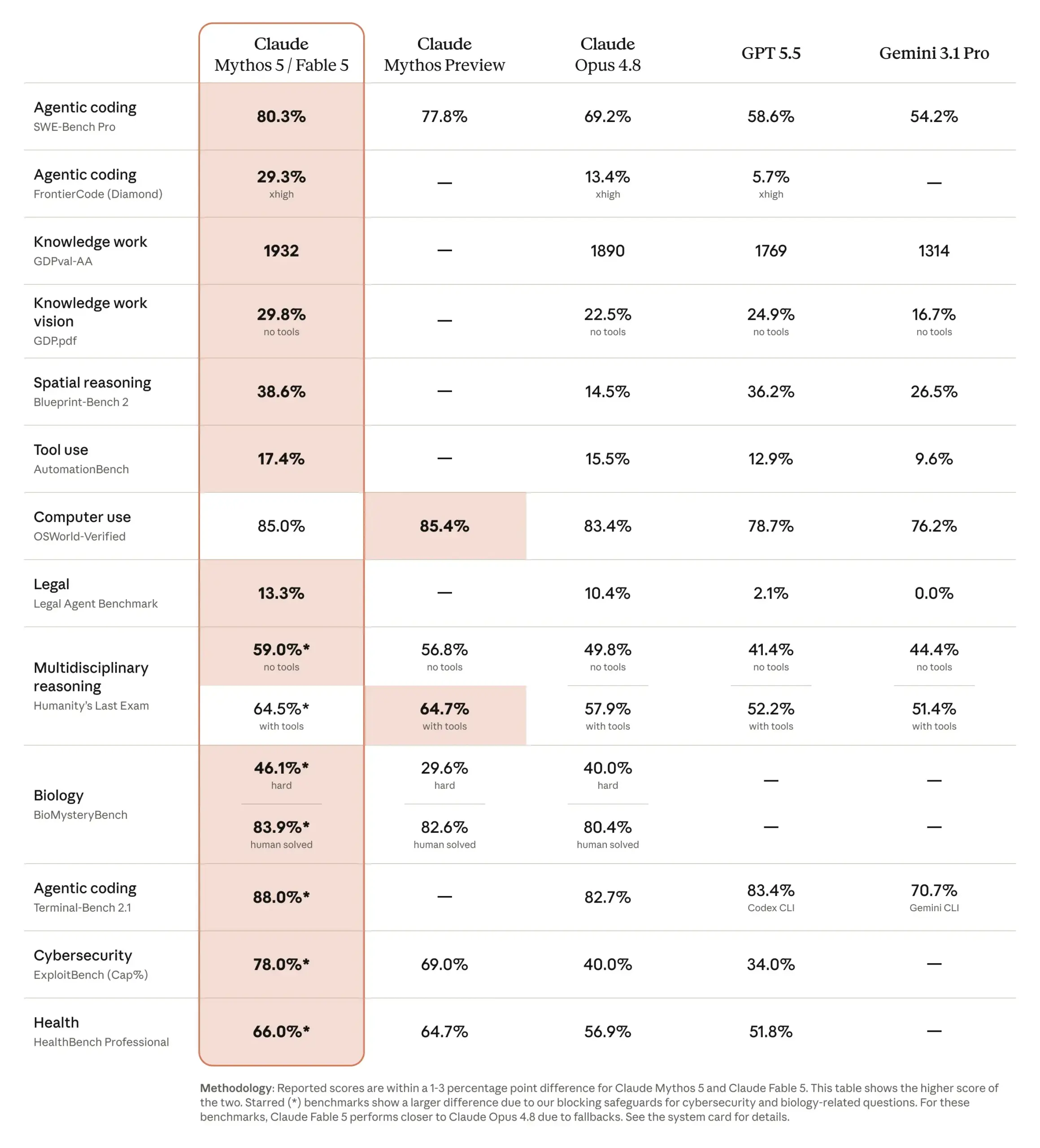
Making Mythos‑class AI available to regular paid users raises a clear concern. How do you stop it being misused? Anthropic’s answer with Fable 5 is a layered safety design. All prompts hit classifiers first. If they touch sensitive areas, the request is routed away from the Mythos core to Claude Opus 4.8. Those areas include offensive cybersecurity, dangerous biology or chemistry, or attempts to reverse engineer the model. This “fall back” approach lets typical business work run on Fable 5, while keeping high‑risk capability behind an extra gate. Independent coverage stresses that this routing is a deliberate guardrail, not a marketing extra.
Beyond routing, Anthropic treats Fable 5 as a “covered” model with stricter data rules. Business customer data sent to Claude is not used to train the underlying models. Mythos‑class traffic is subject to a mandatory 30‑day retention period. This is used for security review and abuse monitoring. That means there is no zero‑retention mode for Fable 5, even for large enterprises. For highly regulated teams in Newcastle – think financial services or health – that trade‑off can still work. A 30‑day, audit‑friendly log makes it easier to prove oversight under Australian guidance on AI and privacy. Local regulators care about clear data flows, monitoring and risk controls more than vague “we forget everything” claims.
Crucially, you seldom run Fable 5 in a vacuum. Anthropic has taken it to the big three clouds as a first‑class model. It is available on Amazon Bedrock, in Microsoft Foundry on Azure, and on Google Cloud’s Gemini Enterprise Agent Platform. That means your identity and access management, VPC isolation, audit logging, and data‑boundary controls come from the cloud stack you already trust. They do not come from a mystery SaaS box. For example, on Bedrock you can keep calls entirely inside an AWS Sydney VPC endpoint. On Azure you can pair Foundry with your existing role‑based access and data residency settings.
That cloud‑first strategy fits with Anthropic’s direct work with the Australian Government on AI safety and research. A formal memorandum of understanding sets expectations around safe deployment, monitoring and responsible scaling of powerful models. This is exactly the sort of framework large Australian organisations want to see behind any “frontier” AI assistant. For CIOs and CISOs, it means Fable 5 is not arriving in Australia as a wild experiment. It is part of a public, negotiated approach to safety.
Context Window, Long‑Horizon Work and Real‑World Use Cases

For most paid users, the change they feel day to day is not the system card. It is the sheer amount of work Fable 5 can hold in its head. A 1M‑token context window is enough to load a full policy library or a decent‑sized codebase. It can also hold a stack of contracts the height of a coffee mug. That means you can treat Fable 5 more like an actual team member with the whole project in front of it. You do not need to drip‑feed tiny snippets. Official docs highlight that this context applies across text, files and images. You can get up to 128k tokens in a single answer. That is plenty of space for detailed plans, multi‑file diffs and step‑by‑step strategies.
Anthropic’s launch material leans hard into long‑horizon “agentic” work. This means letting Fable 5 stay with a complex job across many steps and even many days. You might start by loading a messy SharePoint of Word docs and PDFs. You could then ask it to map all the policies that touch data handling. Next, you refine those into an updated standard that matches OAIC guidance. Or you might pull in a monorepo and have it outline technical debt risks. You can then work through refactors section by section while it keeps the overall architecture in view. For a Newcastle dev shop, that can feel like bringing in a very patient senior engineer. This engineer never gets bored of code review.
The model’s reach now extends deep into tools your team probably already uses. Microsoft has announced Claude Fable 5 as an agent engine inside Foundry and GitHub Copilot. It powers hands‑on coding and workflow automation. On Databricks, it sits behind the Unity AI Gateway. That gives data teams a single, governed entry point to run advanced analysis and documentation tasks. Legal‑tech players like Harvey also expose Fable 5 for drafting, review and research, again inside a governed wrapper. Instead of building your own orchestration from scratch, you can pick the surface that suits your team. That might be an IDE, a notebook, or a chat console.
Where does this leave earlier Claude models and rival platforms? In simple terms, Sonnet and Haiku now look like mid‑tier options. They suit day‑to‑day chatting, drafting and lighter analysis. Fable 5 is what you reach for when the work itself is critical. That includes production code, finance models, or high‑stakes advice that must align with Australian rules and internal policies. Competing large models from OpenAI or Google can match some benchmarks, but Anthropic is betting on its safety‑first Mythos strategy. It pairs that with deep government engagement. This mix should appeal to organisations who want power without losing sleep. For Newcastle businesses trying to move faster without blowing up their risk register, that is a very tempting offer.

Conclusion
Claude Fable 5 opening up to paid users marks a major moment. Mythos‑class intelligence is finally packaged for mainstream business use. With safety routing, clear data policies, cloud‑native governance and a giant context window, it feels ready for serious work in Australian organisations. The next step is simple. Start small – pick one messy, high‑value workflow and trial Fable 5 inside your current stack. Then scale what works. The teams who “get on it early” will shape how Mythos‑class AI shows up in offices from Newcastle CBD to your own meeting room.
Frequently Asked Questions
What is Claude Fable 5 Mythos and how is it different from other Claude models?
Claude Fable 5 (Mythos) is Anthropic’s new top‑tier enterprise AI model that uses the same underlying system as Claude Mythos 5, but with extra safety and enforcement layers. Compared with earlier Claude models, it offers much stronger long‑context reasoning, better performance on coding and knowledge work, and tighter guardrails for business use. It’s also positioned as a product for long‑running, agent‑style tasks, not just an API endpoint.
Who can access Claude Fable 5 and do I need to be a paid user?
Claude Fable 5 is available to paid and enterprise users via Anthropic and major cloud partners. Free users don’t get full access to Mythos‑class capabilities, so you’ll need a paid plan or enterprise agreement to use Fable 5 in production. Agencies like Lyfe Forge can also help Australian teams get set up without managing all the infrastructure themselves.
How much does Claude Fable 5 cost per token?
According to Anthropic’s pricing, Claude Fable 5 is billed at around USD $10 per million input tokens and $50 per million output tokens via the Claude API and supported cloud platforms. This is aggressive pricing for a frontier‑level Mythos‑class model, making it viable for mid‑sized teams that previously couldn’t afford high‑end AI. Lyfe Forge can help estimate usage and costs for your specific workflows so you don’t overspend.
What can Claude Fable 5 be used for in a business setting?
Claude Fable 5 is designed for heavy knowledge work like coding, research, legal analysis, and data‑intensive tasks. Its 1 million token context window makes it ideal for long audits, complex refactors, and multi‑day projects where you need consistent reasoning over large document sets or codebases. Lyfe Forge helps teams in Newcastle and across Australia embed Fable 5 into internal tools, workflows, and platforms so staff can use it safely day‑to‑day.
How does Claude Fable 5’s 1 million token context window help my team?
A 1 million token context window means Claude Fable 5 can ingest and reason over massive inputs like entire code repositories, contract libraries, or multi‑year project archives in a single session. This reduces the need to manually chunk documents or constantly re‑explain context, which saves time and improves accuracy. Lyfe Forge can design prompts and data pipelines that take full advantage of the long context without blowing out costs.
What is adaptive thinking in Claude Fable 5 and why does it matter?
Claude Fable 5 uses “adaptive thinking only,” meaning it always runs in deep reasoning mode instead of switching to a faster, shallow draft mode. This trades a bit of speed for more reliable, consistent outputs on complex tasks like audits, refactors, and strategic analysis. For businesses, that consistency is crucial for trust and compliance, and Lyfe Forge can tune workflows so you get the depth you need while keeping runtimes practical.
Is Claude Fable 5 safe to use for legal, compliance, and sensitive data work?
Fable 5 adds extra safety and enforcement layers on top of the Mythos 5 core model, which is specifically designed to reduce extreme risks in enterprise environments. It’s built to align with security and governance expectations, including stricter handling of sensitive topics and safer tool use. Lyfe Forge complements this with access controls, data‑segregation patterns, and audit trails tailored to Australian privacy and compliance standards.
How does Claude Fable 5 compare to Claude Opus or Sonnet for enterprise use?
Compared with general models like Opus or Sonnet, Claude Fable 5 sits at the top capability tier (Mythos‑class) and is optimised for long‑context, high‑stakes tasks. It offers deeper reasoning over much larger inputs and more robust safety layers, though it may be more expensive and slightly slower than lighter models. Lyfe Forge typically combines Fable 5 with cheaper models, routing routine queries to mid‑tier models and reserving Fable 5 for the hardest work.
How can my Australian business integrate Claude Fable 5 into our existing stack?
You can access Claude Fable 5 through the Claude API or supported cloud providers, then hook it into your apps, internal tools, or data warehouse. This usually involves setting up authentication, prompt patterns, context‑building pipelines, and logging. Lyfe Forge specialises in doing this for teams in Newcastle and across Australia, handling integration, guardrails, and monitoring so you don’t need an in‑house AI engineering team.
Can Lyfe Forge help us pilot Claude Fable 5 before a full rollout?
Yes, Lyfe Forge typically starts with a contained pilot focusing on 1–3 high‑value use cases such as code review, policy summarisation, or research assistance. They help you design prompts, measure quality and cost, and collect staff feedback, then scale into more teams if the results are strong. This approach lets you prove value with Fable 5 and refine governance before committing to a larger deployment.