
Table of Contents
- How AI Website Scanning Identifies Critical On-Page SEO Issues
- Inside AI SEO Website Scanners: How They Crawl and Diagnose
- What “Critical” On-Page SEO Issues Look Like in AI Audit Reports
- Content, E-E-A-T and “Thin Page” Detection with AI Scanners
- Choosing AI SEO Tools and Building a Hybrid Workflow
- Conclusion: Turn AI Scans into a Real SEO Advantage
How AI Website Scanning Identifies Critical On-Page SEO Issues
When your site stops ranking, it is rarely one big mistake. It is usually dozens of small issues hiding in your pages. That is where AI website scanning comes in. Modern AI SEO scanners crawl your site the way search engines do, then layer machine learning over the data to surface the most critical on-page SEO problems fast.
At Lyfe Forge, we see this as the new baseline for serious SEO in Australia. Instead of waiting for traffic to drop, you can run regular automated scans, get a prioritised issue list, and fix what matters before Google does. In this guide, you will learn what these AI scanners actually check, how they rank issue severity, and how to use them to choose the right AI content and SEO tools for your business.
Inside AI SEO Website Scanners: How They Crawl and Diagnose
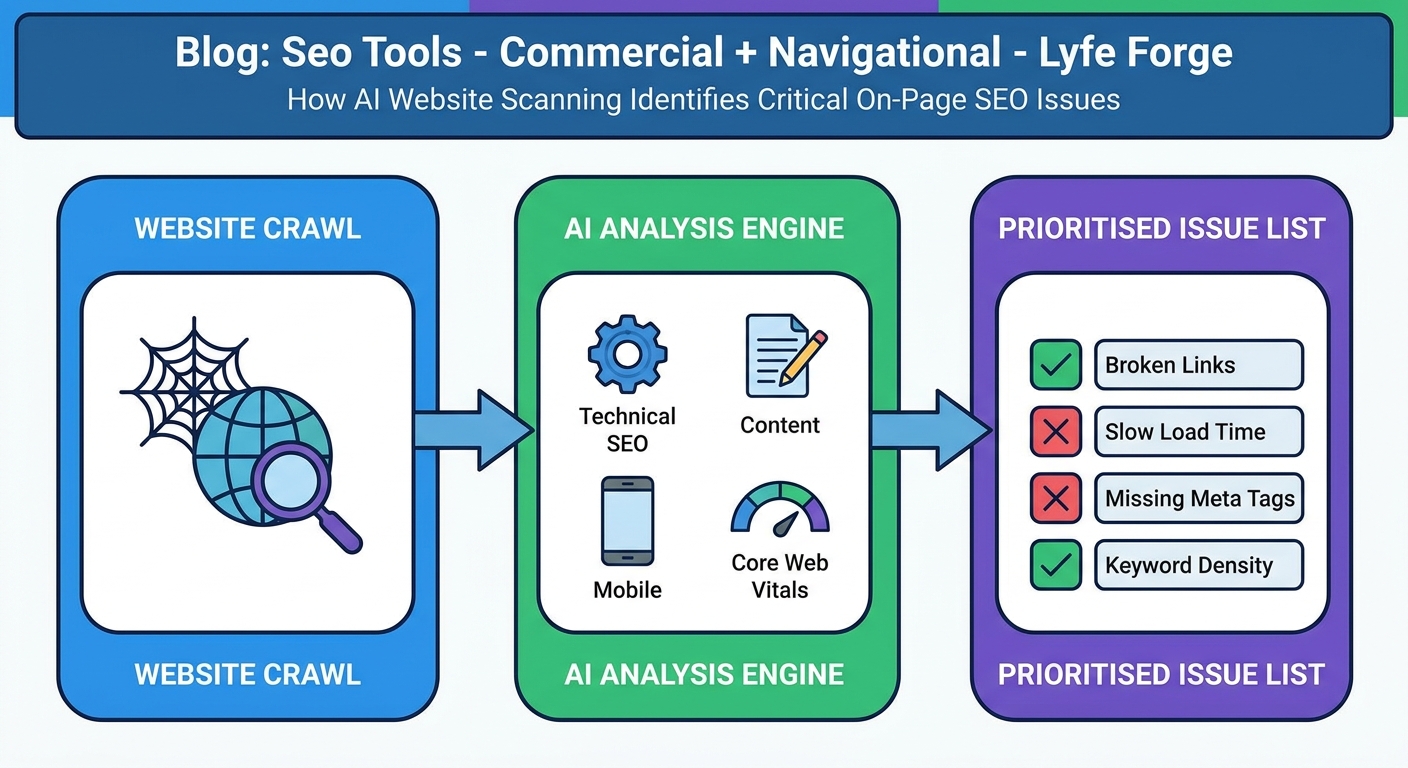
AI SEO website scanners typically run through a multi-step workflow rather than a fixed three-step formula. First, they crawl your site, pulling page content, URLs, titles, headings, internal links, and indexability signals. This mirrors what search engines do, but you get the data in a dashboard you control. Tools like SE Ranking’s On-Page Checker analyse pages against dozens of factors in one pass, cutting out a lot of manual digging. SE Ranking’s breakdown of its On-Page Checker shows how this kind of crawl consolidates technical and content signals into one report.
Next, they run multi-parameter analysis. Instead of checking a few basics, modern scanners can assess dozens of parameters across content, technical SEO, and user signals. That includes title and meta length, keyword usage, heading structure, URL format, broken links, redirects, mobile-friendliness, Core Web Vitals indicators, HTTPS, and schema gaps. SE Ranking notes that its checker grades each page and highlights specific on-page changes that are likely to move the needle, based on real ranking factors and best practices. seranking.com/blog/on-page-seo-checker-upda…
Finally, AI layers on interpretation. Instead of handing you a raw error list, the scanner will score each page, group problems by type, and assign issue severity labels such as error, warning, or notice. That is a crucial step. It prevents your team from wasting time on cosmetic tweaks while serious crawlability or indexability problems sit untouched.
For Australian businesses, this level of automation is especially useful when you are managing dozens of service pages or locations. An AI scanner can sweep your entire site in one go and flag which URLs are holding back your organic visibility, without needing a technical SEO specialist on staff for every check. It becomes your always-on diagnostic engine.
If you want to see this in action, our AI SEO content safety and audit approach uses similar multi-step crawling and analysis but pairs it with human review, so recommendations match your brand and market.
What “Critical” On-Page SEO Issues Look Like in AI Audit Reports
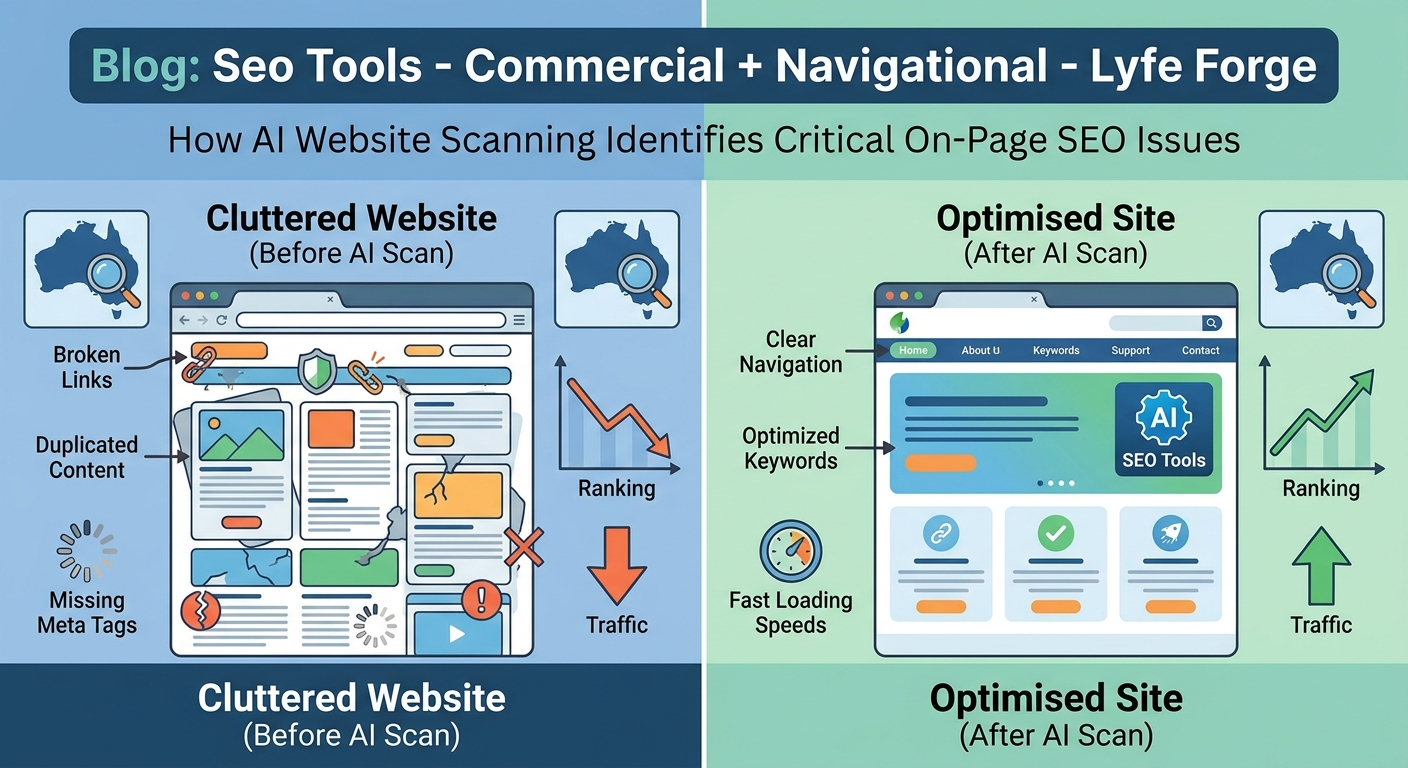
Not every problem flagged in an AI scan deserves the same attention. Most tools now use a severity model that lines up with how search engines treat different issues. This helps you fix what truly threatens rankings first, then tidy everything else later.
Critical issues are the ones that can stop Google from accessing or trusting a page. Think blocked URLs in robots.txt, “noindex” tags on important pages, persistent 5xx server errors, or broken canonical tags on key templates. Technical SEO guides from SE Ranking emphasise that issues in these areas are fundamental to crawlability, duplicate content management, and reliable indexing, and that neglecting them can lead to large‑scale duplication problems or, in more serious cases, pages dropping out of search results entirely.[1][2][3] seranking.com/blog/on-page-seo-guide/
High-priority issues come next. They might not de-index a page, but they hurt user experience and search performance. Examples include slow page speed on mobile, clumsy internal linking that leaves valuable pages orphaned, missing or weak title tags on core commercial URLs, and poor mobile layout. In a market where Google dominates Australian search, shaving seconds off load times and clarifying page intent can mean the difference between sitting on page two and holding a steady top-three position.
Medium and low-priority issues are still worth addressing, just not immediately. Missing meta descriptions, minor heading hierarchy quirks, some duplicate content instances, and unoptimised image filenames all fall into this bucket. Many AI scanners let you filter by severity and page type, so you can, for example, clean up meta fields across all product pages once the big blockers are gone.
For busy marketing teams, this triage view is gold. It turns a giant error dump into a clear to-do list that aligns with business goals. If leads come mostly from your service pages, you can focus effort there instead of chasing minor HTML warnings on your blog.
To go deeper on how we prioritise fixes, explore our structured technical SEO and AI content workflows approach, built for Australian brands that need clarity, not chaos.
[1] atdigital.io [2] firstpage.com.au [3] clutchdigital.com.au
Content, E-E-A-T and “Thin Page” Detection with AI Scanners

Technical health is only one side of on-page SEO. AI website scanners now spend just as much energy on content analysis, because that is where rankings are won for competitive terms. They check keyword targeting, topical coverage, structure, and depth in a way that used to take hours per URL. Guides on E-E-A-T in the age of AI underline how closely this analysis now mirrors what modern search systems reward.
Many platforms mix crawl data with Google Analytics and Search Console metrics to flag likely thin content. Pages with very low word counts, high bounce rates, short time on page, and impressions but almost no clicks are common candidates. Case studies and agency experience show that using these combined signals, AI can often highlight pages that are likely not matching search intent or providing enough value, even if they look fine at a glance, although this isn’t yet backed by large-scale, independent industry research. seranking.com/blog/on-page-seo-guide/
Scanners also look for signals tied to Google’s E-E-A-T framework: Experience, Expertise, Authoritativeness, and Trustworthiness. They cannot “know” if your business is an expert, but they can check for concrete markers: author bios, clear sourcing, first-person case studies, original images, and references from reputable sites. One industry analysis of AI-powered search engines, based on 2,400 AI Overview citations reported by the AI search platform Wellows[4] and echoed by multiple SEO sources,[5] estimates that roughly 96% of the sources these systems surface show strong E-E-A-T signals, effectively turning those signals into a de facto gatekeeper for visibility.[6] www.clickpoint.com.au/blog/e-e-a-t-as-a-ranking-sig…
For Australian companies, this matters both in Google’s standard results and in newer AI-generated answers. If your content lacks trust markers, your brand is less likely to appear when users ask complex questions about pricing, regulations, or local services. An AI scanner that audits E-E-A-T signals can show you where to add proof, such as case studies, credentials, or clear contact details.
Our own AI-powered content optimisation workflow taps into these same ideas. We combine AI-driven thin page detection with manual review to decide whether a page needs a light refresh, a full rewrite, or should simply be merged into something stronger.
Choosing AI SEO Tools and Building a Hybrid Workflow
Once you understand what AI scans can see, the next step is choosing the right tool stack. In Australia, businesses typically look at a mix of classic SEO suites and newer AI-focused platforms. Reviews of tools like Semrush and Ahrefs describe them as powerful but complex, often best suited to agencies and in-house specialists who can invest time in mastering them. Meanwhile, products such as SE Ranking or other AI-first platforms pitch themselves as more accessible for owners and marketers who want guided workflows rather than dashboards full of raw data. this overview of SEO tools for Australian businesses outlines key trade-offs between them.
Whatever you choose, AI should amplify human expertise, not replace it. Multiple Australian agencies and AI SEO guides increasingly argue that the best results come from a hybrid model. AI handles crawl automation, issue clustering, and pattern spotting, while humans bring strategic judgement, local knowledge, and brand voice. This balance is especially important in a market shaped by local slang, suburbs-based search, and strict consumer law around truthful claims. Google’s Vertex AI Search documentation echoes this hybrid expectation.
In practice, a solid workflow looks like this. Run an AI scan across your site monthly or after major deployments. Sort issues by severity and by revenue impact: home, category, and lead pages first. Have a specialist (internal or external) sanity-check the top issues, then push fixes through your dev or content teams in batches. For simpler tasks, such as mass meta description improvements or alt-text generation, you can safely lean on AI suggestions and lightly edit them for tone.
If you need help mapping all this to a roadmap, our SEO strategy packages are built around this hybrid approach. We use AI to surface the data, then apply human judgement to decide where your next dollar of effort should go.
Conclusion: Turn AI Scans into a Real SEO Advantage
AI website scanning gives Australian businesses a clear view of on-page SEO issues that once took days or weeks to uncover. By crawling your site, ranking issue severity, and evaluating both technical and content signals, these tools turn a messy audit into a sharp, prioritised plan. Platforms like Lyfe Forge’s internal linking workflows for AI content make sure the fixes you ship actually support long-term visibility.
The key is what you do next. Pair AI-driven insight with human strategy, focus on truly critical issues first, and choose SEO tools that match your team’s skills and goals. If you are ready to see what AI scanning could reveal on your own site, explore Lyfe Forge’s SEO ROI calculator and Australian AI content platform before you book a walkthrough with our team.
[4] godofprompt.ai [5] tryprofound.com [6] wellows.com
Frequently Asked Questions
What is AI website scanning for SEO and how does it work?
AI website scanning is the process of using automated crawlers and machine learning to audit your site the way search engines do. The scanner collects data on your URLs, content, titles, headings, internal links, and technical signals, then uses AI to interpret that data, score each page, and highlight the most critical on-page SEO issues to fix first.
What on-page SEO issues can AI website scanners detect?
AI SEO scanners can detect missing or poorly written title tags and meta descriptions, weak keyword usage, and broken or redirected links. They also flag issues like poor heading structure, slow page speed, mobile-friendliness problems, Core Web Vitals warnings, HTTPS or security gaps, and missing or incorrect schema markup.
How does AI decide which SEO issues on my website are critical?
AI tools assign severity levels such as error, warning, or notice based on how strongly an issue is known to impact rankings and user experience. For example, crawlability and indexability problems, broken pages, or missing HTTPS will usually be prioritised above smaller issues like minor title length tweaks or low-priority warnings.
How is AI SEO website scanning different from a normal SEO audit?
A traditional SEO audit often involves manual checks or basic tools that list errors without context. AI scanning not only crawls your site but also interprets the data, compares it against best practices and ranking factors, and gives you a prioritised, page-level action plan instead of a flat, overwhelming error list.
How often should I run an AI SEO scan on my website?
Most small to medium businesses benefit from running AI SEO scans at least once a month, or after any major site changes. Larger or frequently updated sites, such as ecommerce or multi-location service businesses, should consider weekly scans so issues are caught and fixed before they hurt traffic and rankings.
Can AI website scanning help my Australian business manage multiple service or location pages?
Yes, AI scanners are particularly helpful for Australian businesses with many service areas or location pages because they can audit the entire site in one pass. The tool will show which specific URLs have serious on-page or technical issues, so you can quickly prioritise fixes for your most important service or location pages.
Which AI SEO tools does Lyfe Forge recommend or work with?
Lyfe Forge works with reputable AI-driven SEO platforms such as SE Ranking’s On-Page Checker and similar tools that combine content and technical analysis in one report. We pair these scanners with our own AI content and SEO workflows to interpret the results and turn them into clear, actionable changes for your site.
Can Lyfe Forge run an AI SEO scan for my website and help fix the issues?
Yes, Lyfe Forge can perform a full AI-powered website scan for your site, then translate the findings into a prioritised list of fixes for your pages. Our team can then implement or guide on-page improvements to titles, content, internal links, technical setup, and schema so your site is better aligned with how Google actually ranks pages.
How do I use AI website scanning results to improve my content strategy?
Start by focusing on pages that the AI scanner scores lowest or marks with critical errors, especially high-traffic or money pages. Then use the tool’s specific recommendations on keyword usage, heading structure, and content gaps to rewrite or expand those pages, aligning them with the topics and search terms your audience actually uses.
Is AI website scanning enough on its own for SEO, or do I still need an SEO agency like Lyfe Forge?
AI scanning is powerful for finding and prioritising issues, but it doesn’t replace strategic thinking, content planning, or nuanced technical fixes. An agency like Lyfe Forge uses AI data as a foundation, then adds human expertise to set strategy, create high-quality content, resolve complex technical problems, and align SEO with your wider business goals.