
Table of Contents
- Introduction: Why Internal Linking Still Wins in an AI World
- Internal Linking Foundations for AI‑Generated SEO Content
- Topic Clusters vs Silos: Internal Linking for AI‑Driven SEO
- Anchor Text Strategy for Scalable AI Internal Linking
- Baking Internal Linking into Your AI Content Workflow
- AI Tools vs Manual Internal Linking: A Hybrid Strategy
- Practical Internal Linking Tips You Can Use This Week
- Conclusion: Turn AI Content into a Connected Asset, Not a Content Dump
Introduction: Why Internal Linking Still Wins in an AI World
Internal linking for AI content sounds boring on the surface. But if you’re scaling blog posts and landing pages with tools like Lyfe Forge, it quietly decides whether that content ranks… or disappears into the void.
In an AI‑first search world, search engines and LLMs need clear paths through your site. Internal links help define those paths. They show how your ideas connect, which pages matter most, and where your real expertise lives, which is why specialists in SEO keep treating internal links as a core ranking lever even as algorithms evolve.
This guide shows you how to turn internal linking from a messy afterthought into a built‑in part of AI‑driven production. You’ll learn how to use topic clusters instead of rigid silos, design smarter anchors, and hard‑wire linking steps into your content workflow so it scales with every new article, not just a handful, especially when that content runs through a dedicated AI platform like the Lyfe Forge blog engine.
https://www.llmvisibilty.com/blog/internal-linking-strategies
Internal Linking Foundations for AI‑Generated SEO Content
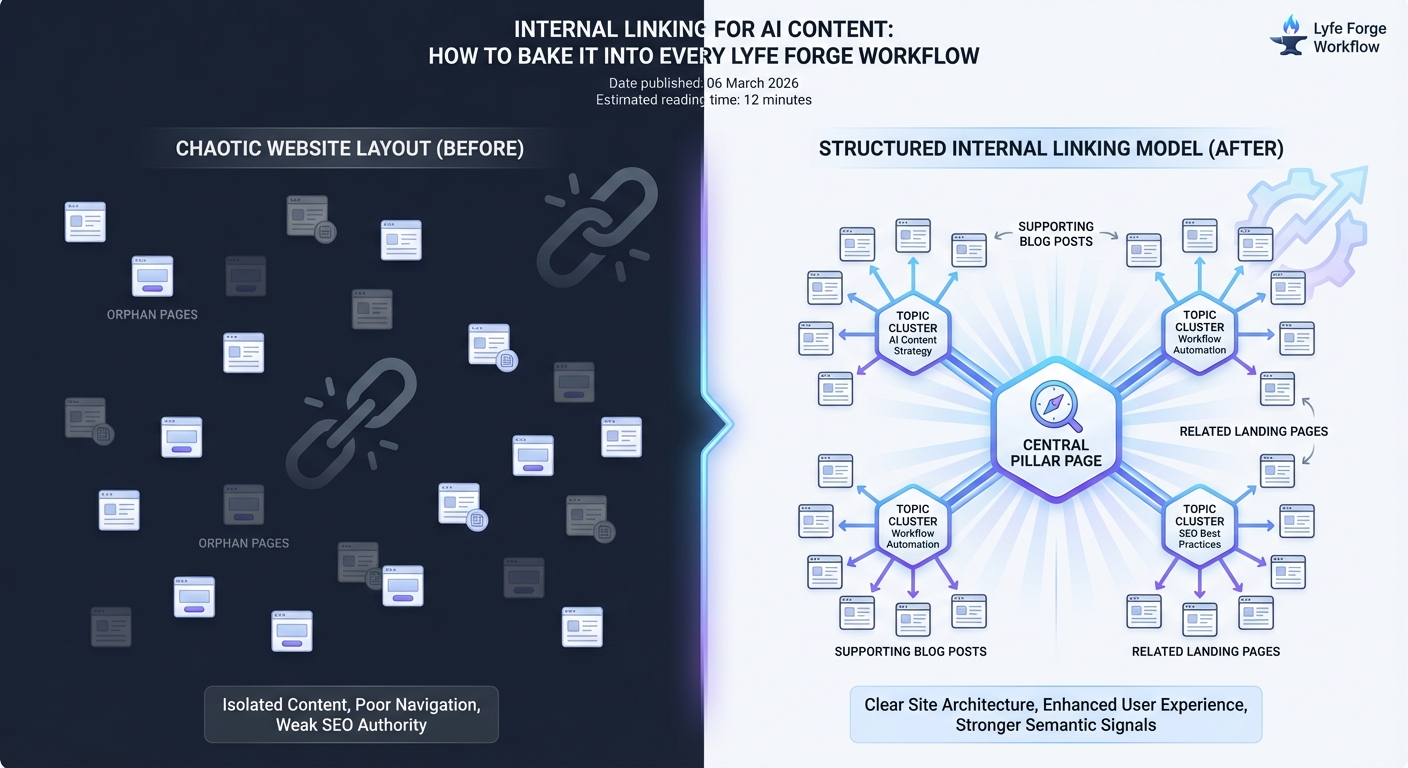
An internal link is just a hyperlink from one page on your site to another page on the same domain. In AI‑generated content, the stakes are higher because AI can churn out hundreds of posts that never properly connect to anything, unless your overall content strategy deliberately bakes in structure.
When that doesn’t happen, you get “orphan pages” – URLs that have no meaningful internal links pointing to them from elsewhere on your site. Search bots are much less likely to discover them reliably. AI crawlers like Googlebot and GPT‑style systems may struggle to fully understand how isolated pages fit into your broader story, which can make them less likely to surface those URLs in summaries, answer boxes, or chat‑like results, especially when the content doesn’t clearly map to specific queries or themes. They basically sit in the dark, even if they’re technically present in a sitemap such as your post index.
Internal links solve this by acting like roads inside a city. They guide both people and bots from stronger, higher‑authority pages to newer or more niche articles. That flow spreads what SEOs call link equity, so your fresh AI pages don’t start from zero every time. According to independent SEO research, well‑planned internal links improve crawlability and signal stronger topical understanding across a whole site, not just single URLs.
There’s no fixed magic number for internal links, but a useful guide is 2 – 5 contextual links per 1,000 words, as long as each one is relevant. While there’s no evidence of a universal ‘traffic peak’ at a specific link count, many SEO practitioners note that keeping total links per page (including nav) to a reasonable number and avoiding excessive linking—often cited around or above the ~150 mark—can help prevent diluting PageRank and overwhelming users. Quality first, then quantity, as echoed in broader internal linking best‑practice guides.
https://surferseo.com/blog/seo-internal-linking
https://inblog.ai/blog/how-many-internal-links-per-page-seo
Topic Clusters vs Silos: Internal Linking for AI‑Driven SEO
Old‑school SEO loved silos: strict folder‑like structures where content stayed inside tidy walls. That model struggles in an AI‑driven landscape. LLMs don’t think in folders; they think in webs of meaning. That’s why topic clusters are a better fit for internal linking today, especially when you’re managing them inside a centralised AI content hub like Lyfe Forge.
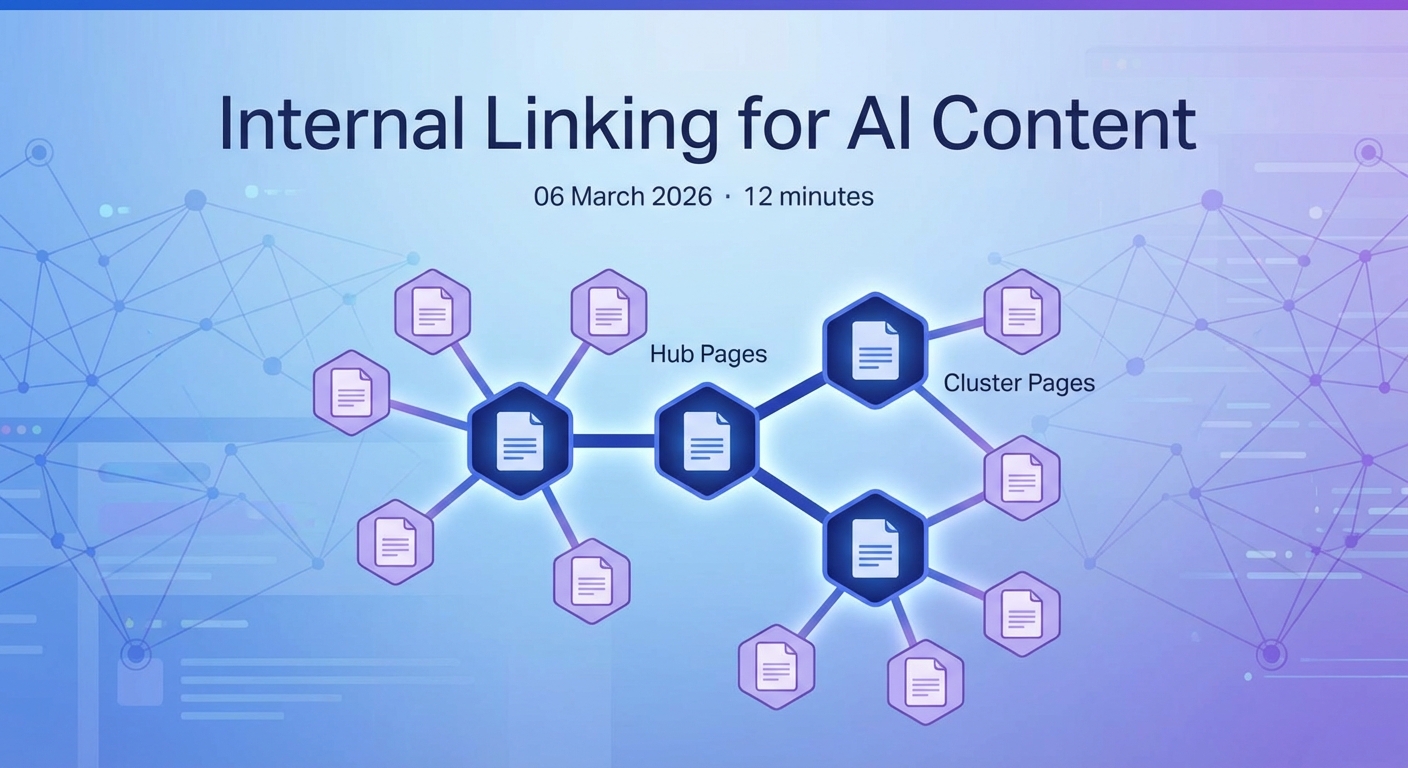
A topic cluster is a hub‑and‑spoke setup. You create a pillar page that covers a broad theme (say, “AI SEO for Australian brands”). Around it, you publish focused cluster articles like “Internal linking strategies for AI content,” “AI topic clusters for SaaS,” and “Scaling content briefs with LLMs.” Each of these cluster pieces links back to the pillar and sideways to each other wherever it makes sense, following the same principles outlined in modern internal linking playbooks.
For AI and LLM‑driven search, this creates a semantic web. Strong clusters help models infer relationships between entities, phrases, and questions. Emerging research and expert consensus on AI SEO topic clusters indicate that this style of interlinking can improve recall in retrieval‑augmented systems and increase the chances of being cited in generative search experiences, compared with rigid, isolated silos.
From a practical angle, try to keep important pages within three clicks of your homepage or main hubs. That shallow click depth makes it easier for crawlers to reach your best money pages and for users to move from broad guides to specific solutions. When you publish new AI articles, ask: “Which pillar does this belong to?” Then link both ways on day one, instead of leaving it floating.
You can also use this cluster model to support product funnels. For example, a pillar on “Marketing automation in AU” can drive link equity and traffic into key conversion pages, simply by ensuring every cluster article routes visitors towards a core demo, pricing, or onboarding page at the right moment, in the same way your own AI platform pricing pages should sit at the heart of related clusters.
https://rathoreseo.com/blog/ai-seo-topic-clusters-internal-linking
https://zcmarketing.au/seo-tips/llm-internal-linking-2025
https://www.llmvisibilty.com/blog/internal-linking-strategies
Anchor Text Strategy for Scalable AI Internal Linking
Anchor text is the clickable text in a link. In AI‑scale content, this tiny detail does a lot of heavy lifting. It tells search engines and LLMs what the linked page is about, and it shapes how users expect that page to help them, which is why AI‑focused SEO teams invest so much care into how anchors are phrased.
Strong anchor text is descriptive and specific. Instead of “read more,” write “see our AI internal linking checklist.” Instead of “here,” write “learn how to build topic clusters for SEO.” This makes it easier for algorithms to understand context and boosts the odds that your content gets pulled into AI answers for those queries, including when those anchors lead to cornerstone resources such as your central AI content guides.
The catch is over‑optimisation. If every link to a page uses the exact same keyword‑stuffed phrase, it can start to look spammy. Research from Surfer and other SEO teams suggests using a mix: partial match phrases, synonyms, intent‑based anchors, and even natural language like “this guide on scaling internal links with AI tools.” Variety looks organic and still sends clear topical signals.
For AI‑generated drafts, you can nudge the model by including anchor rules in your prompt library. For example: “Use descriptive, varied anchor text that explains what the reader will get after clicking, and avoid generic phrases like ‘click here’.” Then run a quick human pass to fix any clunky sentences or anchors that feel forced. Also place key internal links higher on the page, near strong claims or definitions, where LLMs are more likely to latch onto them when building summaries, particularly if those links point to important governance pages like your Terms of Service or privacy policy.
https://surferseo.com/blog/seo-internal-linking
https://zcmarketing.au/seo-tips/llm-internal-linking-2025
Baking Internal Linking into Your AI Content Workflow
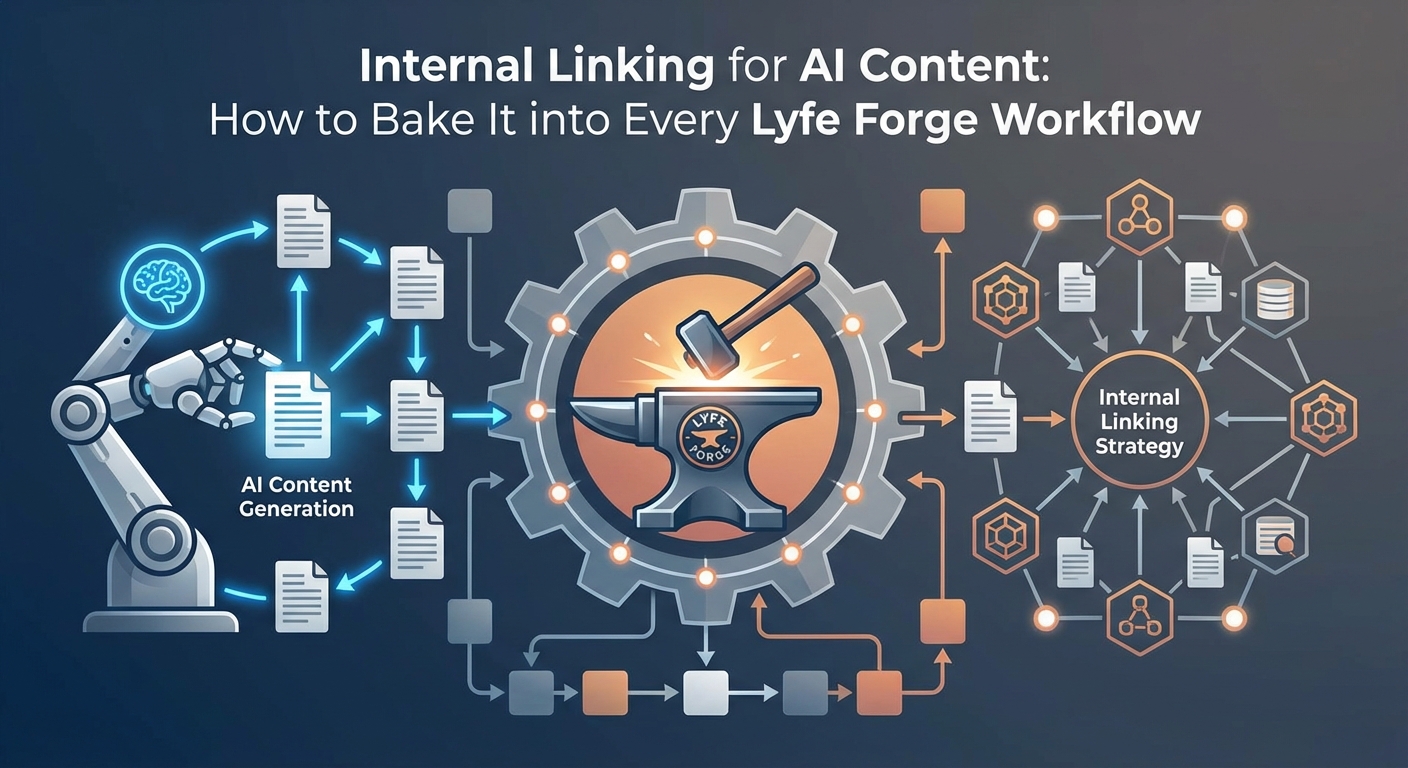
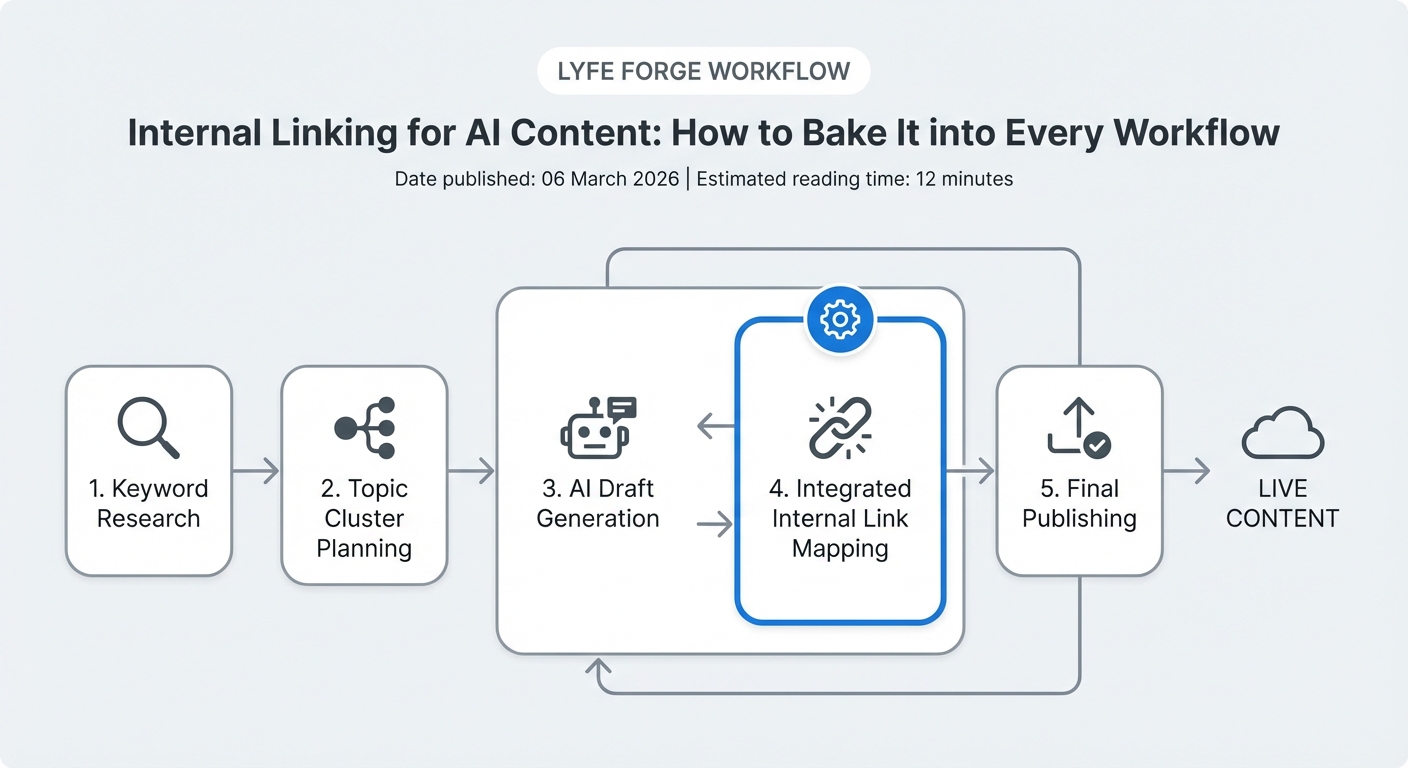
Internal linking breaks when it depends on “I’ll remember to do it later.” With AI content, “later” never comes, because you’re already working on ten new pieces. The fix is to hard‑wire linking into your workflow so it’s part of the process, not a side quest, ideally inside the same environment where you generate and manage AI content.
A simple but effective flow looks like this:
- Generate the AI draft. Use your usual brief and prompts, but include instructions like “suggest 3 – 5 relevant internal link spots per 1,000 words.”
- Scan for link targets. Use an SEO tool or an internal search to find existing pages that match the draft’s subtopics, products, and FAQs.
- Insert and review links. Add 1 – 3 contextual internal links per section. Prioritise recent, high‑quality content and core revenue pages that match intent.
- Audit regularly. Every few weeks, crawl the site to find orphan pages, uneven clusters, or over‑linked areas, then rebalance.
Research into AI‑driven internal linking shows that using high‑authority pages to surface deeper, contextually related resources can boost engagement metrics while helping distribute link equity more effectively across a site. The key is balance. You want every important pillar and money page to have a healthy mix of incoming and outgoing links, but you don’t want bloated paragraphs packed with irrelevant URLs that distract from the main point, a pitfall highlighted in analyses of automated internal linking systems.
In practice, a good baseline is adding 1 – 3 well‑fitted internal links per section of long‑form AI content, then topping that up later when you publish new related pieces. That way, your internal linking system grows with your content library instead of falling behind it, much like you’d iteratively evolve your own API usage and integration policies as the platform scales.
https://topmostlabs.com/ai-related-posts-internal-linking-strategies-2025
AI Tools vs Manual Internal Linking: A Hybrid Strategy
At small scale, you can manage internal links in a spreadsheet or straight inside your CMS. At AI scale – hundreds or thousands of URLs – that falls apart. This is where dedicated internal linking tools and AI‑powered recommendations come into play, echoing what you see with AI content automation platforms that add optimisation features on top of generation.
Platforms like Alli AI or SEOClarity’s Link Seeker analyse your site, match keywords and topics, and suggest internal link placements dramatically faster and at a scale that would be impractical to replicate manually. They’re very good at spotting “you wrote about AI SEO over here, but never linked it to that pillar on AI content strategy.” Used well, these tools can rescue hidden gems and support smarter equity flow into key commercial pages, in line with how internal linking case studies describe revenue‑impacting improvements.
But there’s a flip side. Left on autopilot, AI can hallucinate suggested links, match on surface keywords instead of true meaning, or push the same anchor over and over. Research on internal linking at AI scale warns about semantic misalignment: the tool may think two pages belong together, while a human can see the nuance and realise they don’t, which is why even AI‑assisted strategies like dynamic internal linking still rely on editorial oversight.
The most sustainable path is a hybrid. Let AI do what it’s good at: crawling, pattern‑spotting, and surfacing dozens of candidate links. Then run those suggestions through a quick but thoughtful human filter. Ask, “Would a real reader thank me for this link right here?” If the answer is no, cut or move it. That way, you get the reach of automation and the judgment of a human editor, just as you blend automation and review for legal and accessibility touchpoints such as your service terms and accessibility statement.
https://topmostlabs.com/ai-related-posts-internal-linking-strategies-2025
https://www.llmvisibilty.com/blog/internal-linking-strategies
Practical Internal Linking Tips You Can Use This Week
To make this real, here’s a simple action plan you can run in a week, even with a big AI content library, particularly if that library lives inside a structured platform like the Lyfe Forge blog.
- Audit your top 50 pages. Pull a list of URLs with the most sessions or revenue. Check how many internal links they receive and how many they give out. Mark obvious gaps on a quick sheet.
- Choose one priority cluster. For example, “AI SEO for eCommerce.” Map a pillar page and 5 – 10 supporting articles. Make sure every cluster page links back to the pillar and sideways where relevant.
- Update anchor text on key links. Replace vague anchors like “here” with descriptive phrases that match search intent, such as “AI internal linking strategy guide.”
- Set a linking rule for new AI posts. For every new article, require at least three inbound links from existing content and three outbound internal links to related resources or product pages.
- Create a lightweight SOP. Document your steps in 1 – 2 pages: how to pick targets, how many links per post, and what good anchor text looks like. Share it with anyone using your AI tools.
If you repeat this cycle each month for a different topic cluster, your internal linking structure will steadily tighten. Over time, your AI content library shifts from a pile of unconnected articles into a structured network that both humans and machines can actually navigate and trust, reinforcing the value of running everything through a dedicated AI content system such as Lyfe Forge.
Conclusion: Turn AI Content into a Connected Asset, Not a Content Dump
Internal linking quietly multiplies the value of every AI‑generated page you publish. It helps bots discover new content, guides users towards answers and offers, and teaches LLMs how your expertise fits together, especially when those pages live within a cohesive environment like the Lyfe Forge platform.
The key is to stop treating it as a final tidy‑up task and start baking it into your AI workflows: topic clusters over silos, varied anchor text, link rules in every brief, and a sensible mix of automation and human review. Do that, and your AI content stops being a loose collection of posts and starts acting like a true, scalable asset that keeps paying off long after it’s written, while staying aligned with governance guardrails such as your privacy commitments and accessibility standards.
If you’re ready to tighten up your internal linking strategy for AI‑driven SEO, now is the time to standardise your process, tune your prompts, and give every new piece a clear place in your site’s internal web, starting with how you structure and publish content inside Lyfe Forge.
Frequently Asked Questions
What is internal linking in SEO and why is it important for AI-generated content?
Internal linking is the practice of linking from one page on your website to another page on the same domain. For AI-generated content, it’s critical because AI tools can produce large volumes of pages that risk becoming isolated “orphan pages” with no links pointing to them. Strong internal linking helps search engines discover and crawl new AI content, understand how topics relate, and pass authority to your most important pages. It also makes your content easier for LLMs and AI search features to navigate and use in answers.
How do I create an internal linking strategy for AI content at scale?
Start by mapping your content into topic clusters: one main pillar page for a broad topic and multiple supporting articles around it. For each new AI-generated piece, decide which cluster it belongs to and which core pages it must link to. Then define a simple set of rules (for example, minimum number of internal links, which pillar pages to link to, and where in the article they should appear). Tools like Lyfe Forge can help you enforce these rules consistently across every AI content workflow.
What are topic clusters and how do they help with internal linking for AI content?
Topic clusters are groups of related content built around a central “pillar” page that covers a broad subject in depth. Supporting articles target subtopics or specific questions and consistently link back to the pillar, while also interlinking with each other where relevant. This structure makes it easier for AI content systems to know what to link to and for search engines to understand your site’s expertise. In Lyfe Forge, you can use clusters as a blueprint so every AI-generated article knows its role and its required internal links.
How should I choose anchor text for internal links in AI-generated blog posts?
Use clear, descriptive anchor text that tells users and search engines what they’ll find on the linked page, ideally reflecting the target keyword or topic. Avoid generic phrases like “click here” or over-optimized, identical keyword anchors repeated everywhere. When using AI, define rules or prompts that instruct the model to vary anchors naturally while staying on-topic and readable. Lyfe Forge workflows can bake these anchor text guidelines into your briefs so links feel natural but remain SEO-friendly.
How can I prevent orphan pages when publishing lots of AI content?
Before publishing, decide where each new AI article will receive links from and where it will link to. Make sure every new page includes at least a few internal links to relevant existing content and is also added into navigation, category pages, or related-posts sections where appropriate. Regularly crawl your site or use an internal linking report to spot URLs with no inbound internal links. Lyfe Forge can help by standardising these steps in your content workflow so no page goes live without connections.
Can internal linking improve how my content appears in AI search results and answer boxes?
Yes, strong internal linking can help AI systems and search engines better understand which pages are your authoritative resources on a topic. When content is well-clustered and internally linked, it’s easier for LLMs to follow the relationships between pages and identify comprehensive sources for a given question. This can increase the likelihood that your pages are used in AI-generated summaries, answer boxes, and chat-style responses. It also helps consolidate signals around your most important pillar content instead of scattering relevance across many thin pages.
How do I bake internal linking into my AI content workflows with Lyfe Forge?
In Lyfe Forge, you start by defining your topic clusters and mapping each content brief to a cluster and target pillar page. Then you add internal linking requirements directly into your workflow: minimum number of links, specific pages to reference, and anchor text rules. You can also set prompts or templates that tell the AI where to include links (for example, within key sections like introductions, FAQs, and CTAs). This turns internal linking into a checklist item every piece must satisfy, instead of a manual clean-up step later.
What are some common internal linking mistakes with AI content and how do I avoid them?
Common issues include over-linking to the homepage, using vague anchor text, creating dozens of low-value links in one paragraph, and forgetting to link new posts into older high-authority pages. With AI content, another risk is letting the model generate random or irrelevant links without clear rules. You can avoid these by defining a simple internal linking policy (what to link, how often, and with what anchors) and enforcing it through your AI briefs or templates. Platforms like Lyfe Forge let you hard-code these rules so they’re followed automatically across all AI outputs.
How many internal links should I add in a blog post for best SEO results?
There isn’t a fixed ideal number; the goal is to add as many genuinely useful, contextually relevant links as needed without overwhelming the reader. For most long-form posts, linking to 3–10 related internal pages is a good starting point, ensuring at least one link to a pillar page and a couple to closely related supporting articles. Focus on links that help users go deeper on a subtopic or next logical step. With Lyfe Forge, you can set recommended link counts by content type so AI-generated posts stay consistent.
Is internal linking still effective if most of my content is generated by AI tools?
Yes, internal linking works the same regardless of whether content is human-written or AI-generated, as long as the structure and links are deliberate. In fact, the more AI content you publish, the more you need a strong internal linking system to avoid a bloated, disconnected site. When you bake linking rules into AI workflows, each new page strengthens your existing clusters instead of diluting them. Lyfe Forge is designed specifically to make this kind of structured, scalable internal linking practical for AI-driven content programs.