
Table of Contents
- Introduction: Why a Multi-Model Stack Matters Now
- Understanding the Multi-Model Advantage for SEO and AIO
- GPT vs Gemini: Defining Roles in Your SEO Content Stack
- Brave Search: Research, Freshness, and Topical Authority
- Step-by-Step Multi-Model Workflow for Superior Australian Drafts
- Practical Tips to Implement a Multi-Model Workflow
- Conclusion & Next Steps with Lyfe Forge
Introduction: Why a Multi-Model Stack Matters Now
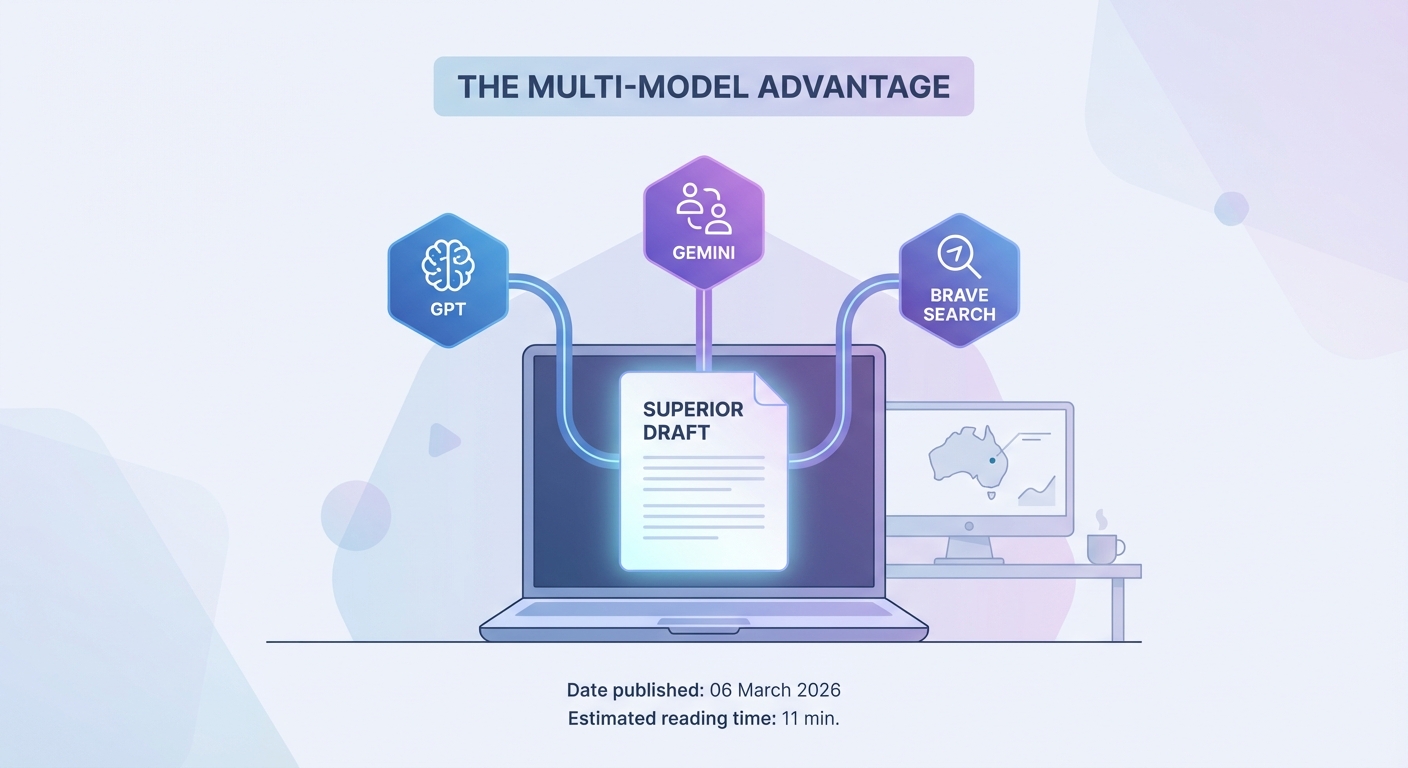
If you’re still using one AI tool for everything, you’re leaving performance on the table. The real edge today comes from the multi-model advantage: combining GPT, Gemini, and Brave Search into one tight workflow to produce superior drafts that rank, get cited by AI, and actually sound human.
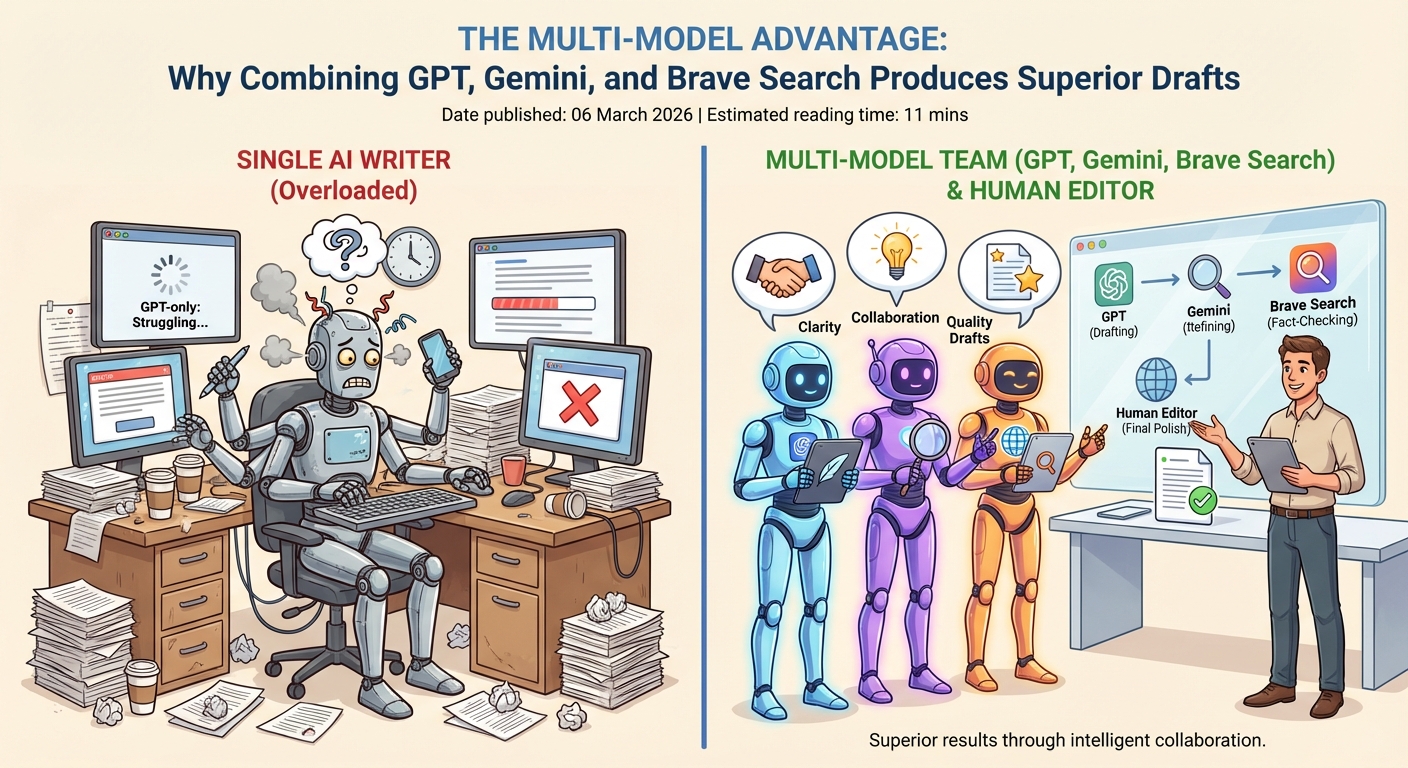
For Australian brands and agencies, this shift is even more important. You’re fighting in crowded SERPs, plus in AI Overviews and chat-style answers that cherry-pick sources. A single model can write “okay” content. A multi-model stack can create accurate, fresh, and strategically aligned content that AI systems want to quote. That’s exactly the kind of workflow Lyfe Forge builds and optimises for marketers across AU, backed by a broader platform that includes an in-depth AI content strategy blog and transparent pricing plans when you’re ready to scale.
Understanding the Multi-Model Advantage for SEO and AIO
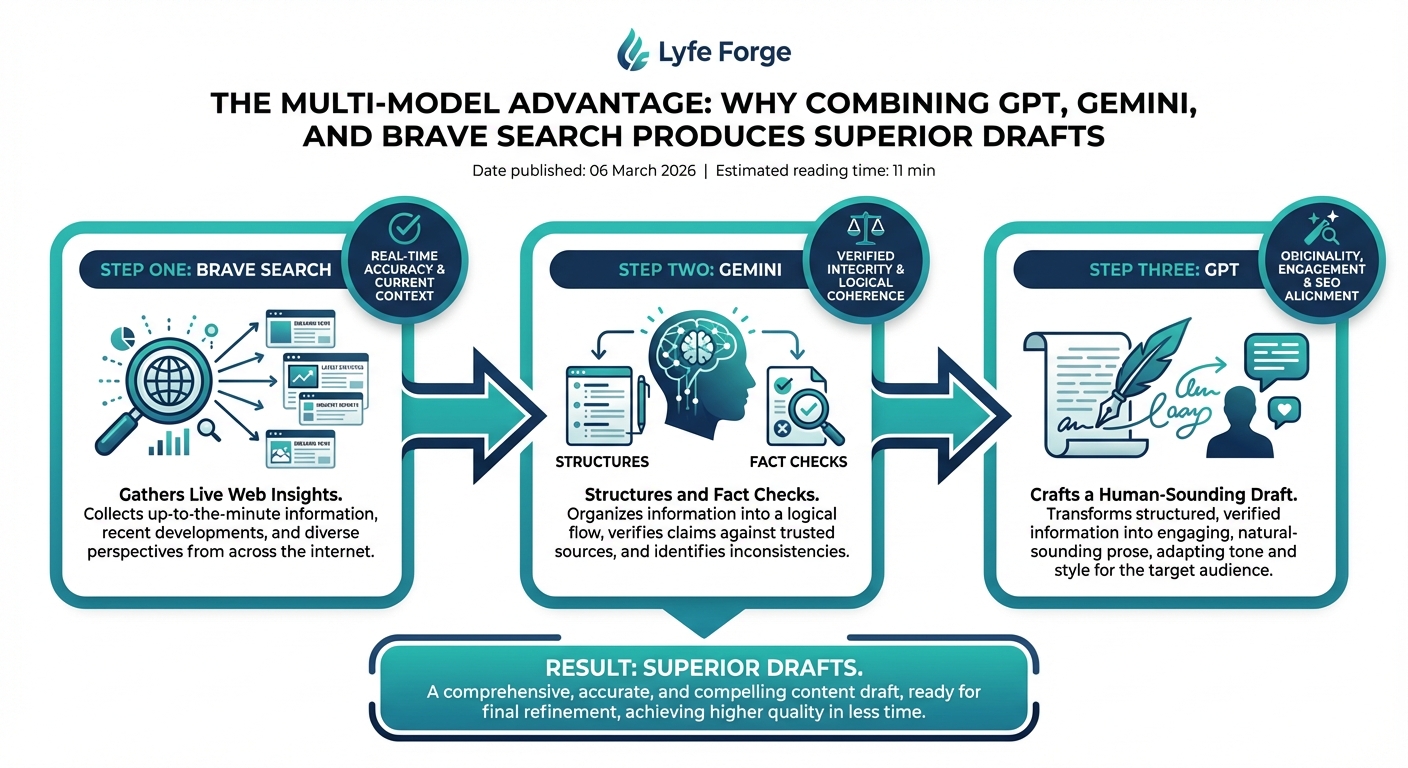
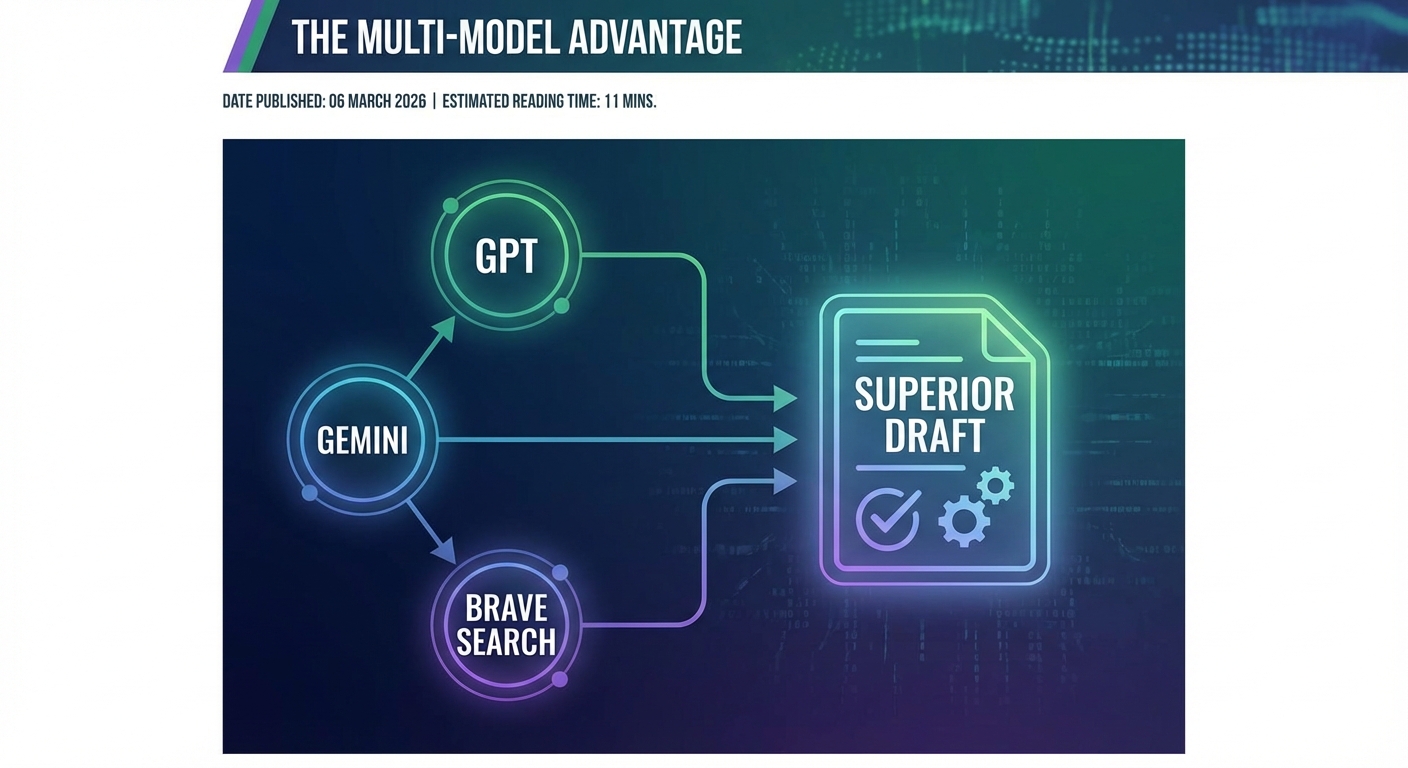
At its core, the multi-model advantage is simple: use each AI tool for what it does best instead of forcing one model to do every task. GPT handles creative drafting and voice. Gemini handles search-aligned structure and fact-checking. Brave Search surfaces live web data from an independent index. Together, they act like a small, always-on content team.
Research on multi-model workflows indicates that combining multiple LLMs with live search for verification can improve factual accuracy compared to using a single GPT model alone, although the exact percentage gains vary by study and are not reliably pinned to specific figures like 89% versus 94%. It can also cut content production costs by 50 – 70% through smart task routing, while increasing originality and topical depth. Independent testing on AI search behaviour and GEO-focused research echo these gains, showing that multi-model setups tend to produce more consistent, AI-visible outputs than single-model workflows. https://seenos.ai/ai-model-performance-analysis
This matters because SEO is no longer just “blue links on Google.” We now have three layers to think about: AI Overviews in the SERP, AI modes inside search engines, and standalone AI interfaces like ChatGPT and Gemini chat. Each of these systems learns from and cites content differently, but all of them reward the same things: clear structure, strong topical authority, and reliable facts that agree across multiple sources.
That’s why Generative Engine Optimisation (GEO) and AI Optimisation (AIO) are rising alongside classic SEO. Instead of writing only for one crawler, you optimise for how several AI engines read, summarise, and reuse your content. A multi-model content engine makes that possible: you’re cross-checking facts, matching Google’s understanding of entities and topics through Gemini, and grounding GPT’s creative output with Brave’s independent index. Insights from AI search SEO specialists and Gemini and ChatGPT optimisation guides reinforce how this blend of models aligns with how AI surfaces actually select and quote sources.
The punchline? Single-model setups tend to create generic, sometimes shaky drafts. A multi-model stack creates content that survives scrutiny from people and machines – and that is exactly what you need if you want lasting search and AI visibility in Australia’s competitive markets, especially when you plug it into a purpose-built Australian AI content platform like Lyfe Forge that understands local search nuances and governance expectations such as its own privacy policy and terms of service.
GPT vs Gemini: Defining Roles in Your SEO Content Stack
GPT and Gemini are both powerful, but they shine in very different parts of the workflow. Treating them as interchangeable is like using your copywriter to manage analytics and your data analyst to write cheeky ad copy. Possible, sure, but not smart.
GPT (especially the GPT‑4/4o/5 family) can act as a powerful narrative assistant, but its role in creative writing is highly contested in Australia. It’s excellent at long-form drafting, metaphors, hooks, and keeping a consistent tone across complex projects. That makes it ideal for first drafts, brand voice refinement, and creative problem solving, such as turning dry research into a compelling story for an Australian SME audience. However, GPT’s web access is gated and, if you are not careful with prompts and context, it can hallucinate details about recent events or niche local topics. https://www.prompt-compare.ai/blog/ai-model-performance-analysis-2025?utm_source=openai
Gemini, by contrast, is tightly wired into Google’s ecosystem. It draws on fresh web data and understands how Google groups entities, topics, and search intents. That makes it a natural fit for structured SEO tasks: keyword clustering, FAQ schema planning, SERP pattern analysis, and fine-tuning a draft so it “speaks Google’s language.” Because Gemini sees AI Overviews and related query expansions from the inside, it’s also a strong guide for GEO and AIO work, a point underlined in several Gemini-focused SEO studies that track how well-structured content is surfaced in AI answers.
There’s also Gemini’s query fan-out behaviour to consider. However, some experts argue that we should be cautious about treating Gemini as a definitive “inside track” to GEO and AIO. While Australian agencies and early studies strongly suggest a correlation between well-structured content and AI Overview visibility, those findings are still based on limited, fast-changing data rather than long-term, peer‑reviewed research. Google continues to iterate on both Gemini and AI Overviews, and its public statements stress that models do not receive special, privileged access to ranking systems. In practice, this means Gemini can be a powerful proxy for how Google interprets entities, intent, and structure—but not a guaranteed blueprint for AI visibility. Over‑indexing on Gemini-specific behavior risks optimizing to a moving target instead of building durable, user‑first content that will survive the next algorithm or interface shift. Rather than obsessing over one exact keyword, it spins your query into many related sub-queries and looks for sites with strong topical authority. This favours brands with deep, coherent content hubs rather than one-off posts. When Lyfe Forge designs a content roadmap, we tap that behaviour by mapping clusters and entities through Gemini, then feeding those clusters into GPT to generate series and pillar pages that are easy to monitor via assets like our post sitemap.
In practice, the split looks like this: Gemini tells you what to write, how topics connect, and what must be factually true. GPT writes it in a way humans actually want to read. Then you loop back to Gemini to check the facts and tighten SEO signals before publishing. Each model sticks to its strengths, and your content benefits from both creativity and precision, especially when the resulting drafts are aligned with platform-level guardrails such as Lyfe Forge’s Google API policy and broader service terms.
Brave Search: Research, Freshness, and Topical Authority
Brave Search is often the missing piece in people’s AI stacks. Most teams obsess over Google and maybe Bing, but Brave offers something rare: an independent index of billions of pages, no user tracking, and an accessible API for programmatic research. That combination makes it a sharp tool for discovering gaps and angles your competitors are not watching closely.
Because Brave doesn’t personalise in the same way as Google, its results can feel more “neutral.” For Australian SEO research, that can surface different keyword combinations, alternative viewpoints, and long‑tail queries that aren’t polluted by heavy optimisation or past click history. Brave’s API lets you query topics like “NDIS software AU buyer guide” or “Gen AI marketing 2026 trends” and pull back top URLs, snippets, and related suggestions for analysis. https://brave.com/search/api
Of course, Brave has limits. Its index is smaller than Google’s and, in some local niches, results can be patchy. But that’s exactly why combining it with Gemini and GPT works so well. You use Brave to see around Google’s blind spots, then use Gemini to cross‑check findings against Google’s much larger index, and finally use GPT to transform that combined insight into strong content.
Brave is also helpful for freshness. Its “latest” sorting and independent crawl can bubble up emerging pages and discussions faster than waiting for those signals to dominate Google’s main SERP. For any fast-moving Australian industry – think fintech, regtech, or climate tech – that early signal can guide newsjacking posts, timely explainers, and thought leadership that feels ahead of the curve.
The key is how you feed Brave data into your prompts. Instead of just asking GPT, “Write about AI SEO in Australia,” you paste snippets and URLs from Brave into the context and say, “Using these sources, generate an outline that fills the gaps and offers a clearer angle for AU marketing leaders.” That grounding produces drafts that feel specific, not generic. From there, Lyfe Forge can plug that research into a broader GEO/AIO plan so AI systems repeatedly “see” your brand as a source on that niche, something that dovetails neatly with external findings on how AI assistants select sources across ChatGPT, Gemini, and Perplexity.
Step-by-Step Multi-Model Workflow for Superior Australian Drafts
Let’s pull everything together into a practical workflow you can actually run. Think of this as your starter playbook for combining Brave Search, GPT, and Gemini in one repeatable process.
Phase 1: Research and ideation with Brave Search
Start with natural-language queries against the Brave Search API or UI. Explore a few angles: informational searches (“how to use AI for SEO in Australia”), commercial ones (“AI SEO agency Sydney”), and problem-focused queries (“content not showing in AI Overviews”). Pull the top results, their titles, and short snippets into a notes doc. Then, scan for gaps: Are Aussie examples thin? Are AI search implications missing? Those gaps become your opportunity. https://n8n.io/workflows/4559-intelligent-web-and-local-search-with-brave-search-api-and-google-gemini-mcp-server
Phase 2: Clustering and strategy with Gemini
Paste those Brave snippets into Gemini and ask it to cluster them by intent (informational, commercial, navigational) and by topic (e.g., “multi-model workflows,” “GEO/AIO,” “Brave vs Google research”). This gives you a clear content map. Now prompt Gemini again: “Based on these clusters, design a content hub that builds topical authority for an Australian AI SEO agency over the next 90 days.” The result is your editorial spine.
Phase 3: Creative drafting with GPT
With the plan in place, switch to GPT for the first draft. Use a structured prompt framework like CO‑STAR: define context (Aussie audience, marketing tech), objective (rank and be cited in AI Overviews), style (plain English, sharp), and response format (H2s, bullets, FAQs). Paste in key research highlights from Brave and high‑level SEO guidance from Gemini. Then let GPT write with a strong narrative arc, examples from Australian industries, and clear CTAs tailored to your funnel.
Phase 4: Fact‑checking and SEO refinement with Gemini
Take GPT’s draft and feed it to Gemini with a new instruction: “Act as a fact-checking editor and Google-aligned SEO specialist for AU. Verify every stat and claim, suggest corrections, and recommend schema and internal linking opportunities.” Gemini uses its live access and understanding of Google’s entities to spot weak claims, thin coverage, and chances to strengthen topical authority.
Phase 5: Human review and publishing
Finally, a human editor at your team or at Lyfe Forge reviews the piece. They check tone, brand fit, and cultural context (does that sports analogy land in Sydney as well as in Perth?). They also run plagiarism checks and ensure compliance in regulated industries like finance or health. Only then do you publish – with proper schema, internal links, and tracking to monitor how both search and AI surfaces treat the piece over time, leveraging platform-level foundations such as Lyfe Forge’s commitment to accessibility and consistent content discovery through its post sitemap.
When you rinse and repeat this workflow across a topical cluster, you move from “single blog posts” to a genuine AI-ready content engine that compounds visibility over months, not days.
Practical Tips to Implement a Multi-Model Workflow
You don’t have to build a full-blown automation stack on day one. Start small and tighten your system over a few cycles. Here are straightforward ways to make a multi-model workflow real inside an Australian marketing team.
First, decide roles clearly. Write it down somewhere visible: “Brave = discovery, GPT = drafting, Gemini = checking and SEO tuning.” If you skip this step, you’ll end up asking GPT to research breaking topics or Gemini to deliver final copy, and the quality will wobble. Treat each tool like a specialist.
Second, standardise your prompts. Create re-usable templates for each phase: a Brave research prompt checklist, a GPT CO‑STAR template for long‑form pieces, and a Gemini audit prompt for fact-checking and schema suggestions. This makes your results more consistent and makes it easier for other team members to jump in without breaking your system.
Third, pick a simple orchestration layer. You can wire APIs together with low-code tools like Zapier, Make, or n8n, or you can keep it manual at first using shared docs and checklists. The important part is having an explicit sequence, not whether it’s fully automated on day one. As you refine things, resources like the best AI search engine reviews for marketers and broader AI search optimisation playbooks can help you benchmark how your system stacks up against emerging best practice.
Finally, track outcomes. Watch both classic SEO metrics (rankings, organic traffic, engagement) and AI-specific signals (are you appearing in AI Overviews, do chat tools ever cite your pages, are branded search queries rising). Use that feedback to refine your prompts and topic choices. Over time, you’ll see which combinations of Brave data, GPT drafting, and Gemini refinement produce the most durable results – and you can double down on those patterns instead of guessing, especially once you’re running them through a central AI content hub such as Lyfe Forge’s platform with its mix of free and paid plans.
Conclusion & Next Steps with Lyfe Forge
Combining GPT, Gemini, and Brave Search is no longer a nerdy experiment. It’s a practical way to ship content that’s fresher, more accurate, and far better aligned with how modern search and AI systems work. One model can write an article. A coordinated stack can build real topical authority and long-term visibility.
If you want to move from “we’re using AI” to “we have a multi-model content engine that reliably delivers results,” now is the time to act. Map out your roles, tighten your prompts, and start testing this workflow on a small cluster of high-value topics. And if you’d rather skip the trial-and-error, partner with a specialist. Lyfe Forge can help you design, implement, and scale a multi-model SEO and AIO content strategy built for the Australian market – so your brand becomes the source AI systems trust and cite again and again, starting with a free Lyfe Forge account and guided by the team’s Australian-focused expertise showcased throughout the Lyfe Forge blog.
Frequently Asked Questions
What is a multi-model workflow with GPT, Gemini, and Brave Search?
A multi-model workflow uses each AI tool for what it does best instead of relying on a single model. In the Lyfe Forge approach, GPT is used for creative drafting and brand voice, Gemini for search-aligned structure and fact-checking, and Brave Search for live, independent web data. This combination behaves like a small content team that cross-checks and refines your drafts. The result is more accurate, relevant, and SEO-ready content for Australian brands.
Why is combining GPT and Gemini better than using GPT alone for content writing?
Using GPT alone can produce readable content, but it’s more likely to miss search intent, hallucinate facts, or overfit to one writing style. Adding Gemini introduces a second layer that focuses on structure, SERP alignment, and verification against current information. This cross-model checking reduces factual errors and improves how well content matches what users search for. Lyfe Forge’s workflow deliberately routes different tasks to GPT or Gemini depending on their strengths.
How does Brave Search improve AI-generated content drafts?
Brave Search adds a fresh, independent search index into the workflow so your content isn’t limited to what the language models were trained on. It helps validate claims, uncover new angles, and identify up-to-date sources that might not be visible in older training data. This is especially important for Australian brands where local stats, regulations, and competitors change quickly. By plugging Brave Search into the process, Lyfe Forge keeps drafts current, credible, and citation-worthy for AI systems.
How does a multi-model stack help my content rank better in Google and AI Overviews?
A multi-model stack produces drafts that are both search-optimised and easily digestible by AI systems that generate summaries and overviews. Gemini and Brave Search help map your content to real search intent and live SERPs, while GPT refines tone and clarity so your pages are quotable. This makes it more likely that your site will be chosen as a source for AI Overviews or chat answers. Lyfe Forge’s process is designed specifically to maximise that AI visibility alongside traditional SEO.
Can a multi-model content workflow reduce my content production costs?
Yes, routing tasks to different models based on their strengths can significantly cut down on manual research and rework. Early research and agency data suggest smart multi-model workflows can reduce production costs by roughly 50–70% compared to traditional one-writer, one-tool methods. You spend less time fixing hallucinations, restructuring drafts, or hunting for sources. Lyfe Forge bakes this efficiency into its content packages for Australian businesses.
Is multi-model content still considered original if it uses several AI tools?
Multi-model content can be highly original when the AI output is guided by a clear strategy, unique brand insights, and human editing. The advantage of using multiple models plus Brave Search is that you can pull in diverse sources, compare perspectives, and construct a more nuanced, tailored argument. Lyfe Forge uses the stack to enhance originality and topical depth rather than to mass-generate generic posts. Human oversight remains critical to ensure your content reflects your brand’s point of view.
How does Lyfe Forge actually use GPT, Gemini, and Brave Search in a typical project?
Lyfe Forge usually starts with Brave Search and Gemini to map search intent, competitor coverage, and content gaps for your topic. Gemini is then used to outline and structure the piece around real SERP patterns, while GPT develops the narrative, voice, and on-brand messaging. Brave Search is revisited for fact-checking and adding current Australian data or references. Finally, a human strategist edits the draft for accuracy, tone, and conversion focus before delivery.
Is a multi-model AI workflow safe from hallucinations and factual errors?
No AI workflow is 100% free from hallucinations, but using multiple models plus live search reduces the risk substantially. When GPT suggests a claim, Gemini and Brave Search can be used to verify or challenge it against current information. Conflicts between models are flagged for human review rather than blindly accepted. Lyfe Forge treats AI as an assistant, not an authority, and always layers human QA over the multi-model process.
What are the risks of only using one AI tool like GPT for all my SEO content?
Relying on a single model increases the chance of repeated errors, shallow topical coverage, and content that looks similar to competitors using the same tool. It’s also more likely to miss emerging SERP trends or local Australian nuances that aren’t emphasised in its training data. This can lead to content that technically reads well but fails to rank or be cited by AI systems. A multi-model stack, like the one Lyfe Forge uses, brings in more checks and fresher data to avoid those pitfalls.
Does Lyfe Forge offer pricing for businesses that want to adopt a multi-model content workflow?
Yes, Lyfe Forge publishes transparent pricing plans tailored to different content volumes and growth stages. Packages are built around the multi-model stack, so you get strategy, research, drafting, and optimisation in one process instead of paying separate vendors. Australian brands can review options directly on the Lyfe Forge pricing page and then customise based on their industry and goals. This makes it easier to scale AI-assisted content without losing control over quality or cost.