
Table of Contents
- Introduction: Why “Small Sites Can’t Win” Is Wrong
- 1. How E‑E‑A‑T Actually Shows Up on a Small Business Site
- 2. Turning First‑Hand Experience into Content that Signals Trust
- 3. Technical and On‑Page Trust Signals You Can Upgrade This Month
- 4. Building Topical Clusters for Niche Authority (Without a Big Team)
- 5. Local and AU‑Specific Trust Cues that Punch Above Their Weight
- Practical Playbook: 30‑Day E‑E‑A‑T Action Plan
- Conclusion: From “Just Another Site” to a Trusted Local Authority
Introduction: Why “Small Sites Can’t Win” Is Wrong
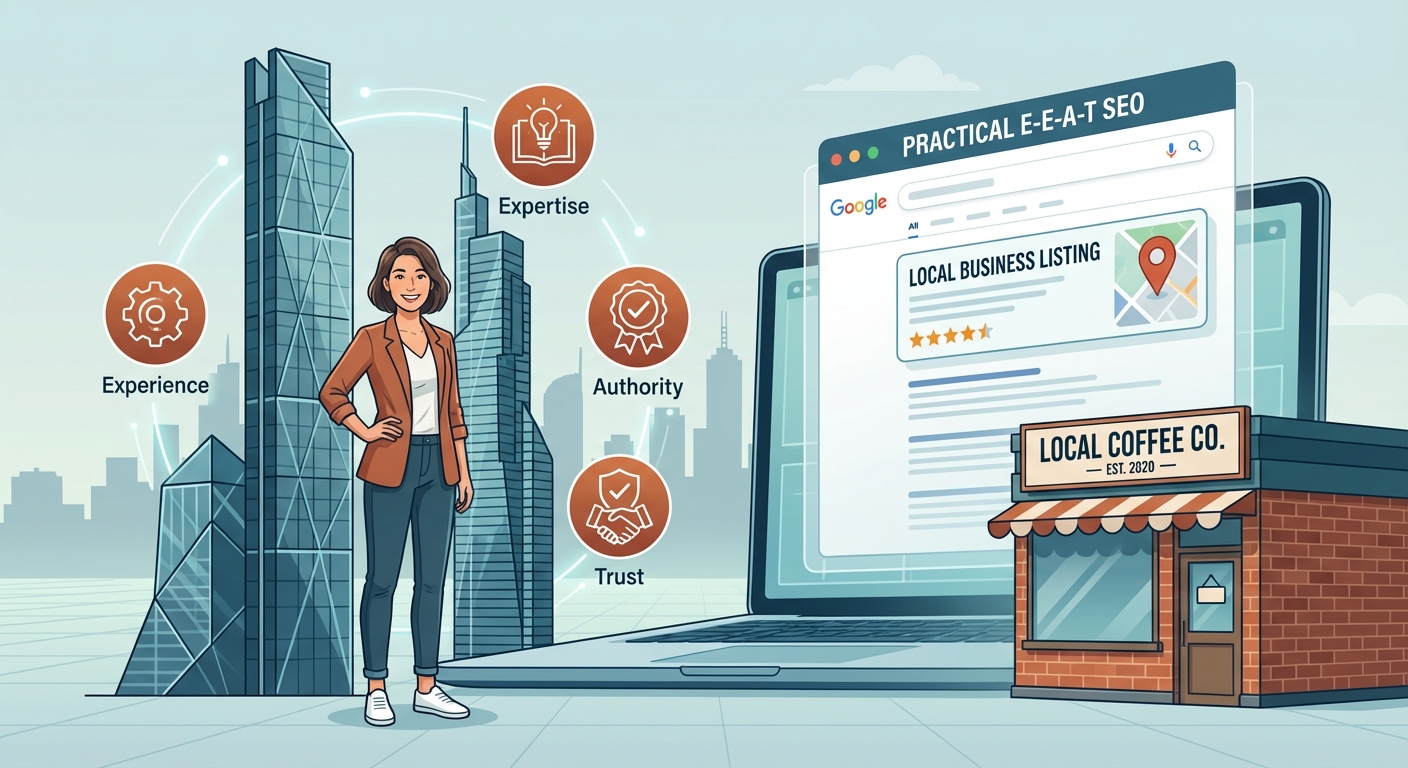
Most people think E‑E‑A‑T is a big‑brand game: universities, banks, and giant publishers with legal teams and PR budgets. That belief quietly keeps a lot of small and local businesses stuck. They assume Google will always favour the giants, so they keep publishing thin blog posts and generic service pages, then wonder why traffic plateaus.
In reality, the E‑E‑A‑T model can level the playing field. A small plumbing business in Melbourne, a health studio in Brisbane, or a niche SaaS like Lyfe Forge can all embed stronger signals of experience, expertise, authority, and trust than a faceless directory site. Especially in non‑YMYL spaces, everyday know‑how often matters more than fancy credentials, a point echoed in independent E‑E‑A‑T guides that emphasise practical trust signals over brand size.
This final part of our series turns E‑E‑A‑T from an abstract framework into a practical playbook. You will study how to turn first‑hand experience into credible content, upgrade technical trust markers, craft lean topical clusters, and leverage local Australian signals that search systems tend to reward. Think of it as a field manual for practitioners who want real‑world SEO payoff and who care about aligning with Google’s documented quality expectations.
https://seranking.com/blog/google-eat-ymyl/?utm_source=openai
1. How E‑E‑A‑T Actually Shows Up on a Small Business Site
For a hands‑on marketer or founder, E‑E‑A‑T only matters if it changes how the site looks and reads. Google’s public documentation and Quality Rater Guidelines describe E‑E‑A‑T as a framework human raters use to judge page quality, not a single ranking switch. Their feedback trains algorithms over time, so content that demonstrates stronger signals tends to secure better visibility, including in AI‑powered summaries. The levers you control are mostly on‑site: layout, wording, evidence, and transparency, all of which line up with how SEO practitioners interpret E‑E‑A‑T in real campaigns.
Experience is the simplest to embed and the one small operators usually have in abundance. A local electrician has hundreds of real jobs behind them; a Pilates studio has direct insight into what clients struggle with in their first month. When those details appear in case studies, before‑and‑after photos, and step‑by‑step walk‑throughs, the content immediately feels grounded instead of theoretical. It is the opposite of the “AI‑generated brochure” tone users increasingly distrust, and aligns with current guidance on making AI‑assisted content demonstrably human‑led. However, some experts argue that the “AI-generated brochure” tone is not inherently the problem so much as how it’s used. Surveys show a sizeable group of people aren’t especially bothered if content is AI-assisted, and a small but growing segment even trust a brand more when it’s transparent about using AI. In other words, users are reacting less to the presence of AI and more to content that feels generic, evasive, or mass-produced. A tightly edited, clearly disclosed AI-assisted guide that incorporates real data, strong structure, and fast updates can perform just as well as – or better than – a purely human draft, provided it still reflects genuine on-the-ground experience. For small operators, that means the win isn’t avoiding AI altogether, but combining their specific, lived examples with AI as a production tool, then clearly signalling the human judgment behind the final piece.
Expertise shows up through depth and correctness. That might mean referencing relevant standards, citing government guidance, or aligning your content with current industry practice. You do not need a PhD to show expertise in non‑YMYL niches, but you do need to avoid vague advice and unsupported claims. Structured resources, such as a focused knowledge hub or an in‑depth guide series like Lyfe Forge might publish for SEO practitioners, signal that you genuinely know your space.
Authoritativeness and trust then grow from the edges: external mentions, local reviews, secure technology, clear contact details, and ethical behaviour. None of these require a corporate budget, only consistency and attention. Once you accept that, E‑E‑A‑T stops being a mystical ranking factor and becomes a practical checklist for every page you ship.
https://www.jumpfly.com/blog/the-history-of-truth-googles-e-e-a-t-ymyl/?utm_source=openai
2. Turning First‑Hand Experience into Content that Signals Trust
Many local businesses under‑use their biggest asset: the work they do every day. Google explicitly recognises “experience” as first‑hand or life involvement with a topic. That might be a tradesperson documenting a tricky installation, a digital agency sharing a real client experiment, or a small retailer walking through their product sourcing process. The more clearly you show “we have actually done this,” the more your content separates itself from generic AI pages, a distinction that modern AI‑SEO playbooks also lean on.
Start by mapping the real jobs, projects, and customer questions you handle weekly. Each one can anchor a piece of experience‑driven content. For example, a local solar installer could write “What We Learned Installing 6.6kW Systems on Inner‑City Terraces in Sydney” and include site photos, roof layout sketches, and data on actual energy output. A local SEO specialist might turn a campaign into a narrative case study, similar to how a growth platform like Lyfe Forge could dissect an experiment in an SEO blog article.
To embed that experience in a way both users and algorithms can pick up, include tangible markers:
- Specific locations (“a clinic in Parramatta”, “a warehouse in Geelong”).
- Concrete numbers (timeframes, cost ranges, traffic lifts, attendance, conversion changes).
- Process steps described in plain language, not just marketing slogans.
- Direct quotes from clients or team members, even if lightly edited for clarity.
Also, share what did not work. A short section on “what we would do differently next time” signals honesty and real‑world experimentation. That kind of detail, paired with appropriate caveats for sensitive topics, tends to build far more trust than polished but empty claims. Over time, a library of these grounded narratives doubles as strong social proof and a clear E‑E‑A‑T signal.
https://seranking.com/blog/google-eat-ymyl/?utm_source=openai
3. Technical and On‑Page Trust Signals You Can Upgrade This Month
You can have great experience‑driven stories and still lose trust because your site “feels” risky or anonymous. That perception matters: quality raters, and more importantly real users, look for concrete cues that a site is safe, legitimate, and accountable. Some of these cues are technical, others are editorial, but most are straightforward for a small team to handle within a month.
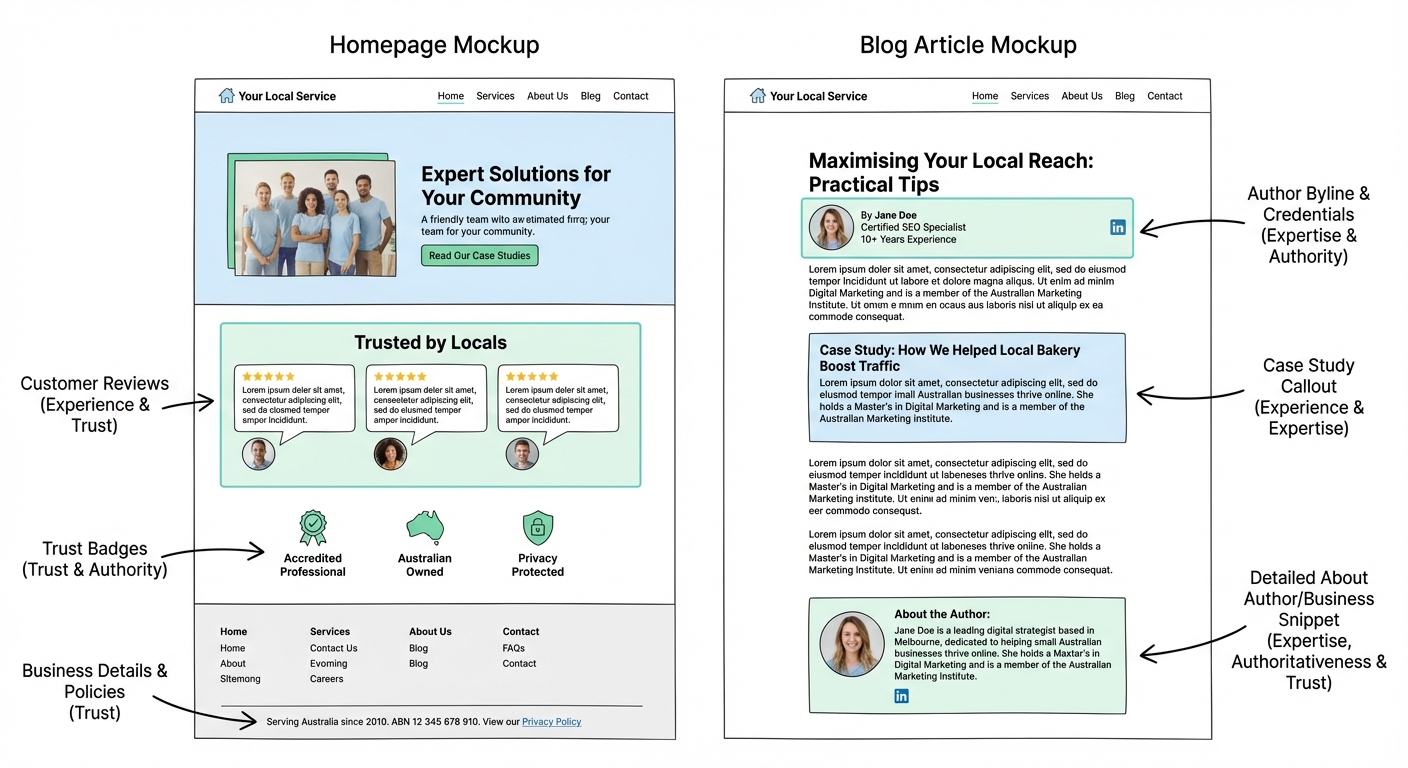
First, security. Running your site over HTTPS with a valid SSL certificate is table stakes. Browsers now flag non‑secure pages, which quietly erodes confidence before a visitor even reads your content. If you collect any personal details – contact forms, newsletter sign‑ups, bookings – secure transport is non‑negotiable. Pair this with a clear, plain‑English privacy policy that explains how you store and use data, referencing Australian privacy requirements where relevant. Platforms that rely on user data, such as Lyfe Forge, typically surface this through a visible privacy policy and Google API data usage disclosures.
Second, identity. Every important page, not just your homepage, should make it obvious who is behind the content. That means:
- Detailed author bios with headshots, roles, and relevant experience.
- An “About” page that tells the story of your business, including location, years in operation, and team makeup.
- Clear contact options: street address (where appropriate), phone, email, and business hours.
A company like Lyfe Forge, for example, might maintain a transparent About page and link author profiles across its content hub, so readers can trace who wrote what and why they are qualified to comment.
Third, sourcing. When you quote statistics, reference legal or financial rules, or mention health‑adjacent topics, link to reputable sources such as government domains and recognised bodies. That habit does double duty: it backs up your claims and shows that you operate inside accepted standards rather than improvising. Combined with basic UX hygiene – fast loading, mobile‑friendly layouts, readable fonts – these elements form a visible scaffold of trust around your content, which is consistent with modern E‑E‑A‑T optimisation advice.
https://www.jumpfly.com/blog/the-history-of-truth-googles-e-e-a-t-ymyl/?utm_source=openai
4. Building Topical Clusters for Niche Authority (Without a Big Team)
One of the smartest moves a small site can make is to stop chasing every topic in its industry and instead commit to compact topical clusters. A cluster is a network of related pages that cover a subject in depth from different angles: definitions, how‑tos, comparisons, FAQs, and real‑world stories. Over time, search engines start to recognise your site as a go‑to resource for that segment, even if you are relatively unknown elsewhere.
For example, imagine a local accounting firm that wants to dominate the space around “tax for tradies in Australia.” Rather than publishing a single overview article, they could map a cluster:
- A hub page: “Complete Tax Guide for Tradies in Australia”.
- Supporting articles: GST rules for different trades, record‑keeping templates, common ATO red flags, equipment deductions, and case stories by trade (plumbers, sparkies, landscapers).
- Downloadable tools or checklists embedded throughout the cluster.
Each supporting piece links back to the hub and to each other where relevant. Internally, this structure helps readers progress from simple questions to more advanced ones, mirroring how a real client engagement develops. Externally, it sends clear authority signals because you are not just grazing topics; you are dissecting a defined slice of the niche in detail.
A SaaS company like Lyfe Forge might do something similar for a theme like AI‑assisted SEO. A central guide could connect to specialised posts on content gap research, E‑E‑A‑T field guides, and case‑based breakdowns, all housed under a dedicated resources section. You do not need a huge editorial team to sustain this, just a deliberate plan to publish in clusters rather than one‑off posts, a strategy that mirrors how E‑E‑A‑T‑aligned site structures are being recommended for AI‑driven search.
https://seranking.com/blog/google-eat-ymyl/?utm_source=openai
5. Local and AU‑Specific Trust Cues that Punch Above Their Weight
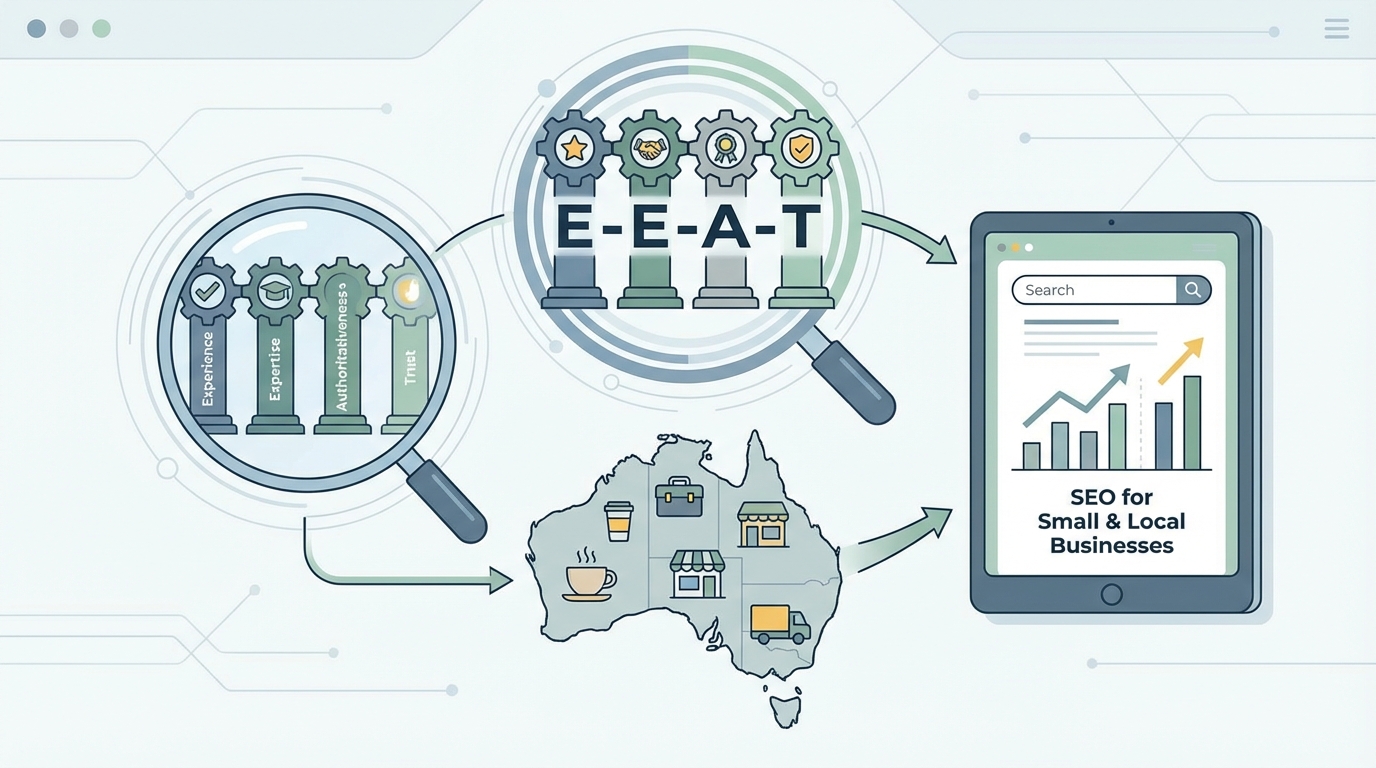
For Australian sites, local and regional signals play a bigger role in perceived authority than many teams realise. When Google defines YMYL topics—pages that can significantly affect people’s health, safety, finances, or civic life—it sets very high quality standards and expects a stronger trust signal, particularly for legal, medical, and financial content. Even if your site sits outside strict YMYL zones, leaning into local credibility still strengthens how people and systems read your brand.
Start with clear geographic grounding. Use .au domains where suitable, list your service areas plainly, and mention suburbs, cities, and states where your work actually occurs. Local citations – consistent listings on directories, local chambers, and professional associations – help corroborate that you are a real entity, not an offshore content farm. Encourage satisfied clients to leave honest reviews on platforms like Google Business Profile, and respond thoughtfully. Those review snippets often surface in SERPs long before someone lands on your pages.
When content touches on regulations, point to Australian primary sources. A financial article might reference ASIC guidance; a health‑adjacent piece can link to the Therapeutic Goods Administration or Healthdirect. Even in non‑YMYL spaces, citing local standards shows you understand the environment your readers live in. If you discuss YMYL‑adjacent matters at all, add prominent disclaimers that clarify the general nature of your information and urge readers to seek personalised advice.
Finally, pay attention to tone. Australian audiences tend to respond well to direct language and visible accountability. A startup like Lyfe Forge, talking to marketers and founders, can lean on straight‑talking case breakdowns, transparent pricing, and frank explanations of limits. Combined with the structural elements covered earlier, these regional cues can turn a small, otherwise ordinary site into one that locals instinctively trust, a pattern that aligns with how E‑E‑A‑T drives trust in AI‑enhanced search results. However, some experts argue that regional cues and E‑E‑A‑T signals aren’t magic keys to trust on their own, especially in an AI‑mediated search landscape. Local spelling, an ABN, and straight‑talking case studies can absolutely nudge the right people to take you more seriously, but they still sit downstream from the fundamentals: delivering real outcomes, earning genuine reviews, and building a defensible track record that third‑party platforms and AI systems can actually verify. In other words, you can’t just ‘skin’ a generic site with Aussie flavour and E‑E‑A‑T jargon and expect locals—or search engines—to buy it. For Lyfe Forge, that means treating regional cues and E‑E‑A‑T as multipliers on proven execution, not substitutes for it, and continuously validating claims with real data, independent mentions, and customer proof that AI‑enhanced search can’t easily fake or ignore.
https://seranking.com/blog/google-eat-ymyl/?utm_source=openai
Practical Playbook: 30‑Day E‑E‑A‑T Action Plan
To make this concrete, here is a 30‑day plan geared for a busy practitioner. It assumes you have limited time each week but want visible movement on trust and authority, especially for non‑YMYL topics with some commercial intent.
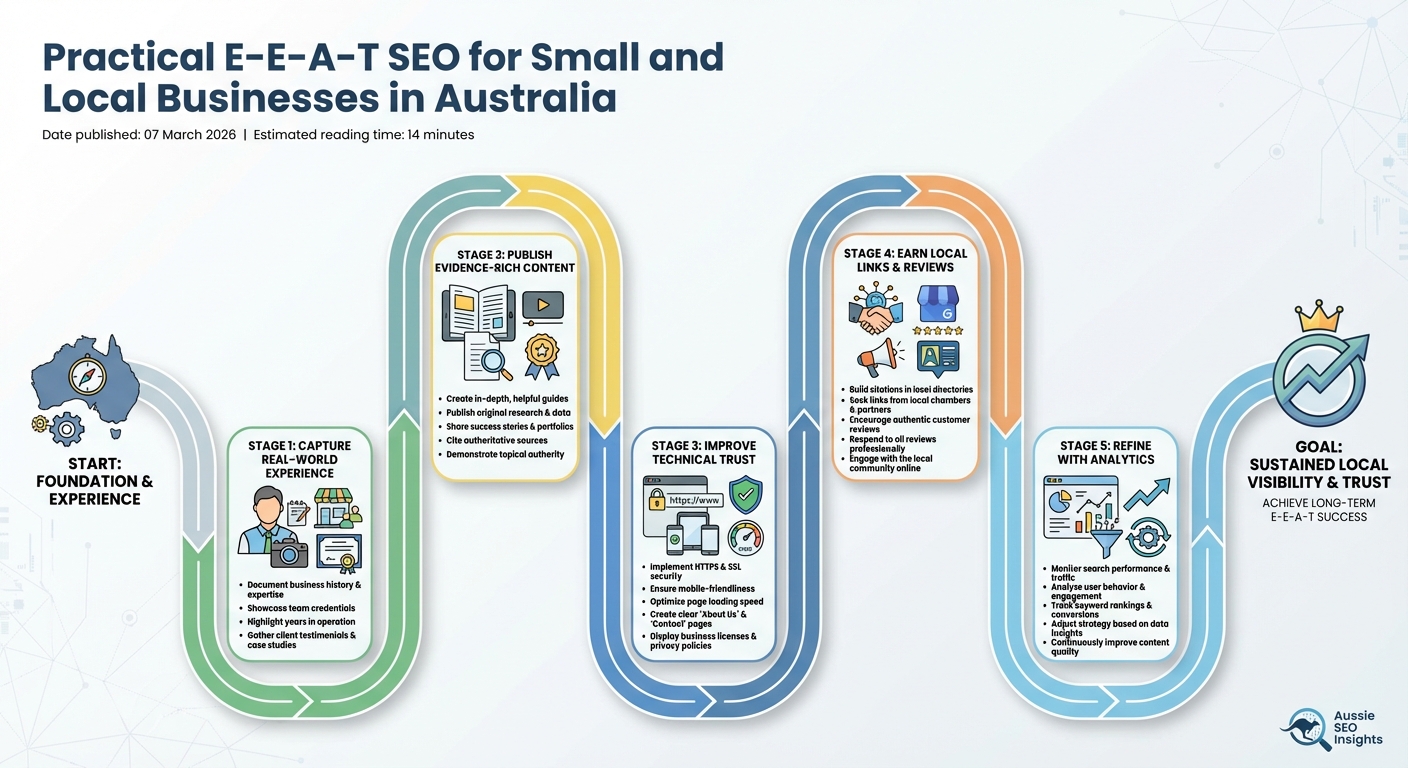
Week 1: Visibility and safety basics
- Confirm your site runs on HTTPS and fix any mixed‑content warnings.
- Publish or tidy your privacy policy and terms, with plain language about data use.
- Add full contact details and business identifiers to your footer and contact page.
Week 2: Author identity and experience
- Create or upgrade author bios with headshots, roles, and 2‑3 lines on their experience.
- Pick one recent project and draft a detailed case story (what happened, what you learned).
- Link that story from a relevant service or product page so it reinforces that offer.
Week 3: Start a topical cluster
- Choose a narrow theme where you have clear hands‑on knowledge.
- Sketch one hub article and three supporting articles that cover different angles.
- Publish the hub first and internally link any existing related posts to it.
Week 4: Local trust and social proof
- Update your Google Business Profile with photos, service areas, and current hours.
- Reach out to recent clients and politely request honest reviews, providing a direct link.
- Add a short “Why locals trust us” section to your home or key landing pages with 2‑3 review quotes.
If you run a lean marketing team or wear multiple hats, consider systems that keep this rolling beyond 30 days. You might use a platform like Lyfe Forge to manage content ideas, schedule cluster topics, and capture insights from each campaign so they turn into new experience‑rich pieces rather than getting lost in Slack. Over time, this steady drumbeat of grounded, trustworthy content compounds in both search visibility and audience confidence, especially when you deliberately apply SEO techniques for AI‑generated or AI‑assisted content instead of treating it as an afterthought.
https://www.jumpfly.com/blog/the-history-of-truth-googles-e-e-a-t-ymyl/?utm_source=openai
Conclusion: From “Just Another Site” to a Trusted Local Authority
E‑E‑A‑T can sound abstract until you view it through the lens of daily work. For small and local businesses, it is less about chasing shiny SEO hacks and more about consistently surfacing what you already do well: real‑world experience, honest communication, and care for your customers’ outcomes. When those qualities are visible in your content, your structure, and your technical setup, Google’s evolving systems have far more to work with.
The payoff is not only rankings. Strong E‑E‑A‑T tends to attract better‑qualified visitors, higher enquiry rates, and audiences who come back because they trust you to tell the whole story. If you want help turning this field guide into a living content system – clusters, case narratives, and trust signals wired into your publishing rhythm – study the rest of this series and explore how Lyfe Forge can support your next phase of growth through its flexible plans, clear terms of service, and a growing library of practitioner‑grade content discoverable via its post sitemap. Then choose one cluster, one case study, and one trust upgrade to action this week, and build from there.
For deeper context on the broader model and AI workflows, you can also circle back to Parts 1 and 2 of “AI, E‑E‑A‑T, and Multi‑Source Research: A Complete SEO Playbook” once you are ready to extend beyond this practitioner’s view, and, if needed, review the platform’s terms and accessibility statement as part of your own compliance checklist.
Frequently Asked Questions
What is E-E-A-T in SEO and why does it matter for small businesses in Australia?
E-E-A-T stands for Experience, Expertise, Authoritativeness, and Trustworthiness, and it’s part of how Google assesses content quality. For small and local Australian businesses, strong E-E-A-T helps search systems understand that your advice is based on real work you’ve done, not just generic AI content. This can improve visibility in local search and build more trust with potential customers. It’s especially important in competitive niches where users need to feel safe choosing a provider.
Can a small local business really compete with big brands on E-E-A-T?
Yes, small businesses can compete by leaning into their real-world experience and niche specialisation. Google doesn’t only reward big brands; it also values specific, first-hand expertise shown through case studies, photos, projects, and detailed how-to content. A Melbourne plumber, for example, can showcase dozens of real jobs, local building code knowledge, and customer stories that generic national sites can’t match. The key is to document and publish that proof consistently in ways search engines can parse.
How do I show real-world experience on my website for E-E-A-T?
Turn the work you already do into content: before-and-after galleries, project breakdowns, troubleshooting walkthroughs, and case studies with dates, locations (suburbs), and outcomes. Add your name, role, and years of experience to articles and service pages, and include photos or short videos of you and your team doing the work. Where relevant, explain local conditions (Australian standards, state regulations, climate, materials) you had to factor in. This creates a clear trail of first-hand experience that both users and Google can understand.
How can Australian small businesses use AI for content without hurting E-E-A-T?
Use AI as a drafting, outlining, and research assistant, then layer in your own real experience and checks. Start with your own job notes, customer questions, and local insights, use AI to structure it, and then rewrite and fact-check so it reflects what you actually do in Australia. Always keep a human expert as the final editor and avoid publishing generic AI text that could apply to any country or business. Where helpful, disclose how content was created and reviewed to strengthen trust.
What are some practical E-E-A-T optimisations for local SEO in Australia?
Make sure your business name, address, and phone number are consistent across your website, Google Business Profile, and major Australian directories. Add detailed service pages and location pages that reference suburbs, cities, and Australian terminology, plus locally relevant FAQs and examples. Include clear author bios with Australian credentials, ABN, certifications, and membership of local associations. Finally, collect and showcase verified reviews and testimonials from Australian customers with specific details about the work you did.
How do I create topical clusters that help with E-E-A-T for a local service business?
Pick a core service (for example, “emergency plumbing in Melbourne”) and build a main page that explains it clearly, then support it with related articles answering specific questions people ask. These could include guides on common emergencies, costs in your area, what to do before the plumber arrives, and local regulations or safety issues. Internally link all these pages together and back to the main service page so Google sees a connected body of expertise. Over time, add real job examples and updated advice to keep the cluster fresh.
What technical trust signals should my website have for better E-E-A-T?
At minimum, your website should use HTTPS, load quickly on mobile, and avoid intrusive pop-ups that block important content. Add clear contact details, an about page, privacy policy, terms, and refund or warranty information where relevant. Use schema markup (like LocalBusiness, Organization, and Review schema) so search engines can clearly identify your business details and trust elements. Regularly fix broken links, thin pages, and any security or spam issues that could undermine credibility.
How does Lyfe Forge help small Australian businesses with E-E-A-T SEO?
Lyfe Forge specialises in turning your day-to-day work, know-how, and customer wins into structured content that builds E-E-A-T. They work with you to plan topical clusters, document real projects, and align on-page content with technical and local SEO best practices for the Australian market. Their approach focuses on sustainable, multi-source research and practical implementation rather than chasing short-lived SEO hacks. This is especially useful for small teams that don’t have in-house SEO expertise.
How do I know if weak E-E-A-T is why my traffic dropped after a Google update?
Look for patterns like loss of rankings to more established brands, content that’s very generic, or pages with no clear author, credentials, or proof of work. Compare your pages to the top-ranking results: do competitors show stronger bios, references, case studies, or local evidence? If most of your content could be written by anyone, from anywhere, it’s likely an E-E-A-T issue. An SEO audit focused on content quality, on-site trust signals, and backlink quality can confirm this and guide fixes.
How quickly can improving E-E-A-T help my local rankings?
Changes to E-E-A-T signals typically take a few weeks to a few months to show impact, depending on crawl frequency, competition, and how extensive your updates are. Quick wins can come from tightening up key pages, adding author info, and improving your Google Business Profile and reviews. Larger gains usually follow a sustained effort: publishing better topical content, earning quality local links, and keeping information up to date. Monitoring rankings and conversions over several months is the best way to measure progress.